
Grass Types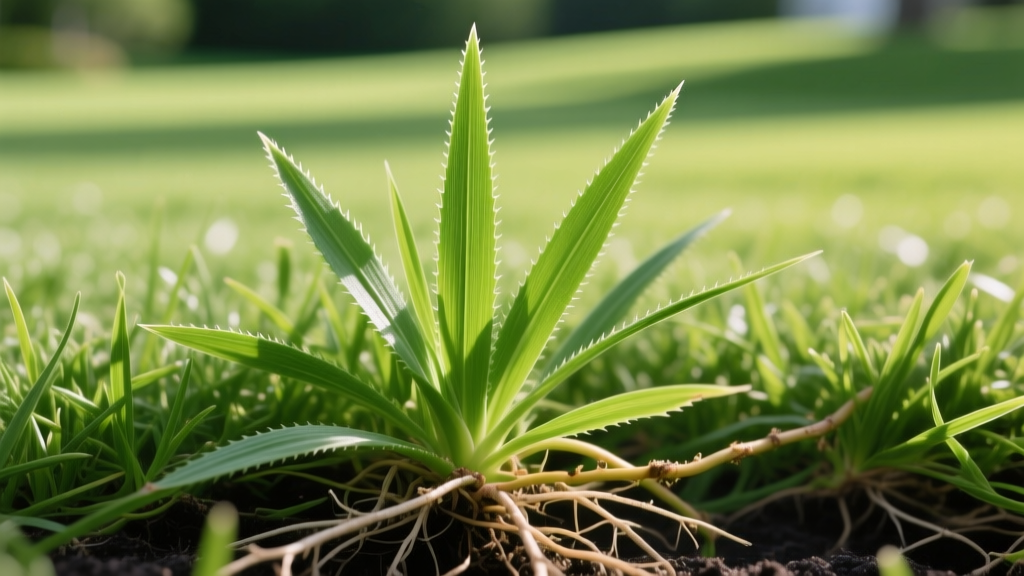
Bermuda Grass Close Up: How to Identify and Diagnose Turf Issues
The Micro-Anatomy of Cynodon dactylon
Most homeowners evaluate their lawns from the porch or the driveway, judging turf health by overall color and density. However, mastering warm-season grass care requires getting down to eye level. A bermuda grass close up inspection reveals critical anatomical features that dictate how you should mow, fertilize, and treat for disease. According to the NC State Extension TurfFiles, understanding the micro-structure of Cynodon dactylon is the first step in distinguishing it from look-alikes like Zoysia or Centipedegrass, and identifying early stress signals.
Key Identification Features (Up Close)
- Vernation: Folded in the bud (unlike St. Augustine, which is rolled).
- Ligule: A distinctive fringe of hairs at the collar region. This is the most reliable close-up identifier separating Bermuda from Zoysia (which lacks a hairy ligule).
- Leaf Blade: Typically 1/8 inch wide, 2 to 6 inches long, with rough, serrated margins that feel like fine sandpaper when pulled between your fingers.
- Collar: Broad, continuous, and slightly angled.
Stolons and Rhizomes: The Dual-Threat Engine
Bermuda grass survives extreme heat and heavy foot traffic because of its dual reproductive system. Above ground, you will see stolons (horizontal runners) creeping across the soil surface, rooting at nodes to form new plants. Below ground, rhizomes act as a subterranean network, storing carbohydrates and allowing the turf to recover from severe scalping or drought. When inspecting your lawn close up, part the canopy to check stolon thickness. Thin, pale stolons indicate nitrogen deficiency or excessive shade, while thick, rigid stolons with deep green nodes signal a healthy, aggressively growing stand.
Close-Up Diagnostics: Spotting Stress Before It Spreads
By the time a lawn turns uniformly brown, the damage is already severe. A close-up inspection of individual leaf blades and crown tissue allows you to diagnose issues when they are localized and easily treatable. Below is a diagnostic matrix for common Bermuda grass anomalies observed at the micro level.
| Close-Up Symptom | Probable Cause | Actionable Fix |
|---|---|---|
| Hourglass-shaped tan lesions with dark brown borders on individual blades | Dollar Spot (Clarireedia jacksonii) | Apply an SDHI fungicide (e.g., fluopyram) at 0.3 oz per 1,000 sq ft. Increase nitrogen slightly to push growth through the infection. |
| Interveinal chlorosis (yellowing between green veins) on new growth | Iron Deficiency (often induced by soil pH > 7.0) | Foliar spray chelated iron (Fe-EDDHA) at 2 oz per 1,000 sq ft. Avoid soil applications if pH is high. |
| Purple-tinted leaf tips, severely stunted stolon elongation | Phosphorus Deficiency | Apply a starter fertilizer (e.g., 18-24-12) at 4 lbs per 1,000 sq ft during the active spring green-up phase. |
| Dark, greasy-looking lesions at the base of the sheath; roots easily pull away | Pythium Root Rot | Improve drainage immediately. Apply a preventative QoI fungicide (e.g., azoxystrobin) and reduce irrigation frequency. |
Mowing Heights Dictated by Turf Density
The height at which you mow Bermuda grass is not arbitrary; it is directly tied to the specific cultivar you are growing and the density of the canopy you observe up close. Clemson University Cooperative Extension emphasizes that mowing too high leads to thatch accumulation and a 'puffy' lawn, while mowing too low exposes the crown to desiccation.
Common vs. Hybrid Bermuda: A Micro-Level Comparison
- Common Bermuda (C. dactylon): Features wider leaf blades and longer internode lengths. Maintain at 1.5 to 2.5 inches. If you look close up and see excessive stem tissue below the canopy, you are mowing too high and allowing the grass to become stemmy.
- Hybrid Bermuda (e.g., Tifway 419, Celebration): Bred for dense, fine-textured growth. Maintain at 0.5 to 1.5 inches. Hybrids require reel mowers to achieve these heights without tearing the leaf tissue. Up close, a properly mowed hybrid should look like a dense carpet with virtually no visible soil or stem tissue between the blades.
Pro Tip: Managing Turf Grain
When inspecting your lawn close up, you may notice the grass leaning heavily in one direction—this is 'grain.' Grain causes uneven mowing and scalping. To correct this, change your mowing pattern every two weeks, and consider verticutting the lawn in late spring to stand the stolons upright.
When inspecting your lawn close up, you may notice the grass leaning heavily in one direction—this is 'grain.' Grain causes uneven mowing and scalping. To correct this, change your mowing pattern every two weeks, and consider verticutting the lawn in late spring to stand the stolons upright.
Thatch Measurement: The Trowel Test
Thatch is the layer of living and dead organic matter (primarily stolons and rhizomes) that accumulates between the green canopy and the soil surface. Because Bermuda grass is a vigorous lateral grower, thatch buildup is its most common structural flaw. You cannot judge thatch thickness from above; you must perform a close-up physical inspection.
- Extract a Core: Use a 6-inch soil probe or a flat spade to cut a 3x3 inch cross-section of your turf, removing it entirely from the ground.
- Measure the Layer: Look at the profile. The green tissue is the canopy. The brown, spongy layer immediately below it is thatch. The dark, mineral soil at the bottom is the root zone.
- Evaluate: If the brown thatch layer exceeds 0.5 inches, it is blocking water infiltration, harboring fungal pathogens, and preventing fertilizer from reaching the soil.
- Remediate: For layers under 1 inch, use a power rake or dethatching blade in early June when the grass is actively growing. For layers exceeding 1 inch, core aeration combined with heavy topdressing (1/4 inch of coarse sand) is required to introduce soil microbes that break down the organic matter.
Weed Intrusion at the Canopy Level
A dense Bermuda grass canopy naturally outcompetes most weeds. However, when you inspect the turf close up, you can spot early invaders before they establish deep root systems. Look specifically for Poa annua (annual bluegrass) in the winter months, identifiable by its boat-shaped leaf tips and light green color contrasting against dormant brown Bermuda. In the summer, inspect the collar regions for crabgrass, which features a wide, flat collar and a membranous ligule—a stark contrast to the hairy ligule of your Bermuda grass. Spot-treating these invaders with a targeted post-emergent herbicide like quinclorac (for crabgrass) when they are less than 2 inches tall prevents canopy disruption and maintains the structural integrity of your warm-season turf.

