
Grass Types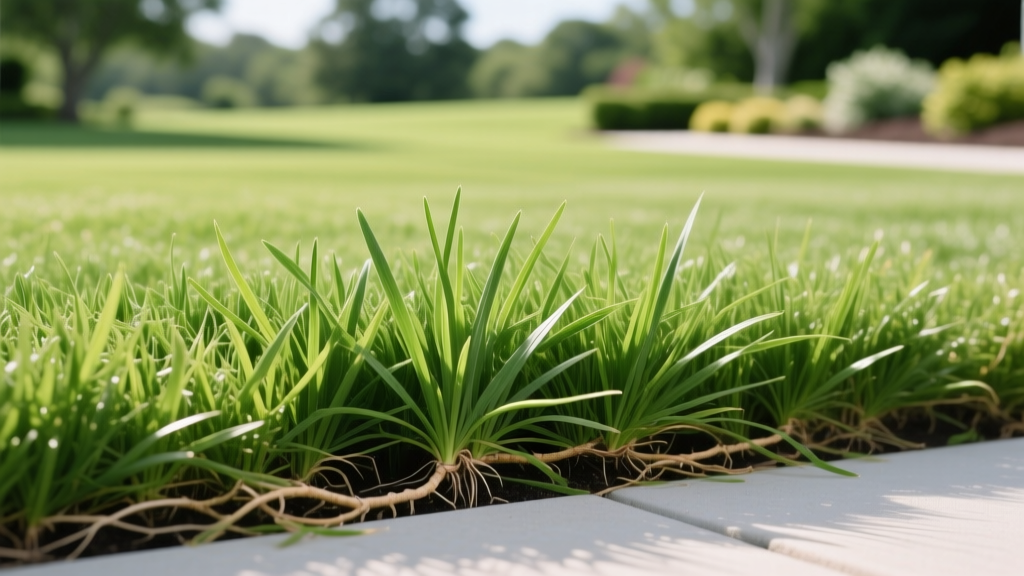
What Does Bermuda Grass Look Like? Visual ID & Cultivar Guide
Accurately identifying turfgrass is the foundational step for any successful lawn care program. Misidentifying your grass can lead to disastrous herbicide applications, incorrect mowing heights, and improper fertilization schedules. For homeowners in USDA Hardiness Zones 7 through 10, the most prevalent warm-season turf is Bermuda grass (Cynodon dactylon). But because it shares visual similarities with several other warm-season species and invasive weeds, knowing exactly what Bermuda grass looks like at the microscopic and macroscopic levels is critical.
This guide breaks down the precise anatomical traits, seasonal color shifts, and cultivar variations of Bermuda grass, providing a definitive framework for visual identification in 2026.
Core Visual Traits: The Anatomy of Bermuda Grass
To confidently identify Bermuda grass, you must look beyond the overall lawn color and examine the structural anatomy of the individual grass plant. Turfgrass scientists rely on specific vegetative characteristics to differentiate species. Here is the exact morphological profile of Cynodon dactylon.
Quick Field ID Checklist:
- Vernation (Leaf in Bud): Folded
- Leaf Blade Width: 1.5 mm to 4.0 mm (varies by cultivar)
- Ligule: Membranous with a distinct fringe of hairs (cilia)
- Spread Mechanism: Both stolons (above-ground) and rhizomes (below-ground)
- Seed Head: 3 to 7 finger-like spikes (racemes) arranged in a whorl
The Ligule: The Ultimate Identifier
If you only examine one part of the grass plant, make it the ligule. The ligule is located at the collar region, where the leaf blade meets the leaf sheath. Bermuda grass features a membranous ligule that is topped with a fringe of short, white hairs. This dual-structure is the most reliable way to separate Bermuda from its closest look-alikes. For instance, Zoysiagrass has a ligule that is strictly a fringe of hairs with no membrane, while Crabgrass has a membranous ligule but completely lacks the hair fringe.
Leaf Blade and Texture
Bermuda grass leaf blades are flat, taper to a sharp point, and feature a prominent midrib. The edges of the blade are often slightly serrated or rough to the touch when you run your fingers from the tip down to the base. The top surface is typically a medium to dark green and may have sparse, long hairs near the base, while the underside is smooth and lighter in color.
Stolons and Rhizomes
Bermuda grass is highly aggressive due to its dual spreading mechanism. It produces stolons (above-ground runners) that creep across the soil surface, rooting at nodes to form new plants. Simultaneously, it produces rhizomes (below-ground stems) that grow horizontally beneath the soil, allowing the grass to recover rapidly from drought, traffic damage, and winter dormancy. If you pull up a patch of turf and see a dense, wiry network of underground roots alongside surface runners, you are likely looking at Bermuda.
Common vs. Hybrid Bermuda: Spotting the Differences
Not all Bermuda grass looks the same. The species is broadly divided into 'Common' Bermuda (seeded varieties) and 'Hybrid' Bermuda (vegetatively propagated cultivars developed by agricultural universities). As of 2026, advanced hybrids like TifTuf, Latitude 36, and Celebration dominate the premium sod market, and they possess distinct visual differences from common varieties.
| Trait | Common Bermuda (Seeded) | Hybrid Bermuda (Sod/Sprigs) |
|---|---|---|
| Leaf Width | Wider (2.0 - 4.0 mm), coarser texture | Narrower (1.0 - 2.0 mm), fine texture |
| Seed Heads | Produces abundant 3-7 fingered seed heads | Sterile; rarely produces seed heads |
| Color | Lighter, yellowish-green under stress | Deep, dark green (especially Tifway 419) |
| Growth Habit | More upright, open canopy | Dense, low-growing, lateral spread |
| Ideal Mowing Height | 1.0 to 2.5 inches (rotary mower) | 0.5 to 1.5 inches (reel mower preferred) |
Source: Turfgrass selection data adapted from the NC State University TurfFiles database.
Bermuda Grass Look-Alikes: A Diagnostic Decision Tree
Homeowners frequently confuse Bermuda grass with other warm-season grasses and invasive weeds. Use this diagnostic framework to eliminate look-alikes based on visual evidence.
1. Bermuda vs. Crabgrass
Smooth and Large Crabgrass are notorious for invading thinning Bermuda lawns. The Tell: Crabgrass has a much wider leaf blade (up to 10 mm), a lighter, almost apple-green color, and lacks rhizomes. Crucially, the crabgrass ligule is membranous but completely lacks the fringe of hairs found on Bermuda. Furthermore, crabgrass grows in distinct, isolated clumps rather than forming a uniform, interconnected sod via stolons.
2. Bermuda vs. Zoysiagrass
Zoysia (particularly Zoysia japonica and Zoysia matrella) shares the same hardiness zones and growth habits as Bermuda. The Tell: Zoysia leaf blades are noticeably stiffer and more rigid than Bermuda. When you bend a Zoysia blade, it tends to snap or crease sharply, whereas Bermuda bends smoothly. At the collar, Zoysia's ligule is strictly a fringe of hairs with no membranous base. Zoysia also grows much slower and forms a denser, almost carpet-like thatch layer.
3. Bermuda vs. Centipedegrass
Centipedegrass is common in the Southeast and can easily be mistaken for a coarse Bermuda variant. The Tell: Centipedegrass has alternate leaf arrangement on the stem (leaves stagger on opposite sides), whereas Bermuda leaves are often more closely spaced and can appear opposite. Centipede also features a distinct, sharp crease down the center of the leaf blade and lacks rhizomes entirely, spreading only via above-ground stolons.
Seasonal Color Shifts: What Bermuda Looks Like Year-Round
Bermuda grass is a warm-season perennial, meaning its visual appearance changes drastically with soil temperature and daylight hours. Understanding these shifts prevents homeowners from misdiagnosing seasonal dormancy as disease or death.
- Spring Green-Up: Bermuda remains brown well into the spring. It will not break dormancy until soil temperatures at the 2-inch depth consistently reach 65°F for five consecutive days. Early spring lawns often look patchy, with green shoots emerging from a brown, dormant canopy.
- Summer Peak: During the heat of summer (soil temps 80°F+), Bermuda exhibits its most aggressive growth and deepest green color, provided it receives 1 to 1.5 inches of water per week and adequate nitrogen.
- Fall Dormancy: Following the first hard frost, the canopy will rapidly turn straw-brown. The underground rhizomes remain alive and store carbohydrates for the winter. Do not apply nitrogen fertilizer during this brown phase, as it will force vulnerable new growth that will be killed by freezing temperatures.
Expert Identification Tips & Common Mistakes
'The most common mistake homeowners make is attempting to identify turfgrass solely by looking at the lawn from a standing position. You must get on your hands and knees, pull a single tiller from the soil, and examine the collar region and root structure. A $10 jeweler's loupe is the best investment you can make for accurate turf identification.' — Adapted from turfgrass management guidelines by Texas A&M AgriLife Extension.
The 'Pull Test' for Rhizomes
If you are trying to determine if a patch of grass is Bermuda or a stolon-only grass like Centipede or St. Augustine, perform the pull test. Grab a handful of the turf and pull straight up. If you feel significant resistance and see white, scaly, underground stems (rhizomes) snapping and pulling up with the sod, you have Bermuda grass. Stolon-only grasses will detach from the soil surface with minimal underground resistance.
Frequently Asked Questions
Does Bermuda grass produce seed heads?
Common, seeded varieties of Bermuda grass produce prominent seed heads that look like three to seven slender, finger-like spikes branching from a central stem. These often appear when the grass is stressed, mowed too high, or during peak summer flowering. Hybrid Bermuda grasses (like Tifway 419) are sterile triploids and do not produce viable seed heads.
Why does my Bermuda grass look thin and stemmy?
A 'stemmy' or leggy appearance with visible brown stolons at the base is a classic symptom of mowing too high or insufficient sunlight. Bermuda grass requires a minimum of 8 hours of direct, unfiltered sunlight daily. When shaded or mowed above 2 inches, the plant stretches its internodes to reach light, resulting in an open, thin canopy that invites weed invasion.

