Grass Types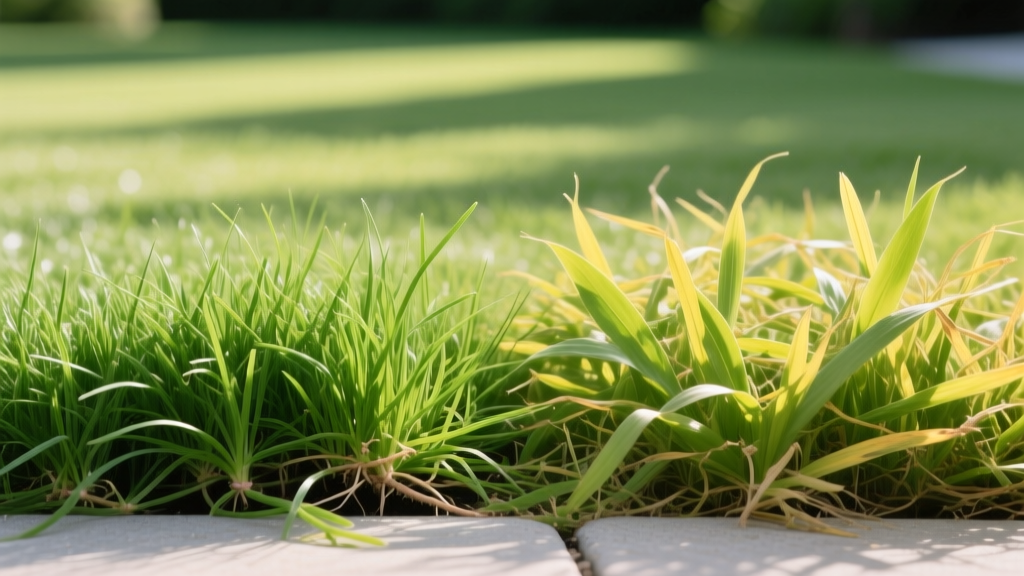
Bermuda Grass vs Crabgrass: Identification and Spot-Treatment Guide
Misidentifying invasive grasses is the leading cause of accidental turf death during DIY weed control. When homeowners confuse bermuda grass (Cynodon dactylon) with crabgrass (Digitaria sanguinalis), they frequently apply the wrong herbicide, resulting in dead patches that take months to recover. While both species spread aggressively via above-ground stolons and thrive in summer heat, their biological classifications dictate entirely different chemical control strategies.
Bermuda grass is a perennial warm-season turfgrass, often highly desirable in southern lawns but a noxious weed in northern cool-season lawns. Crabgrass is a summer annual weed that is universally unwanted. This guide provides the exact morphological identifiers and professional-grade spot-treatment protocols required to eliminate the invader while preserving your desirable turf.
The Visual Showdown: Morphological Identification Matrix
Before mixing any chemicals, you must definitively identify the target. Relying on 'broad, spreading grass' as an identifier will lead to misapplication. Examine the grass at the soil line and the collar region (where the leaf blade meets the sheath) to confirm the species.
| Feature | Bermuda Grass (Perennial) | Crabgrass (Annual) |
|---|---|---|
| Ligule | Short, membranous with a fringe of hairs (collar region). | Tall, membranous, jagged, and highly visible (no hairs). |
| Stolons & Roots | Roots deeply at every node; stolons are wiry and tough to pull. | Roots shallowly at nodes; stolons are brittle and snap easily. |
| Leaf Blade | Narrow (1/8 inch), greyish-green, smooth texture. | Wider (1/4 to 1/2 inch), pale yellow-green, slightly fuzzy. |
| Seedhead | Spike-like, wind-pollinated, rarely noticeable when mowed. | Distinctive 'turkey foot' or finger-like spikes at the top. |
| Winter Behavior | Enters complete dormancy; turns uniform straw-brown. | Dies completely after first frost; leaves white/transparent husks. |
Scenario A: Spot-Treating Crabgrass IN a Bermuda Grass Lawn
If your desirable bermuda grass lawn is being invaded by crabgrass, your chemical strategy must utilize a selective post-emergent herbicide that targets broadleaf and annual grass weeds without causing phytotoxicity to the bermuda. The undisputed industry standard for this is Quinclorac.
Product Selection and Pricing
- Drive XLR8 (Quinclorac 7.8%): The professional benchmark. Retails for approximately $85 to $95 per gallon. One gallon treats up to 1.2 acres.
- QuinKill Max (Quinclorac 18.92%): A higher concentration alternative, typically $110 per 2.5 gallons.
Exact Mixing and Application Rates
For spot-treating isolated crabgrass patches in an established bermuda lawn, mix 1.0 fluid ounce of Drive XLR8 per 1,000 square feet. Crucially, Quinclorac requires a high-quality Non-Ionic Surfactant (NIS) to penetrate the waxy cuticle of the crabgrass. Add 0.25 fluid ounces of NIS (such as DyneAmic or Hi-Yield Spreader Sticker) per gallon of water.
⚠️ Temperature Warning: Never apply Quinclorac when ambient temperatures exceed 85°F. High heat causes the herbicide to volatilize, leading to rapid tissue desiccation and severe burning of your desirable bermuda grass. Apply in the early morning when temperatures are below 80°F.
Scenario B: Spot-Treating Bermuda Grass IN a Cool-Season Lawn
In transition zones and northern climates, bermuda grass is an invasive nightmare in Tall Fescue and Kentucky Bluegrass lawns. Because bermuda is a grass, standard broadleaf weed killers (like 2,4-D) will not touch it. You need a graminicide that selectively targets warm-season grasses.
Product Selection and Pricing
- Fusilade II (Fluazifop-p-butyl): Highly effective for suppressing bermuda in fescue. Costs roughly $90 per quart.
- Acclaim Extra (Fenoxaprop-p-ethyl): Excellent for cool-season lawns, but slightly less aggressive on mature bermuda stolons than Fluazifop. Costs around $120 per 2.5 gallons.
Exact Mixing and Application Rates
To suppress bermuda grass in a Tall Fescue lawn, apply 0.2 to 0.4 fluid ounces of Fusilade II per 1,000 square feet. You must include a Crop Oil Concentrate (COC) at a rate of 1% v/v (1.25 oz per gallon of water) to ensure the herbicide penetrates the bermuda stolon nodes. Expect temporary chlorosis (yellowing) of the Tall Fescue for 10-14 days post-application; this is a normal physiological response and the fescue will recover.
Step-by-Step Spot-Treatment Protocol
Broadcast spraying is unnecessary and increases the risk of turf damage. Use a 1-gallon or 2-gallon pump sprayer for precise spot-treatment.
- Calibrate Your Sprayer: Mark a 10x10 foot area (1,000 sq ft) on your driveway. Fill the sprayer with 1 gallon of water and spray the area at your normal walking pace. If you run out of water before covering the area, you are walking too fast or your nozzle pressure is too low. Adjust until exactly 1 gallon covers 1,000 sq ft.
- Add Surfactant First: Fill the tank halfway with water, add the surfactant (NIS or COC), and agitate. This prevents excessive foaming.
- Add Herbicide and Dye: Add the measured herbicide and 1 teaspoon of turf-marking dye (like Basagran or Indicator Blue). The dye is non-negotiable for spot-treating; it prevents overlapping, which is the primary cause of chemical burn.
- Apply to Foliage: Spray the invader until the leaves are wet but not dripping. Do not drench the soil; post-emergent grass herbicides are foliar-absorbed.
Advanced Pre-Emergent and Post-Emergent Synergy
Spot-treating is a reactive measure. True lawn management requires breaking the germination cycle. According to University of Minnesota Extension, crabgrass germinates when soil temperatures at a 2-inch depth reach 55°F to 60°F for consecutive days.
The Dimension Advantage
While Prodiamine (Barricade) is a standard pre-emergent, Dithiopyr (Dimension) offers a unique dual-action advantage. Dimension provides pre-emergent control but also possesses early post-emergent activity against crabgrass up to the 1-tiller (early vegetative) stage. If you miss your spring pre-emergent window and crabgrass begins to sprout, applying Dimension at 0.15 lbs of active ingredient per 1,000 sq ft will halt the invasion without requiring a separate post-emergent application.
Common Failure Modes and Troubleshooting
| Symptom | Cause | Corrective Action |
|---|---|---|
| Crabgrass turns white but resumes growing in 3 weeks. | Herbicide applied without surfactant; cuticle blocked absorption. | Re-apply with a high-quality NIS or Methylated Seed Oil (MSO). |
| Bermuda grass turns severely brown and brittle after Quinclorac. | Applied during high heat (>85°F) or drought-stressed turf. | Water deeply (1 inch) to flush the root zone; apply liquid kelp extract to reduce stress. |
| Tall Fescue shows severe necrosis after Fusilade application. | Over-application or failure to use Crop Oil Concentrate buffer. | Mow the lawn to remove dead tissue; apply a balanced 20-0-10 fertilizer to push new growth. |
Accurate identification and precise chemical selection are the dividing lines between a pristine lawn and a chemical burn disaster. By leveraging the specific morphological differences between bermuda grass and crabgrass, and applying professional-grade active ingredients at calibrated rates, you can surgically remove invaders while maintaining the structural integrity of your turf. For further reading on warm-season turf management, consult the Texas A&M AgriLife Extension resources on bermudagrass cultivar selection and maintenance.