Grass Types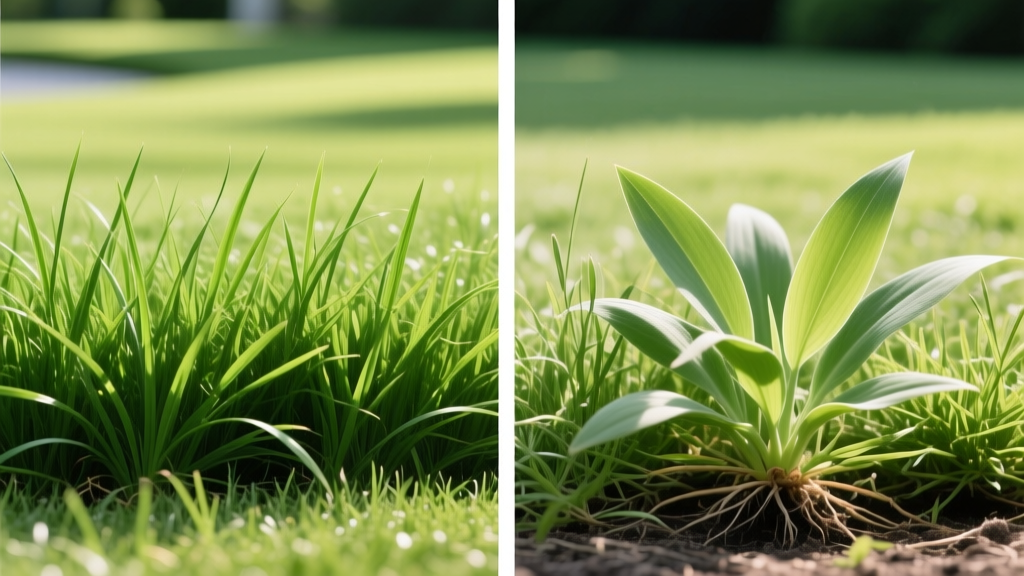
Bermuda vs Crabgrass: Spot-Treatment and Identification Guide
Bermuda grass (Cynodon dactylon) is a highly desirable, drought-tolerant warm-season turfgrass, but its aggressive growth habit is frequently challenged by crabgrass (Digitaria sanguinalis), a prolific summer annual weed. Because both species thrive in high heat and full sun, homeowners often struggle to differentiate young Bermuda shoots from invasive crabgrass, leading to misapplied herbicides that either fail to kill the weed or chemically burn the turf.
This guide provides a precise morphological breakdown to accurately identify the invader, followed by a professional-grade spot-treatment protocol using selective herbicides that spare your Bermuda lawn while eradicating crabgrass.
The Morphological Matrix: Identifying the Invader
Before mixing any herbicide, you must confirm the weed species. While both grasses can appear as pale green, fast-growing patches in mid-summer, their botanical structures differ significantly at the collar region (where the leaf blade meets the stem) and the root zone.
| Feature | Bermuda Grass (Desirable Turf) | Crabgrass (Invasive Weed) |
|---|---|---|
| Leaf Blade Width | Narrow (1/16 to 1/8 inch), pointed tip | Wide (1/4 to 1/2 inch), rounded or boat-shaped tip |
| Ligule (Collar) | Short membranous ligule with a distinct fringe of white hairs | Tall, jagged membranous ligule; completely lacks hairs |
| Stem Base Color | Typically green or slightly purplish | Distinctly reddish or purplish at the base node |
| Growth Habit | Spreads via above-ground stolons and below-ground rhizomes | Spreads via above-ground stolons only; roots at nodes |
| Seed Head | Fine, wispy, finger-like spikes (often mowed off) | Thick, branching, zipper-like seed heads (resembles a crow's foot) |
For authoritative botanical references on turfgrass identification, consult the Clemson University Home & Garden Information Center or the NC State University TurfFiles database.
Post-Emergent Spot-Treatment Chemistry
Once crabgrass is positively identified, the goal is selective eradication. Non-selective herbicides like glyphosate will kill both the crabgrass and the surrounding Bermuda. Instead, you must use a selective post-emergent herbicide formulated specifically for warm-season turfgrasses.
The Quinclorac Protocol for Bermuda Lawns
Quinclorac is the industry-standard active ingredient for post-emergent crabgrass control in Bermuda grass. It mimics plant auxins, causing uncontrolled, lethal growth in broadleaf weeds and specific grassy weeds like crabgrass, while Bermuda grass naturally metabolizes the chemical without harm.
- Commercial Formulation: Drive XLR8 (Quinclorac 75% WDG) or professional liquid equivalents.
- Consumer Formulation: Ortho WeedClear with Quinclorac or BioAdvanced All-In-One Lawn Weed and Crabgrass Killer (verify quinclorac is listed on the active ingredient label).
- Spot-Treatment Mix Rate: 0.75 fluid ounces of liquid quinclorac per 1,000 square feet, diluted in 1.5 to 2 gallons of water.
CRITICAL SURFACTANT REQUIREMENT: Quinclorac molecules are large and struggle to penetrate the waxy cuticle of mature crabgrass. You must add a Methylated Seed Oil (MSO) surfactant at a rate of 1% v/v (approx. 1.3 oz per gallon of spray solution). Standard non-ionic surfactants (NIS) or household dish soaps will result in a 40-60% reduction in efficacy on crabgrass older than the 3-leaf stage.
Step-by-Step Spot-Treatment Execution
Timing and environmental conditions dictate the success of your quinclorac application. Follow this exact sequence to maximize translocation of the herbicide down to the crabgrass root system.
- Mowing Prep: Mow your Bermuda lawn 2 days before application. This allows the crabgrass to push out new, tender leaf tissue, which absorbs herbicide much faster than older, weathered leaves.
- Temperature Check: Ensure daytime highs are between 70°F and 85°F. Do not apply quinclorac if temperatures exceed 85°F; heat stress compromises the Bermuda grass's ability to metabolize the chemical, leading to temporary turf yellowing (phytotoxicity).
- Application: Use a 1-gallon or 2-gallon pump sprayer with a pin-stream nozzle. Coat the crabgrass leaves evenly until wet, but avoid dripping onto the soil.
- Post-Application Watering: Do not water the lawn or allow rainfall for at least 24 hours after spraying. The herbicide requires this window to fully translocate into the plant's vascular system.
- The 14-Day Rule: Wait 14 days before a second application. Crabgrass in the 'tiller' stage (multiple branching stems) often requires a two-pass system. The first application stunts the plant; the second finishes the root system.
Pre-Emergent Defense: The 53°F Soil Rule
Spot-treating crabgrass in July is a reactive, expensive, and labor-intensive process. The most effective management strategy is a pre-emergent herbicide barrier applied in early spring. Crabgrass seeds require a specific soil temperature threshold to break dormancy.
According to the Clemson HGIC Crabgrass Management Guide, crabgrass germination initiates when the soil temperature at a 2-inch depth reaches 53°F to 55°F for three to five consecutive days. In most transition and southern zones, this occurs between late February and mid-March.
Pre-Emergent Active Ingredients
- Prodiamine (Barricade): Creates a long-lasting chemical barrier in the top 1/2 inch of soil. Rate: 0.4 oz per 1,000 sq ft. Provides up to 6 months of residual control. Note: Do not use if you plan to overseed your Bermuda with ryegrass in the fall, as prodiamine has a long soil half-life.
- Dithiopyr (Dimension): Offers early post-emergent control. If you miss the pre-emergent window and crabgrass has just sprouted (1-leaf to 2-leaf stage), dithiopyr will kill the young seedling while still providing a residual soil barrier. Rate: 0.5 oz per 1,000 sq ft.
Troubleshooting: Why Your Spot-Treatment Failed
If your crabgrass patches turned white but did not die, or if the Bermuda grass suffered severe burning, review these common failure modes:
Symptom: Crabgrass leaves turn purple/white, but the plant resumes growing after 2 weeks.
Diagnosis: The crabgrass was in the mature 'seed-head' stage. Quinclorac translocation fails in highly lignified, mature stems.
Solution: Manually pull mature, seed-bearing crabgrass. Do not spray, as the dying plant will drop viable seeds into the soil before the herbicide kills the roots. Focus on pre-emergents next spring.
Diagnosis: The crabgrass was in the mature 'seed-head' stage. Quinclorac translocation fails in highly lignified, mature stems.
Solution: Manually pull mature, seed-bearing crabgrass. Do not spray, as the dying plant will drop viable seeds into the soil before the herbicide kills the roots. Focus on pre-emergents next spring.
Symptom: Bermuda grass exhibits severe bleaching and stunted growth after spraying.
Diagnosis: Application occurred during a heat spike (>88°F) or the quinclorac rate was doubled in an attempt to 'speed up' the kill.
Solution: Apply 0.5 lbs of nitrogen per 1,000 sq ft and irrigate deeply to help the Bermuda grass metabolize the chemical stress. Never exceed the maximum label rate of 0.75 fl oz per 1,000 sq ft for spot treatments on Bermuda.
Frequently Asked Questions
Can I use MSMA to kill crabgrass in Bermuda?
MSMA (Monosodium methanearsonate) was historically the go-to herbicide for crabgrass in Bermuda. However, the EPA has heavily restricted MSMA for residential use due to arsenic toxicity and groundwater concerns. While still available for commercial golf courses and sod farms under strict regulations, homeowners should rely entirely on Quinclorac or Fenoxaprop-p-ethyl for residential spot-treatments.
Will pulling crabgrass by hand damage my Bermuda lawn?
Hand-pulling is highly effective for isolated patches, but crabgrass roots at the nodes along its stolons. If you pull too aggressively, you may rip up the intertwined Bermuda stolons. Use a specialized weeding tool, such as a dandelion digger or a stand-up weeder with a clawed base, to sever the crabgrass taproot just below the soil surface without disturbing the surrounding Bermuda rhizomes.
How long after killing crabgrass can I lay new Bermuda sod?
If you used a quinclorac-based post-emergent, you must wait at least 21 days before laying new Bermuda sod or plugging bare spots. Quinclorac persists in the top layer of soil and can inhibit the root establishment of newly planted warm-season turfgrasses if introduced too soon.