Grass Types
Best Grass Seed for Michigan: A Complete Guide to
Best Grass Seed for Michigan: A Complete Guide to Choosing the Right Turf
Michigan's diverse climate presents unique challenges for homeowners trying to establish & maintain a lush, green lawn. From the frigid winters of the Upper Peninsula to the humid summers of the southern Lower Peninsula, selecting the right grass seed is the single most important decision you can make for your lawn's long-term health. The best grass seed for Michigan will be a cool-season variety that can withstand freezing temperatures, tolerate moderate drought, & thrive in the state's varied soil conditions.
Whether you're establishing a brand-new lawn in Grand Rapids, overseeding an existing turf in Detroit, or repairing bare patches in Traverse City, this comprehensive guide will walk you through the top-performing grass species for Michigan's growing conditions. We'll cover everything from hardiness zones & soil preferences to mowing heights & disease resistance so you can make an informed decision that keeps your lawn looking its best year after year.
Before diving into specific varieties, it's worth exploring our broader lawn care guides for foundational tips on soil preparation, seeding techniques, & seasonal maintenance schedules that apply regardless of which grass type you choose.
Understanding Michigan's Climate & Growing Zones for Lawns
Michigan spans USDA Hardiness Zones 4a through 6b, with the Upper Peninsula experiencing the coldest temperatures (down to -30°F) & the southernmost counties enjoying milder winters. The state's climate is classified as humid continental, meaning homeowners face four distinct seasons with significant temperature swings, moderate to heavy precipitation, & varying snowfall totals.
Key Climate Factors That Affect Grass Selection
Several environmental factors make cool-season grasses the only viable option for Michigan lawns:
- Winter freeze cycles: Grass must survive prolonged sub-freezing temperatures & repeated freeze-thaw cycles that can cause frost heaving & crown damage.
- Spring moisture abundance: Snowmelt & spring rains create saturated soils, increasing the risk of fungal diseases like snow mold & dollar spot.
- Summer heat stress: July & August temperatures frequently reach the upper 80s & low 90s, pushing cool-season grasses into dormancy if irrigation is insufficient.
- Variable soil types: Michigan soils range from heavy clay in the southeast to sandy loams in the west & north, affecting drainage, nutrient retention, & root development.
- Lake-effect microclimates: Areas near Lake Michigan & the Great Lakes experience moderated temperatures but heavier snowfall & extended cloud cover, which can influence grass performance.
Because of these conditions, cool-season grasses dominate the Michigan lawn market. These grasses grow most vigorously during the cool, moist periods of spring & fall, slow down during summer heat, & go dormant in winter. For a deeper understanding of how cool-season grasses compare to warm-season varieties, visit our complete grass types guide.
The Best Grass Seed Varieties for Michigan Lawns
After evaluating cold hardiness, drought tolerance, disease resistance, & overall performance across Michigan's growing zones, the following grass species consistently deliver the best results for homeowners throughout the state.
1. Kentucky Bluegrass (Poa pratensis)
Kentucky Bluegrass is widely considered the gold standard for Michigan lawns, & for good reason. This perennial grass forms a dense, dark green turf with a fine to medium texture that is both beautiful & durable. Its rhizomatous growth habit allows it to spread laterally, filling in bare spots & creating a thick carpet that resists weed invasion.
Characteristics:
- Texture: Fine to medium leaf blade
- Color: Dark green to blue-green
- Growth habit: Rhizomatous (spreads via underground stems)
- Cold hardiness: Excellent — thrives in Zones 3-7
- Drought tolerance: Moderate — goes dormant during extended dry spells but recovers well with irrigation
- Shade tolerance: Moderate — prefers full sun but can tolerate light shade
- Establishment rate: Slow — takes 14-30 days to germinate & up to a full season to fully establish
Maintenance Requirements:
- Mowing height: 2.5 to 3.5 inches
- Fertilization: 2-4 pounds of nitrogen per 1,000 square feet annually
- Irrigation: 1 to 1.5 inches per week during active growth
- Aeration: Annual core aeration recommended to manage thatch buildup
Pros:
- Exceptional cold tolerance, ideal for all Michigan zones
- Self-repairing through rhizome spread
- Attractive, dense turf with excellent curb appeal
- Widely available & affordable
Cons:
- Slow establishment from seed
- Prone to thatch buildup over time
- Requires consistent moisture during summer
- Susceptible to dollar spot, leaf spot, & summer patch diseases
Learn more about this popular turfgrass in our Kentucky Bluegrass guide.
2. Perennial Ryegrass (Lolium perenne)
Perennial Ryegrass is the fastest-germinating cool-season grass available, making it an invaluable component in Michigan lawn seed mixes. While it doesn't spread laterally like Kentucky Bluegrass, its bunch-type growth habit produces a lush, fine-textured turf that establishes in as little as 5-7 days. This rapid establishment makes it an excellent choice for overseeding, erosion control, & quick lawn repairs.
Characteristics:
- Texture: Fine leaf blade with a glossy underside
- Color: Medium to dark green
- Growth habit: Bunch-type (does not spread laterally)
- Cold hardiness: Good — performs well in Zones 4-7
- Drought tolerance: Moderate
- Shade tolerance: Moderate
- Establishment rate: Very fast — germinates in 5-10 days
Maintenance Requirements:
- Mowing height: 2 to 3 inches
- Fertilization: 2-3 pounds of nitrogen per 1,000 square feet annually
- Irrigation: Regular watering during summer months
- Overseeding: May require periodic overseeding to maintain density
Pros:
- Extremely fast germination & establishment
- Excellent wear tolerance — ideal for high-traffic areas
- Great for overseeding thin or damaged lawns
- Provides quick erosion control on slopes
Cons:
- Does not self-repair — bare spots require reseeding
- Less cold-hardy than Kentucky Bluegrass in Upper Peninsula zones
- Can be susceptible to gray snow mold in Michigan winters
- Shorter overall lifespan compared to Kentucky Bluegrass
3. Fine Fescue (Festuca species)
Fine Fescue is actually a group of several closely related species, including creeping red fescue, chewings fescue, hard fescue, & sheep fescue. Collectively, these grasses are prized for their exceptional shade tolerance & low maintenance requirements, making them ideal for Michigan homeowners with mature trees or those seeking a more sustainable lawn.
Characteristics:
- Texture: Very fine, needle-like leaf blades
- Color: Medium green to dark green
- Growth habit: Bunch-type or creeping (varies by species)
- Cold hardiness: Excellent — hardy to Zone 3
- Drought tolerance: Very good — among the best of cool-season grasses
- Shade tolerance: Excellent — the most shade-tolerant cool-season grass
- Establishment rate: Moderate — germinates in 7-14 days
Maintenance Requirements:
- Mowing height: 2.5 to 4 inches (taller mowing promotes deeper roots)
- Fertilization: 1-2 pounds of nitrogen per 1,000 square feet annually (low feeder)
- Irrigation: Minimal once established
- Aeration: Less frequent than Kentucky Bluegrass due to lower thatch production
Pros:
- Best shade tolerance of any cool-season grass
- Low fertilizer & water requirements
- Excellent cold hardiness for all Michigan zones
- Good drought resistance once established
- Environmentally friendly option for low-input lawns
Cons:
- Poor traffic tolerance — not ideal for play areas
- Can develop a slightly clumpy appearance over time
- Slower recovery from damage
- May struggle in full-sun, high-heat southern Michigan summers
For more information on low-maintenance lawn options, check out our low-maintenance lawn care tips.
4. Tall Fescue (Festuca arundinacea)
Tall Fescue, particularly the newer turf-type & dwarf turf-type varieties, has gained tremendous popularity in Michigan over recent decades. This bunch-type grass features deep roots that can extend 2-3 feet into the soil, giving it superior drought tolerance & heat resistance compared to other cool-season grasses. Modern cultivars have been bred for finer leaf texture & denser growth, making them far more attractive than the older forage-type varieties.
Characteristics:
- Texture: Medium to coarse (turf-type varieties are finer)
- Color: Medium to dark green
- Growth habit: Bunch-type with deep root system
- Cold hardiness: Good — best in Zones 5-7 (southern & central Lower Peninsula)
- Drought tolerance: Excellent — deep roots access moisture unavailable to other grasses
- Shade tolerance: Good — better than Kentucky Bluegrass but less than Fine Fescue
- Establishment rate: Moderate — germinates in 7-12 days
Maintenance Requirements:
- Mowing height: 3 to 4 inches (taller mowing maximizes drought resistance)
- Fertilization: 2-3 pounds of nitrogen per 1,000 square feet annually
- Irrigation: Deep, infrequent watering to encourage root depth
- Overseeding: Occasional overseeding to fill in bare areas
Pros:
- Outstanding drought & heat tolerance
- Deep root system improves soil structure
- Good disease resistance overall
- Tolerates a wide range of soil types, including clay
- Requires less irrigation than Kentucky Bluegrass
Cons:
- Does not spread laterally — bare spots need reseeding
- Coarser texture than Kentucky Bluegrass (though improved varieties are much finer)
- Less cold-hardy in Upper Peninsula zones
- Can develop brown patch in hot, humid summers
5. Rough Bluegrass (Poa trivialis)
Rough Bluegrass is a specialty grass that fills a specific niche in Michigan lawn care: persistently wet, shady areas where other grasses struggle. While not recommended as a primary lawn grass, it can be a valuable component in seed mixes designed for challenging sites near streams, in low-lying areas, or beneath dense tree canopies.
Characteristics:
- Texture: Fine, soft leaf blades
- Color: Light green to yellow-green
- Growth habit: Stoloniferous (spreads via above-ground runners)
- Cold hardiness: Excellent
- Drought tolerance: Poor — requires consistent moisture
- Shade tolerance: Excellent
- Establishment rate: Fast — germinates in 7-10 days
Pros:
- Thrives in wet, shady conditions where other grasses fail
- Quick establishment
- Good cold tolerance
Cons:
- Poor heat & drought tolerance
- Light green color may clash with other turf species
- Can become invasive in ideal conditions
- Not suitable for full-sun lawn areas
Michigan Grass Seed Comparison Table
The following table provides a side-by-side comparison of the top grass varieties for Michigan lawns, helping you quickly identify the best match for your specific conditions & preferences.
| Characteristic | Kentucky Bluegrass | Perennial Ryegrass | Fine Fescue | Tall Fescue | Rough Bluegrass |
|---|---|---|---|---|---|
| Germination Time | 14-30 days | 5-10 days | 7-14 days | 7-12 days | 7-10 days |
| Cold Hardiness | Excellent | Good | Excellent | Good | Excellent |
| Drought Tolerance | Moderate | Moderate | Very Good | Excellent | Poor |
| Shade Tolerance | Moderate | Moderate | Excellent | Good | Excellent |
| Traffic Tolerance | Good | Excellent | Poor | Good | Poor |
| Mowing Height | 2.5-3.5 in | 2-3 in | 2.5-4 in | 3-4 in | 1.5-2.5 in |
| Nitrogen Needs | High | Moderate | Low | Moderate | Low-Moderate |
| Self-Repairing | Yes | No | Varies | No | Yes |
| Best Michigan Zones | 4a-6b | 5a-6b | 4a-6b | 5a-6b | 4a-6b |
| Best Use | Primary lawn | Overseeding, high traffic | Shady, low-input lawns | Drought-prone, clay soils | Wet, shady areas |
Recommended Seed Mixes & Blends for Michigan Lawns
Most Michigan lawn experts recommend using a blend or mix of multiple grass species rather than a single monoculture. Blends combine multiple cultivars of the same species (e.g., three different Kentucky Bluegrass cultivars), while mixes combine different species. Both approaches provide genetic diversity that improves disease resistance, environmental adaptability, & overall lawn resilience.
Best Seed Mix for Full-Sun Michigan Lawns
For lawns receiving six or more hours of direct sunlight daily, a mix of 60-70% Kentucky Bluegrass & 30-40% Perennial Ryegrass provides an ideal balance of beauty, density, & quick establishment. The ryegrass germinates quickly to hold soil & provide cover while the slower-growing bluegrass establishes. Over time, the bluegrass spreads via rhizomes to dominate the turf.
Best Seed Mix for Shady Michigan Lawns
For lawns with significant tree cover or structures casting shade, a mix of 40-50% Fine Fescue, 30-40% Kentucky Bluegrass (shade-tolerant cultivars), & 10-20% Perennial Ryegrass delivers the best performance. The Fine Fescue handles the deepest shade while the bluegrass fills in sunnier patches.
Best Seed Mix for Low-Maintenance Michigan Lawns
Homeowners seeking to minimize watering, fertilizing, & mowing should consider a Fine Fescue-dominant mix with 60-70% Fine Fescue (a combination of creeping red, chewings, & hard fescue) & 30-40% Kentucky Bluegrass. This combination requires roughly half the nitrogen & significantly less water than a traditional bluegrass lawn. For more sustainable lawn practices, explore our organic lawn care guide.
Best Seed Mix for High-Traffic Michigan Lawns
Families with active children & pets need a durable turf. A mix of 40-50% Kentucky Bluegrass, 30-40% Perennial Ryegrass, & 10-20% Tall Fescue (turf-type) provides excellent wear tolerance & recovery potential. The bluegrass self-repairs, the ryegrass withstands heavy foot traffic, & the tall fescue adds deep-rooted resilience.
When & How to Plant Grass Seed in Michigan
Timing your seeding correctly is just as important as choosing the right seed. Michigan's climate provides two optimal seeding windows, with a clear winner for best results.
Late Summer to Early Fall (Mid-August through Late September)
This is the best time to seed a lawn in Michigan. Fall seeding offers several critical advantages:
- Warm soil temperatures promote rapid germination
- Cool air temperatures reduce heat stress on seedlings
- Fall rains provide consistent moisture without heavy spring downpours
- Fewer weed seeds germinate in fall, reducing competition
- Grass establishes strong roots before winter & gets a head start the following spring
Spring Seeding (Mid-April through Late May)
Spring seeding is the second-best option & is sometimes necessary for repairing winter damage or addressing erosion. However, spring-seeded lawns face greater weed competition & must establish quickly before summer heat arrives. If you must seed in spring, choose fast-germinating species like Perennial Ryegrass & be prepared to irrigate consistently through summer. For detailed seasonal timing, see our lawn seeding timing guide.
Essential Seeding Steps for Michigan Lawns
- Test your soil: Michigan State University Extension recommends a soil test to determine pH (ideal range: 6.0-7.0) & nutrient levels before seeding.
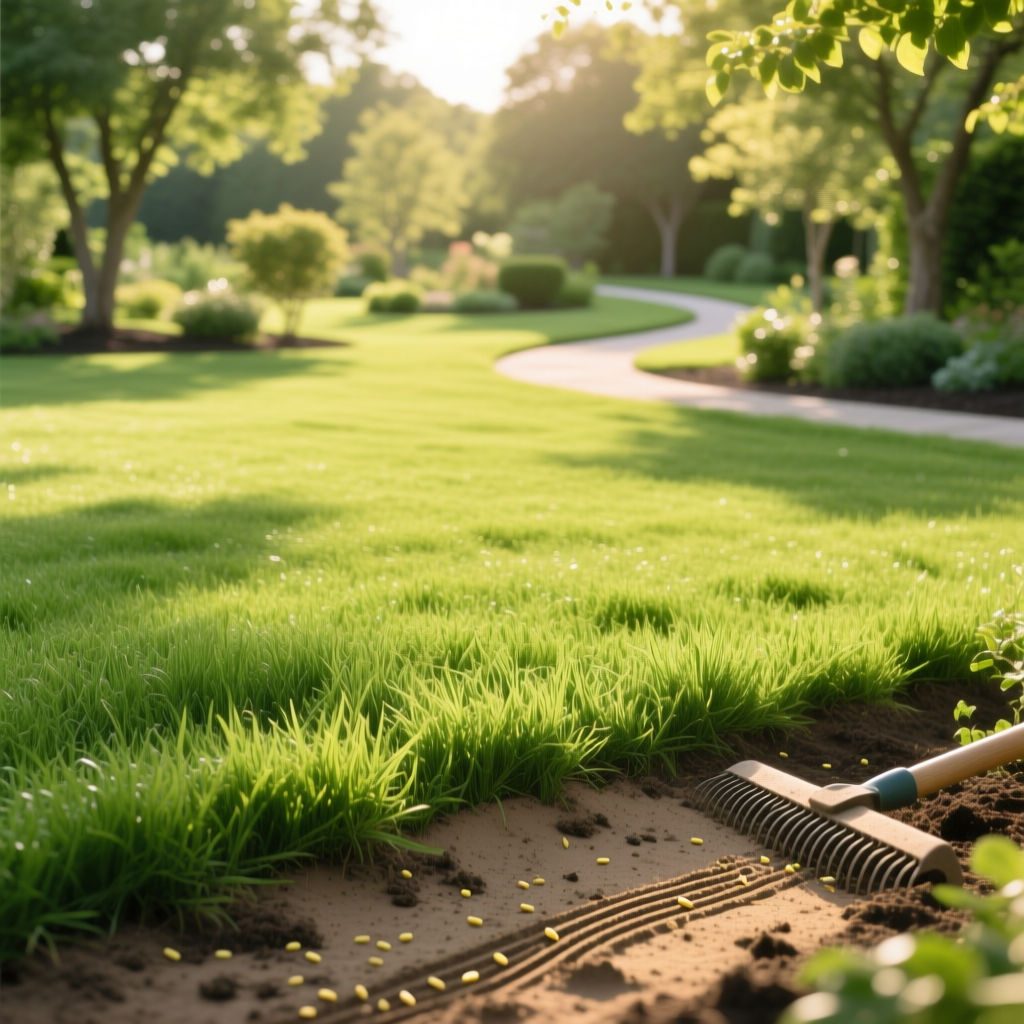
- Prepare the seedbed: Remove debris, loosen the top 2-3 inches of soil, & grade for proper drainage.
- Apply starter fertilizer: Use a phosphorus-rich starter fertilizer to promote root development.
- Sow seed at the recommended rate: Kentucky Bluegrass: 1-2 lbs/1,000 sq ft; Perennial Ryegrass: 5-6 lbs/1,000 sq ft; Tall Fescue: 6-8 lbs/1,000 sq ft; Fine Fescue: 3-5 lbs/1,000 sq ft.
- Ensure seed-to-soil contact: Lightly rake or roll the seeded area.
- Water consistently: Keep the top inch of soil moist until seedlings reach mowing height.
- Begin mowing when grass reaches one-third above the target height.
For comprehensive step-by-step instructions, visit our complete lawn seeding guide.
Michigan Lawn Grass FAQ
What is the single best grass seed for Michigan's climate?
Kentucky Bluegrass is widely regarded as the best overall grass seed for Michigan due to its exceptional cold hardiness, attractive appearance, & self-repairing growth habit. It performs well across all of Michigan's hardiness zones (4a-6b) & forms the backbone of most premium seed mixes sold in the state. However, the "best" grass ultimately depends on your specific site conditions — shady yards benefit from Fine Fescue blends, while drought-prone areas may be better served by Tall Fescue.
Can I use warm-season grasses like Bermuda or Zoysia in Michigan?
Warm-season grasses such as Bermuda grass, Zoysia grass, & St. Augustine grass are not recommended for Michigan lawns. These species thrive in hot climates & go dormant during cool weather, meaning they would remain brown for the majority of Michigan's long fall, winter, & early spring. They also lack the cold hardiness to survive Michigan winters, particularly in Zones 4 & 5. Stick with cool-season grasses for reliable, year-round performance.
How long does it take for grass seed to grow in Michigan?
Germination times vary by species. Perennial Ryegrass germinates fastest, typically within 5-10 days. Fine Fescue & Tall Fescue follow at 7-14 days, while Kentucky Bluegrass is the slowest at 14-30 days. After germination, expect 6-8 weeks of active growth before the lawn is ready for regular use. Fall-seeded lawns will continue developing roots through late fall & will be fully established by the following spring.
Should I overseed my Michigan lawn every year?
Annual overseeding is not strictly necessary for healthy, dense lawns, but it is highly beneficial. Overseeding every 2-3 years helps maintain turf density, introduces newer disease-resistant cultivars, & fills in thin areas before weeds can invade. The best time to overseed in Michigan is late August through mid-September, coinciding with the ideal fall seeding window. Pair overseeding with core aeration for maximum seed-to-soil contact & improved results.
What grass seed grows best in Michigan's Upper Peninsula?
The Upper Peninsula falls primarily in USDA Zones 4a-5a, where winters are severe & growing seasons are shorter. Kentucky Bluegrass & Fine Fescue are the top choices for UP lawns due to their superior cold hardiness. A blend of Kentucky Bluegrass (for density & appearance) & Fine Fescue (for shade tolerance & low-input performance) works exceptionally well. Avoid Tall Fescue in the UP, as it may suffer winter kill in the coldest zones. Perennial Ryegrass can be included at low percentages (10-20%) for quick establishment but should not be the dominant species.
Choosing the right grass seed for your Michigan lawn is an investment that pays dividends for years to come. By matching the grass species to your site conditions, climate zone, & maintenance preferences, you'll establish a resilient, attractive lawn that enhances your property & withstands everything Michigan's weather has to offer. For ongoing care tips, explore our full library of lawn care resources & grass type guides to keep your turf thriving in every season.