
Grass Types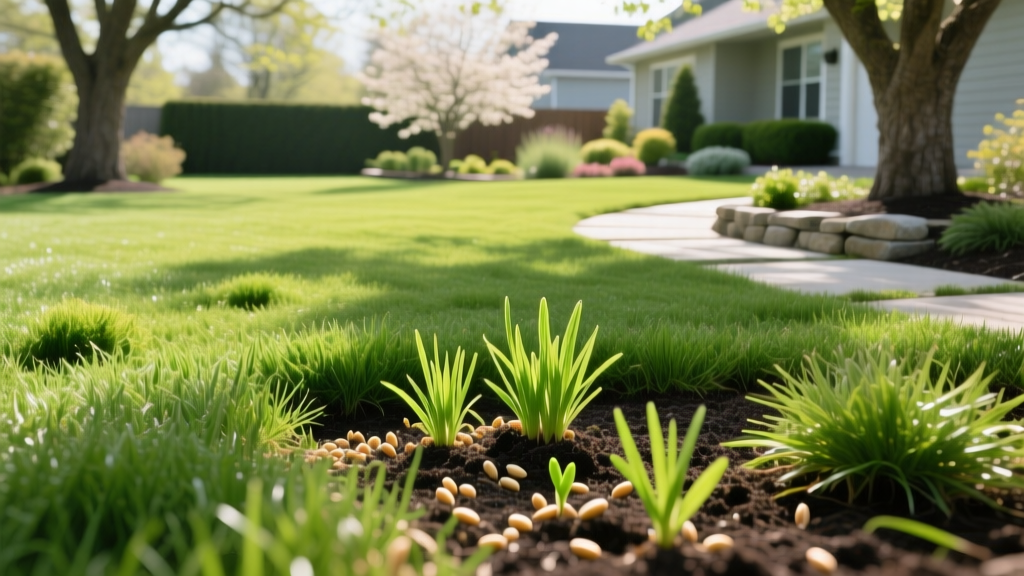
Best Overseeding Grass Seed for Thin Existing Lawns
The Science of Seed-to-Soil Contact in Overseeding
Thickening a thin, degraded lawn requires far more than simply scattering seed across the surface. The single highest point of failure in lawn renovation is poor seed-to-soil contact. When seed is left resting on top of thatch or existing turf canopy, germination rates plummet. According to turfgrass research from the University of Minnesota Extension, surface-sown seed experiences up to an 80% loss rate due to desiccation, wind displacement, and predation by birds. To achieve a dense, uniform turf, the seed must be incorporated into the top 1/4 inch of the soil profile or firmly pressed against bare soil exposed through mechanical aeration.
Selecting the right overseeding grass seed depends heavily on your existing turf type, regional climate, and the specific wear-and-tear your lawn endures. Cool-season lawns (Tall Fescue, Kentucky Bluegrass, Perennial Ryegrass) require different overseeding strategies and cultivar selections compared to warm-season lawns (Bermudagrass, Zoysia) that are typically overseeded with winter annuals like annual ryegrass for color.
Top Grass Cultivars for Overseeding Cool-Season Lawns
Not all seed blends are created equal. Big-box store generic mixes often contain high percentages of annual ryegrass or coarse forage grasses that will germinate quickly but die off or outcompete your desired turf within a single season. For permanent establishment, source single-cultivar or professionally blended seeds from specialized turf suppliers. Below is a comparison matrix of the most effective cultivars for overseeding existing cool-season lawns.
| Grass Species | Recommended Cultivar | Overseeding Rate (per 1,000 sq ft) | Germination Time | Best Application Scenario |
|---|---|---|---|---|
| Turf-Type Tall Fescue (TTTF) | 'Titan Ultra' or 'Firewall' | 3.0 - 5.0 lbs | 7 - 12 days | High-traffic areas, heat stress, clay soils |
| Kentucky Bluegrass (KBG) | 'Midnight' or 'Blue Note' | 1.0 - 1.5 lbs | 14 - 28 days | Full sun, blending with existing KBG, rhizome spread |
| Perennial Ryegrass (PRG) | 'Manhattan' or 'Pizzazz' | 2.0 - 3.0 lbs | 5 - 7 days | Rapid erosion control, quick canopy fill |
| Fine Fescue | 'Shoreline' Creeping Red | 2.0 - 3.0 lbs | 7 - 14 days | Deep shade, low-maintenance zones, poor soils |
For lawns suffering from severe thinning, a blend of 80% Turf-Type Tall Fescue and 20% Kentucky Bluegrass provides the deep drought-resistance of fescue with the self-repairing rhizomatous spread of bluegrass. Data from NC State TurfFiles consistently highlights TTTF as the most resilient option for transitional climate zones due to its deep rooting architecture, which can reach 2 to 3 feet in well-aerated soils.
The Dilemma of Putting Topsoil Over Grass Seed
A frequent question among homeowners is whether they should apply topdressing or topsoil over grass seed after broadcasting. The short answer is yes, but with strict depth limitations. When applying a topdressing of compost or screened topsoil over grass seed, the layer must not exceed 1/8 to 1/4 of an inch in depth.
Warning: The Coleoptile Limit
Grass seedlings push through the soil using a protective sheath called the coleoptile. If you put too much topsoil over grass seed (exceeding 1/2 inch), the seedling will exhaust its endosperm energy reserves before reaching the sunlight. This results in subterranean germination followed by rapid rot, effectively killing the seed before it ever breaks the surface.
If your goal is to level a bumpy lawn while overseeding, it is vastly superior to core aerate first, broadcast the seed, and then drag the aeration plugs across the lawn to cover the seed. Alternatively, apply your leveling sand or topsoil before seeding, rake it smooth, and then sow the seed directly onto the freshly prepared soil bed.
Step-by-Step Overseeding Protocol for Maximum Germination
Follow this precise 6-step agronomic protocol to ensure your overseeding investment yields a dense, weed-resistant canopy.
- Scalp the Existing Canopy: Lower your mower deck to 1.5 inches. Bag the clippings. This removes the thatch barrier and allows sunlight to reach the soil surface, which is critical for triggering the photoblastic germination response in seeds like Kentucky Bluegrass.
- Deep Core Aeration: Rent a gas-powered core aerator. Make two passes over the lawn in perpendicular directions (a grid pattern). Aim for 20 to 40 holes per square foot, with plugs extracted at a depth of 2.5 to 3 inches. Leave the plugs on the lawn; they will break down and inoculate the new seed with beneficial soil microbes.
- Apply a Mesotrione-Based Starter Fertilizer: Weeds will aggressively compete with new seedlings. Apply a starter fertilizer containing Mesotrione (the active ingredient in Tenacity) at a rate of 4 oz per acre. This provides a pre-emergent barrier against crabgrass and broadleaf weeds without harming germinating cool-season grass seed. A standard N-P-K ratio of 24-25-4 is ideal for root development.
- Calibrate and Broadcast Seed: Use a rotary spreader. Apply the seed at the rates listed in the cultivar matrix above. Split your seed quantity in half; apply the first half walking North-South, and the second half walking East-West to guarantee uniform distribution and prevent striping.
- Optional Topdressing: If your soil is highly compacted clay, apply a 1/4 inch layer of peat moss or finely screened compost over the seed to retain moisture. Do not bury the seed deeper than 1/4 inch.
- Execute the Micro-Watering Schedule: For the first 14 days, the top 1/2 inch of soil must remain consistently moist but never saturated. Water the lawn for 5 to 10 minutes, three times a day (morning, noon, and late afternoon). Overwatering leads to Pythium blight, a devastating fungal disease that can wipe out an entire overseeding effort in 48 hours.
Calculating Exact Costs for a 5,000 Sq Ft Lawn
Budgeting accurately prevents mid-project shortages. Below is a realistic cost breakdown for overseeding a 5,000 square foot cool-season lawn in 2026, utilizing premium commercial-grade materials rather than diluted consumer blends.
| Material / Service | Quantity Required | Estimated Cost (USD) |
|---|---|---|
| Premium TTTF Seed Blend (e.g., Jonathan Green or SeedRanch) | 20 lbs (at 4 lbs/1k sq ft) | $110 - $140 |
| Core Aerator Rental (Half-Day) | 1 Rental | $75 - $95 |
| Starter Fertilizer with Mesotrione (e.g., Scotts Starter w/ Tenacity) | 1 bag (covers 5k sq ft) | $35 - $45 |
| Sphagnum Peat Moss (for 1/4" topdressing) | 4 bales (3 cu ft each) | $60 - $80 |
| Total Estimated Project Cost | $280 - $360 |
Pro-Tip: The Mowing Transition
Do not mow the new seedlings until they have been mowed at least three times. Wait until the new grass reaches 3.5 inches, then mow off the top 1/3 inch using a razor-sharp mower blade. A dull blade will rip the shallow-rooted seedlings entirely out of the soil, ruining weeks of careful watering and establishment.
Frequently Asked Questions
Can I just throw grass seed on an existing lawn without aerating?
While a small percentage of seed may germinate in bare patches or animal divots, broadcasting seed directly over an un-aerated, thatch-covered lawn yields an abysmal return on investment. The seed will dry out on the surface. At minimum, vigorously rake the lawn with a steel thatching rake to expose bare soil before seeding if core aeration is not an option.
How long does it take for overseeded grass to fully establish?
Germination occurs within 5 to 28 days depending on the species, but full root establishment takes 8 to 12 weeks. You should avoid heavy foot traffic and postpone any chemical herbicide applications (other than Mesotrione) until the new grass has been mowed at least four times.
Should I soak grass seed in water before planting?
Pre-soaking seed (priming) is a commercial agricultural technique used to speed up germination by 1 to 2 days. However, for residential overseeding, soaking seed makes it clump together and impossible to spread evenly through a broadcast spreader. It is highly recommended to plant dry seed and manage moisture via your irrigation system instead.

