
Grass Types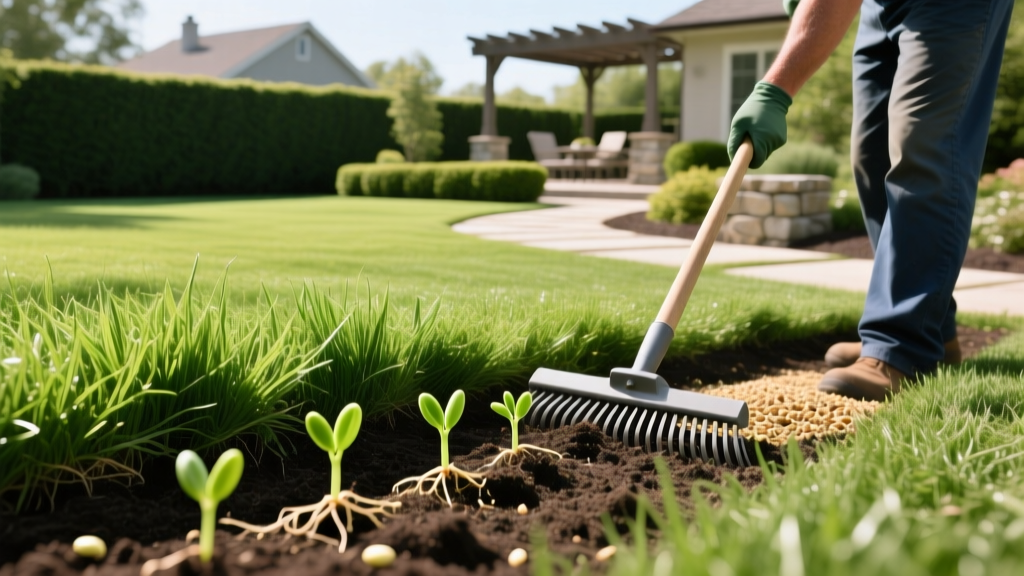
Master Buffalo Grass Seeding: Germination & Establishment Guide
The Challenge of Buffalo Grass Seeding
Buffalo grass (Bouteloua dactyloides) is the premier native, drought-tolerant turfgrass for the Great Plains, Transition Zone, and arid Southwest. Once established, it requires up to 75% less water than traditional Kentucky bluegrass or tall fescue lawns. However, buffalo grass seeding is notoriously unforgiving. Unlike aggressive cool-season grasses that sprout in 5 to 7 days and quickly form a dense canopy, buffalo grass seedlings are delicate, slow to establish, and highly susceptible to weed competition during their first 60 days.
Success relies entirely on precise soil preparation, selecting the correct seed type, and executing a strict irrigation protocol. According to Colorado State University Extension, the most common reason for establishment failure is not poor soil quality, but rather weed encroachment and improper watering depth during the critical 30-day germination window.
Hulled vs. Unhulled Seed: The Cost-Benefit Matrix
Before purchasing seed, you must understand the physical difference between hulled and unhulled buffalo grass seed, as this dictates your entire planting strategy and budget.
- Unhulled Seed (Burs): The seed is encased in a woody, protective carpel. In nature, this bur requires winter freezing and thawing (stratification) to break dormancy. If planted in spring without mechanical scarification, germination can take 30 to 45 days, and emergence rates are highly erratic.
- Hulled Seed: The woody casing has been mechanically removed. This exposes the raw seed, allowing it to absorb water immediately. Germination occurs in 7 to 14 days under optimal soil temperatures (70°F to 85°F).
| Seed Type | Avg. Cost per Pound | Seeding Rate (per 1,000 sq ft) | Germination Time | Best Planting Window |
|---|---|---|---|---|
| Unhulled (Burs) | $8.00 - $14.00 | 3.0 - 5.0 lbs | 30 - 45 days | Late Fall / Early Winter |
| Hulled (Clean) | $30.00 - $45.00 | 1.0 - 2.0 lbs | 7 - 14 days | Mid-May to Mid-July |
Expert Verdict: Always invest in hulled seed for spring and summer plantings. While the upfront cost is roughly $400 per 1,000 square feet for hulled seed compared to $90 for unhulled, the water savings, reduced herbicide needs, and guaranteed germination make hulled seed the only viable choice for homeowners seeking a reliable lawn in a single season.
Selecting the Right Seeded Cultivar
Many premium buffalo grass varieties (like 'Legacy' or 'Prestige') are female clones and are only available as sod or plugs. If you are seeding, you must select dioecious or seeded cultivars. The top performing seeded varieties for residential lawns include:
- Cody: Excellent density, fine leaf texture, and superior dark green color. Best for high-visibility front yards.
- Bison: A reliable, general-purpose cultivar with good drought tolerance and moderate density. Highly adaptable across the Great Plains.
- Sundancer: A newer release offering faster establishment, denser canopy, and improved winter hardiness compared to older varieties.
Phase 1: Site Preparation and the 'False Seedbed' Technique
Because buffalo grass seedlings are incredibly weak, they cannot compete with broadleaf weeds or crabgrass. You must eradicate the existing weed seed bank before planting.
Step-by-Step False Seedbed Protocol
- Initial Tilling: Rototill the area to a depth of 4 to 6 inches. Remove all rocks, debris, and large root masses.
- Level and Rake: Grade the soil to ensure positive drainage away from foundations. Rake smooth.
- Pre-Irrigation: Water the bare soil deeply to encourage dormant weed seeds to germinate. Wait 10 to 14 days.
- Weed Eradication: Once the flush of weeds emerges, kill them using a non-selective herbicide (like glyphosate) or a heavy solarization tarp. Do not use residual pre-emergent herbicides, as they will also kill your buffalo grass seed.
- Final Prep: Once the weeds are dead, lightly rake the top 1/2 inch of soil. Do not re-till. Tilling will bring a fresh layer of weed seeds to the surface, ruining your preparation.
Phase 2: Precise Seeding and Soil Contact
Buffalo grass seed requires light to germinate and must not be buried deeply. According to Texas A&M AgriLife Extension, planting depth is the most critical mechanical factor in establishment success.
- Mixing: Mix 1 pound of hulled seed with 2 pounds of dry masonry sand. This adds bulk, making it easier to see where you have spread the seed and ensuring even distribution.
- Application: Use a broadcast spreader set to a low setting. Apply half the mixture walking North-South, and the other half walking East-West to create a cross-hatch pattern.
- Incorporation: Use a stiff push-broom or a light leaf rake to drag the seed into the top 1/4 inch of soil. If buried deeper than 1/2 inch, the seedlings will exhaust their energy reserves before reaching the surface.
- Rolling: Rent a water-filled lawn roller and go over the entire area. This presses the seed firmly into the soil, eliminating air pockets and ensuring vital seed-to-soil contact.
⚠️ Erosion Warning for Sloped Yards: If your yard has a slope greater than 5%, standard seeding will result in seed washout during the first heavy rain. On slopes, you must apply a weed-free straw hydromulch or pin down biodegradable erosion control blankets immediately after rolling the seed.
Phase 3: The 30-Day Germination Watering Protocol
Buffalo grass seed must remain consistently moist, but never waterlogged, until the radicle (first root) anchors into the soil. Use an automated irrigation timer to ensure consistency.
| Timeline | Watering Frequency | Duration per Zone | Visual Goal |
|---|---|---|---|
| Days 1 - 14 | 3 to 4 times daily | 5 to 8 minutes | Top 1 inch of soil visibly damp; no standing puddles. |
| Days 15 - 21 | 2 times daily | 10 to 12 minutes | Seedlings emerge; soil surface allowed to slightly dry between cycles. |
| Days 22 - 30 | 1 time daily | 15 to 20 minutes | Roots anchoring; transition to deeper, less frequent moisture. |
| Days 31 - 60 | Every 2 to 3 days | 25 to 30 minutes | Canopy filling in; encouraging deep root growth. |
Troubleshooting Common Establishment Failures
Even with meticulous preparation, environmental variables can disrupt establishment. Use this diagnostic matrix to correct issues early.
| Symptom | Probable Cause | Corrective Action |
|---|---|---|
| Patchy, uneven emergence after 21 days | Seed buried too deep or poor soil contact in specific zones. | Overseed bare spots immediately with hulled seed; top-dress with 1/8 inch of compost and roll. |
| Seedlings sprout but quickly turn yellow and die | Damping-off disease caused by overwatering and poor drainage. | Reduce watering frequency immediately. Apply a light dusting of sand to improve surface drainage. |
| Massive broadleaf weed invasion by Day 30 | Failure to execute the false seedbed technique; residual weed seed bank. | Hand-pull weeds carefully. Do NOT apply chemical broadleaf herbicides until the buffalo grass has been mowed at least three times. |
First-Year Maintenance and Mowing Rules
Once the grass reaches 4 inches in height, execute the first mowing. Set your mower deck to exactly 3 inches. Never remove more than one-third of the leaf blade at a single time. During the first year, maintain a mowing height of 2.5 to 3 inches to shade the soil, retain moisture, and suppress late-germinating weeds.
Fertilization should be minimal. Buffalo grass is adapted to low-nitrogen soils. Applying heavy nitrogen will only fuel weed growth and cause excessive thatch. Apply a single application of a slow-release, low-nitrogen fertilizer (such as a 10-0-0 or 16-4-8 blend) at a rate of 1.0 pound of actual nitrogen per 1,000 square feet in early June. Avoid fertilizing after August 1st, as late-season growth reduces the plant's winter hardiness.

