Grass Types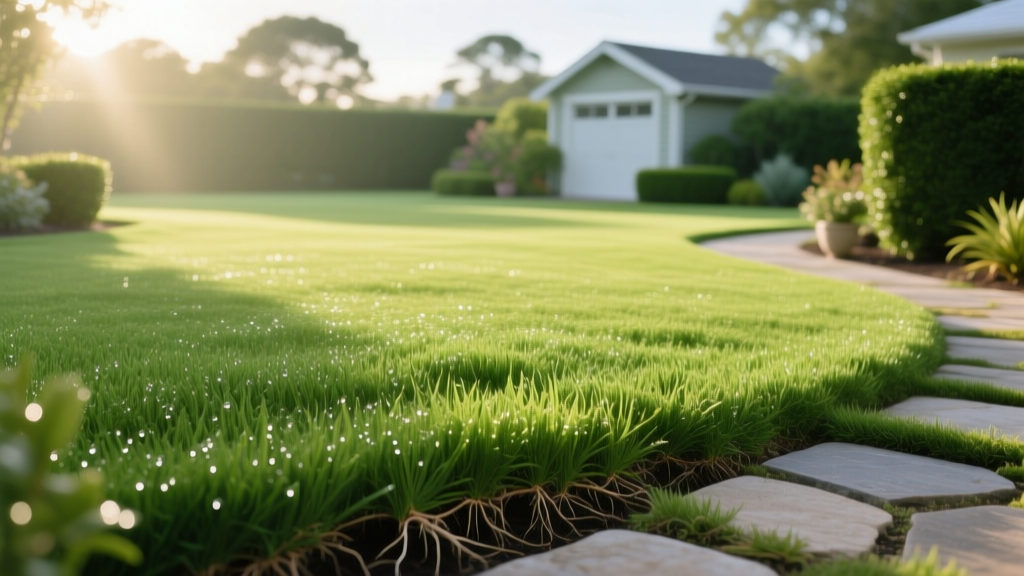
Complete Care Guide for a Thriving Celebration Bermuda Lawn
The Cultivar Profile: What Sets Celebration Apart?
Celebration Bermuda is a premium vegetative bermudagrass cultivar that consistently ranks at the top of warm-season turf trials. Originally developed by turf breeder Waymon Huie, this grass is celebrated for its striking deep blue-green color, exceptional wear tolerance, and superior drought resistance. Unlike older standard varieties such as Tifway 419, Celebration exhibits notably better shade tolerance and resistance to chinch bugs, making it a highly versatile choice for transitional and deep-south zones.
In 2026, Celebration Bermuda sod averages between $0.45 and $0.65 per square foot delivered, depending on your proximity to licensed sod farms. While the initial investment is higher than common bermudagrass seed, the aggressive stolon and rhizome growth rate ensures rapid establishment and a dense, carpet-like canopy that aggressively chokes out most annual weeds once mature.
Site Preparation and Sod Establishment Protocol
Establishing a celebration bermuda lawn from sod requires meticulous soil preparation. Bermudagrass is highly responsive to soil chemistry and physical structure. Follow this exact sequence to ensure rapid root knit and long-term vigor.
- Step 1: Comprehensive Soil Testing. Never guess your soil amendments. Send samples to a university extension lab. Celebration thrives at a pH of 6.0 to 6.5. If your pH is below 6.0, apply pelletized dolomitic limestone at the rate of 25 to 50 lbs per 1,000 square feet, depending on your buffer index.
- Step 2: Deep Tilling and Grading. Rototill the top 4 to 6 inches of soil to break up compaction layers. Rake the surface to establish a 1% to 2% slope away from your foundation to prevent water pooling, which can lead to root rot.
- Step 3: Pre-Plant Fertilization. Apply a high-phosphorus starter fertilizer, such as Scotts Turf Builder Starter (24-25-4), at a rate of 3.5 lbs per 1,000 square feet. Phosphorus is critical for early rhizome development.
- Step 4: Laying and Rolling. Lay sod in a staggered brick pattern, pushing edges tightly together without overlapping. Immediately run a lightweight lawn roller filled halfway with water to press the sod roots firmly into the soil, eliminating air pockets that cause desiccation.
Pro Tip: Water the newly laid sod immediately within 30 minutes of installation. Apply 0.5 inches of water. For the first 14 days, irrigate lightly 2 to 3 times daily to keep the top inch of soil consistently moist until the roots resist a gentle upward tug.
The 12-Month Celebration Bermuda Maintenance Matrix
To maintain the genetic potential of this cultivar, your agronomic inputs must shift with the seasons. According to NC State TurfFiles and Texas A&M AgriLife Extension, bermudagrass requires a highly structured nitrogen and mowing regimen. Use the matrix below as your foundational calendar.
| Season | Mowing Height | Nitrogen Rate (per 1k sq ft) | Irrigation Target | Key Chemical Application |
|---|---|---|---|---|
| Spring (Green-up) | 1.0 - 1.5 inches | 0.5 lbs (after last frost) | 0.75 inches / week | Pre-emergent (Prodiamine) |
| Summer (Peak Growth) | 0.5 - 1.0 inches | 0.75 - 1.0 lbs / month | 1.0 - 1.5 inches / week | Post-emergent (Celsius WG) |
| Fall (Hardening) | 1.0 - 1.5 inches | 0 lbs (Stop 6 weeks pre-frost) | 0.5 inches / week | Pre-emergent & Potassium |
| Winter (Dormancy) | 1.5 inches (or unmowed) | 0 lbs | Natural precipitation only | Spot treat winter annuals |
Precision Agronomy: Mowing, Watering, and Feeding
Mowing Mechanics: Reel vs. Rotary
Celebration Bermuda can be maintained anywhere from 0.5 inches to 1.5 inches. If you target the lower end of this spectrum (0.5 to 1.0 inches) for a golf-course-style carpet, a walk-behind reel mower is mandatory. Rotary mowers typically scalp the turf at heights below 1.0 inches, exposing the thatch layer and soil to direct UV radiation, which invites weed invasion. If you only have a rotary mower, maintain the canopy strictly between 1.25 and 1.5 inches. Always adhere to the one-third rule: never remove more than 33% of the leaf blade in a single pass to prevent photosynthetic shock.
Evapotranspiration (ET) Based Irrigation
While Celebration is highly drought-tolerant and will survive severe water deficits by entering a dormant, brown state, maintaining active green growth requires 1.0 to 1.25 inches of water per week during peak summer. Utilize the 'cycle and soak' method to prevent runoff on clay-heavy soils. Program your smart controller to run three separate cycles of 5 to 7 minutes each, spaced an hour apart, allowing the water to infiltrate the soil profile deeply. Deep, infrequent watering drives rhizomes deeper into the soil, anchoring the turf against extreme heat.
Nitrogen Loading and Micronutrients
This cultivar is a heavy feeder, requiring 3.0 to 5.0 lbs of actual Nitrogen per 1,000 square feet annually during the growing season. Use a high-quality slow-release granular fertilizer, such as a 15-0-15 or 16-4-8 blend, where at least 50% of the nitrogen is derived from sulfur-coated urea or methylene urea. This prevents the rapid, succulent flush of growth that attracts pests and disease. Additionally, apply a chelated iron supplement (like Ironite) at 2 lbs per 1,000 square feet in mid-summer to enhance the signature deep blue-green pigmentation without forcing excessive vertical leaf growth.
Warning: Herbicide Sensitivity. Celebration Bermuda is sensitive to certain herbicides during high-temperature stress. Avoid MSMA and 2,4-D when daytime temperatures exceed 85°F, as they will cause severe phytotoxicity and yellowing. Instead, use university-recommended alternatives like Celsius WG, which remains safe for warm-season turf even in peak summer heat.
Troubleshooting Edge Cases and Pathogens
Even with perfect maintenance, environmental factors can trigger specific turf diseases. Recognizing the symptoms early is critical for saving your lawn.
- Spring Dead Spot (Ophiosphaerella korrae): Manifests as circular, sunken, straw-colored patches upon spring green-up. The actual infection occurs in the fall. To prevent this, apply a preventative fungicide containing azoxystrobin (e.g., Heritage G) in September and October when soil temperatures drop below 70°F.
- Thatch Accumulation: Celebration produces aggressive stolons. If the thatch layer exceeds 0.5 inches, water and fertilizer will not penetrate to the root zone. Rent a verticutter or power rake in late May (after full green-up) to physically slice and remove the excess organic matter.
- Bermudagrass Decline: Often confused with drought stress, this root-rot disease occurs in poorly drained soils during prolonged rainy periods. The turf thins out and roots turn black. The only cure is to improve sub-surface drainage and apply a systemic fungicide like propiconazole.
Advanced Weed Control Chemistry
A dense Celebration Bermuda lawn is your best pre-emergent herbicide, but chemical barriers are necessary for pristine results. In early spring, when soil temperatures at a 2-inch depth consistently reach 55°F, apply a granular prodiamine (Barricade 65 WDG) at a rate of 1.15 lbs per acre (approximately 1.5 teaspoons per 1,000 square feet). Water it in with 0.5 inches of irrigation immediately to activate the chemical barrier in the top inch of soil. For stubborn summer grasses like crabgrass or dallisgrass that break through, use a targeted post-emergent application of quinclorac, ensuring you use a non-ionic surfactant to help the chemical adhere to the waxy leaf cuticles of the weeds.
Summary Checklist for 2026
Maintaining a celebration bermuda lawn requires a commitment to precision agronomy. By strictly managing your mowing heights, utilizing slow-release nitrogen sources, and timing your pre-emergent herbicides based on soil temperature rather than calendar dates, you will cultivate a resilient, deeply colored turf that outperforms neighboring lawns. Invest in a quality reel mower, monitor your soil pH annually, and adjust your irrigation cycles to match seasonal evapotranspiration rates for optimal results.