
Grass Types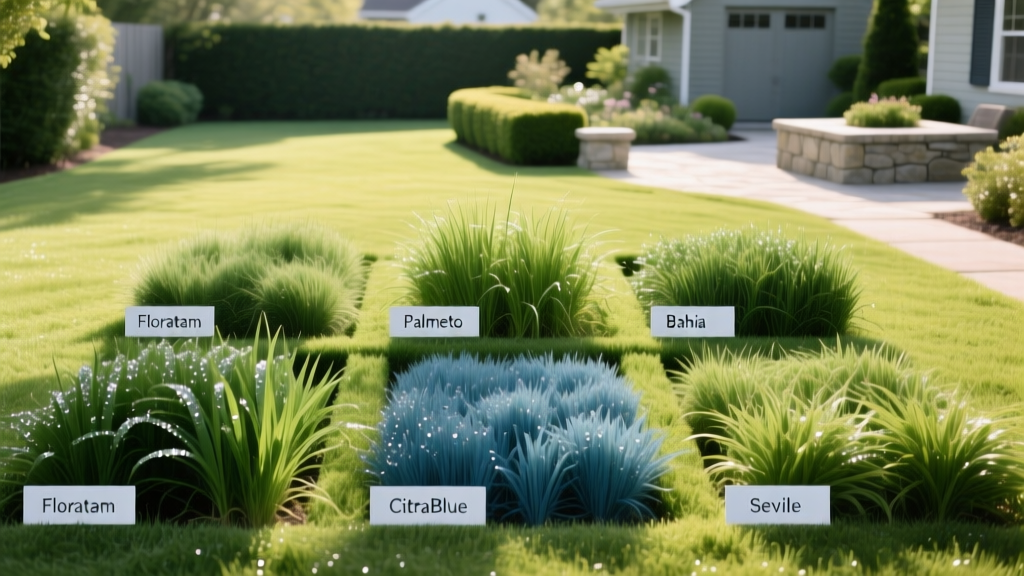
Comparing Top St. Augustine Grasses for Warm Climates
The Cultivar Matrix: Navigating St. Augustine Grasses
When homeowners refer to St. Augustine grasses, they are usually talking about Stenotaphrum secundatum, the dominant warm-season turf in coastal and southern regions. However, treating all St. Augustine as a single entity is a primary reason for lawn failure. The species is highly heterozygous, meaning seed-grown plants are wildly inconsistent. Therefore, commercial St. Augustine is propagated vegetatively (via sod, plugs, or sprigs) to maintain specific cultivar traits.
Selecting the right cultivar dictates your mowing height, shade tolerance, and vulnerability to the southern chinch bug (Blissus insularis). According to the University of Florida IFAS Turfgrass Science program, modern breeding has shifted focus from mere establishment speed to disease resistance and reduced water requirements.
| Cultivar | Blade Texture | Min. Direct Sun | Chinch Bug Resistance | Cold Hardiness |
|---|---|---|---|---|
| Floratam | Coarse, wide | 6+ hours | Moderate (declining) | Good |
| Palmetto | Medium, finer | 4-5 hours | Low | Excellent |
| CitraBlue | Medium, blue-green | 3-4 hours | High | Very Good |
| Seville | Fine, dwarf | 3-4 hours | Low | Poor |
Expert Insight: Floratam was the undisputed king for decades due to its initial chinch bug resistance. However, biotypes of the southern chinch bug have developed resistance to the plant's natural defenses in several Florida and Texas corridors. If you are in a high-pressure pest zone, CitraBlue or a targeted chemical rotation is mandatory.
Real-World Establishment: Sod Costs and Soil Prep
Establishing St. Augustine grasses from seed is not commercially viable; you must use sod or plugs. In 2026, supply chain stabilization has brought sod prices down slightly from their peak, but premium cultivars still command a premium.
- Standard Pallet (400-450 sq ft): Floratam and Palmetto typically range from $180 to $230 per pallet.
- Premium Pallet: CitraBlue and Seville range from $250 to $310 per pallet due to licensing fees and slower growth rates at the farm level.
- Delivery Fees: Expect $75 to $140 depending on distance from the sod farm.
Before laying sod, soil preparation is non-negotiable. St. Augustine thrives in a pH range of 6.0 to 7.5. If your soil pH drops below 5.5, the grass will suffer from severe iron chlorosis, presenting as yellowing leaves with green veins. Apply pelletized dolomitic lime at a rate of 20 to 50 lbs per 1,000 square feet three months prior to installation to correct acidic soils.
Precision Warm-Season Care: N-P-K Ratios and Irrigation
Maintaining St. Augustine grasses requires a shift away from generic 'weed and feed' products, which often contain herbicides like atrazine that can stunt root growth if applied during summer heat stress. Instead, focus on precise macronutrient delivery.
The Fertilizer Protocol
St. Augustine has a high nitrogen requirement but is highly sensitive to phosphorus runoff. Unless a soil test explicitly shows a phosphorus deficiency, use a zero-phosphorus fertilizer.
- Spring Green-Up (April): Apply a 15-0-15 or 16-4-8 formulation with at least 50% slow-release nitrogen (e.g., methylene urea or sulfur-coated urea). Target 1.0 lb of actual nitrogen per 1,000 sq ft. Products like Lesco Professional 15-0-15 are industry standards.
- Mid-Summer Maintenance (June/July): Switch to an organic or semi-organic blend like Milorganite (5-2-0). It provides iron and micronutrients without the risk of fertilizer burn during 90°F+ temperatures.
- Fall Winterizer (September): Apply a high-potassium fertilizer (e.g., 5-10-30) to promote root carbohydrate storage and improve winter hardiness, especially for Palmetto and Seville cultivars.
Irrigation and Mowing Specifics
Mowing height is the most common failure point. Never scalp St. Augustine. The optimal cutting height is 3.5 to 4.5 inches. Cutting below 3 inches removes the photosynthetic leaf area and exposes the thatch layer to UV radiation, drying out the stolons. Use a sharp rotary mower; reel mowers tend to bog down in the thick, spongy thatch layer characteristic of mature St. Augustine lawns.
Water deeply but infrequently. Apply 0.5 to 0.75 inches of water per session. Frequent, shallow watering (e.g., 10 minutes daily) promotes shallow root systems and creates the perfect humid microclimate for gray leaf spot (Pyricularia grisea).
Diagnostic Framework: Why Your St. Augustine is Declining
When St. Augustine grasses decline, homeowners often misdiagnose the issue, applying fungicides to insect problems or watering heavily when the roots are already rotting. Use this framework to identify the actual stressor.
'Take-All Root Rot and Chinch Bug damage look nearly identical from the street level—both cause expanding yellow-to-brown patches in the summer. You must pull the grass to check the roots and part the thatch to check for insects before spending a dime on treatments.' — Texas A&M Agrilife Extension Turfgrass Pathology Guidelines
Symptom-to-Solution Flowchart
- Symptom: Irregular yellow/brown patches in peak summer heat. Grass pulls up easily, but roots are white and firm.
Action: Part the thatch at the edge of the patch. If you see tiny black-and-white insects scurrying, it is the Southern Chinch Bug. Treat with a bifenthrin or clothianidin-based insecticide, applying directly to the thatch layer and watering in lightly. - Symptom: Yellowing patches in spring or early summer. Grass pulls up easily, and roots are black, short, and rotted.
Action: This is Take-All Root Rot (TARR) (Gaeumannomyces graminis). Fungicides are largely ineffective once symptoms appear. The proven mitigation strategy is applying a 1/4-inch layer of acidic sphagnum peat moss over the affected area to lower the localized soil pH to 5.5, which suppresses the fungus. Follow up with a systemic fungicide like azoxystrobin preventatively in the fall. - Symptom: Perfectly circular brown patches with distinct orange-brown margins appearing in late fall or early spring.
Action: This is Large Patch (Rhizoctonia solani). It thrives in cool, wet soil. Improve drainage, reduce fall nitrogen applications, and apply a preventative application of propiconazole or myclobutanil in September before soil temperatures drop below 70°F.
By matching the specific cultivar to your site's light conditions and adhering to precise nutritional and diagnostic protocols, St. Augustine grasses will form a dense, weed-resistant carpet that outperforms almost any other warm-season turf in coastal environments.

