
Grass Types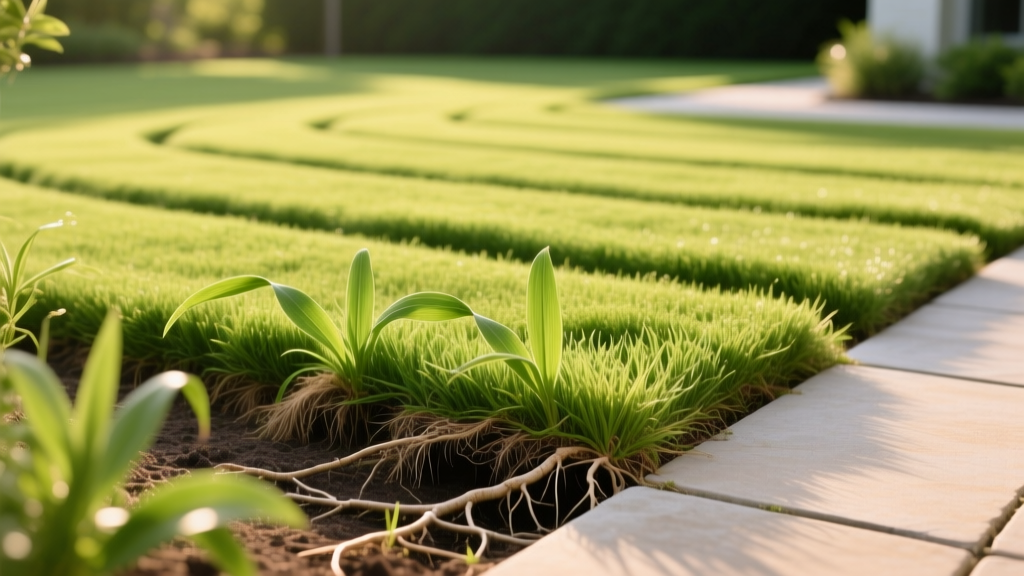
Controlling St Augustine Grass Runners: Edging, Rooting & Thatch
The Anatomy of St Augustine Grass Runners
St. Augustine grass (Stenotaphrum secundatum) is a aggressively spreading, warm-season turfgrass that relies entirely on above-ground stems called stolons—commonly referred to as runners—to expand its footprint. Unlike Bermudagrass or Zoysiagrass, St. Augustine lacks true rhizomes (underground lateral stems). This biological distinction dictates everything about how you must maintain, edge, and troubleshoot this specific turf.
Each runner consists of alternating nodes and internodes. The internodes are the horizontal bridges that push the grass outward, capable of growing up to 1.5 inches per day during peak summer temperatures (75°F to 85°F soil temperature). The nodes are the critical junctions where adventitious roots push downward into the soil and new leaf shoots push upward. If a node fails to make direct contact with the soil surface, it cannot root, and the runner becomes a structural liability rather than a lawn-building asset.
Peak Growth Metrics: Under optimal irrigation and 1 lb of nitrogen per 1,000 sq. ft., a single St. Augustine stolon can extend up to 3 feet in a single month, rooting at 2-inch to 4-inch intervals along the stem.
Encouraging Runners to Root and Fill Bare Spots
When repairing dog spots, fungal damage, or thinning areas, you need to force existing runners to root rapidly. Simply throwing water on exposed stolons is insufficient; the nodes require soil contact, moisture, and specific nutrient ratios to trigger root initiation.
Step-by-Step Runner Rooting Protocol
- Mow and Rake: Lower your mower deck to 2.5 inches (one notch lower than your standard 3.5-inch summer height) to expose the runners. Use a flexible leaf rake to gently pull the stolons outward over the bare soil patch.
- Pinning: For steep slopes or heavily trafficked areas, use 2-inch landscape staples or U-pins to secure the nodes directly against the bare dirt. This prevents foot traffic from displacing the runner before the adventitious roots anchor it.
- Topdressing: Apply a 1/4-inch layer of screened compost or a 70/30 sand-to-compost mix over the runners. This buries the nodes just enough to retain moisture without smothering the emerging leaf shoots.
- Targeted Fertilization: Apply a phosphorus-rich starter fertilizer (such as a 18-24-12 NPK) directly to the bare spots. Phosphorus is the primary catalyst for root development in stolon nodes. Avoid high-nitrogen synthetic fertilizers at this stage, as they will push excessive leaf growth at the expense of root establishment.
- Micro-Irrigation: Water the patched area 2 to 3 times daily for 5 minutes per session for the first 14 days. The goal is to keep the top 1 inch of soil and the topdressing material constantly damp, preventing the delicate node roots from desiccating in the sun.
Controlling Runners in Landscape Beds and Hardscapes
Because St. Augustine lacks underground rhizomes, it will not secretly tunnel beneath your garden borders like Bermudagrass. However, its aggressive above-ground stolons will easily climb over standard plastic edging, invade mulch beds, and creep across concrete driveways. Managing this lateral creep requires physical barriers that address surface-level stolon migration.
| Barrier Material | Required Depth | Stolon Block Rate | Est. Cost (per linear ft) | Best Application |
|---|---|---|---|---|
| Manual Trench Edge | 4 inches | 85% | $0.15 (labor only) | Budget-friendly; requires monthly re-cutting with a half-moon edger. |
| Corrugated Plastic | 6 inches | 90% | $1.50 - $2.00 | Curved beds; stolons may eventually root over the top lip if mulch touches the edge. |
| Powder-Coated Steel | 6 inches | 99% | $3.50 - $5.00 | Modern landscapes; thin profile prevents mulch bridging and stolon climb-over. |
| Poured Concrete Curb | 8 inches | 100% | $10.00 - $15.00 | Permanent hardscape borders; eliminates stolon migration entirely. |
According to Clemson University's Home and Garden Information Center, maintaining a clean edge is critical not just for aesthetics, but for pest management. Overgrown runners that drape over retaining walls or into dense shrubbery create humid, shaded microclimates that harbor Southern chinch bugs and gray leaf spot pathogens.
The Thatch Connection: When Runners Become a Problem
Thatch is a dense layer of living and dead organic matter that accumulates between the soil surface and the green vegetation canopy. In St. Augustine lawns, thatch is primarily composed of unrooted, dead stolons and tough leaf sheaths that resist microbial breakdown due to their high lignin content.
Critical Warning: Never Power-Rake St. Augustine
Unlike cool-season fescues or Kentucky bluegrass, you must never use a motorized dethatcher (power rake or verticutter) on a St. Augustine lawn. The vertical blades will sever the active, living stolons, effectively destroying the structural integrity of the turf and leaving massive bare patches. If your thatch layer exceeds 0.5 inches, rely on liquid biological dethatchers (containing Bacillus strains) or deep core aeration to alleviate the issue without tearing the runner network.
Unlike cool-season fescues or Kentucky bluegrass, you must never use a motorized dethatcher (power rake or verticutter) on a St. Augustine lawn. The vertical blades will sever the active, living stolons, effectively destroying the structural integrity of the turf and leaving massive bare patches. If your thatch layer exceeds 0.5 inches, rely on liquid biological dethatchers (containing Bacillus strains) or deep core aeration to alleviate the issue without tearing the runner network.
Excessive thatch prevents new runners from making soil contact. When stolons are forced to grow on top of a spongy thatch layer, the lawn becomes highly susceptible to drought stress, as the shallow roots cannot access the deeper soil moisture profile. To prevent runner-induced thatch, limit synthetic nitrogen applications to 3 or 4 lbs per 1,000 sq. ft. annually, and transition to slow-release organic nitrogen sources like Milorganite (5-2-0) which promote steady, manageable stolon growth rather than explosive, thatch-producing flushes.
Troubleshooting Common Runner Issues
When your St. Augustine runners behave abnormally, they are communicating underlying soil or environmental deficiencies. Use this diagnostic framework to address specific runner failures.
- Runners Suspend Above the Soil (No Rooting)
- Cause: Severe soil compaction or a thatch layer thicker than 0.5 inches is physically blocking the nodes from reaching the dirt. Solution: Rent a core aerator to pull 3-inch plugs, then topdress with 1/4 inch of masonry sand to create pathways for root penetration.
- Runners Turn Purple or Red
- Cause: This is rarely a disease. Purple stolons indicate a phosphorus deficiency or environmental stress (such as sudden temperature drops in late autumn). Solution: Conduct a soil test via your local extension office (such as Texas A&M AgriLife). If phosphorus is low, apply a targeted 0-20-0 liquid phosphite spray.
- Runners Snap Easily and Show Yellowing at Nodes
- Cause: Southern chinch bug (Blissus insularis) feeding. These insects inject a salivary toxin into the stolon nodes that severs the vascular tissue, causing the runner to snap like a dry twig when pulled. Solution: Part the grass at the soil line and inspect the nodes. If present, treat immediately with a bifenthrin-based insecticide or an imidacloprid systemic drench, rotating chemical classes to prevent resistance.
- Runners Grow Thin and Spindly
- Cause: Insufficient sunlight. St. Augustine requires a minimum of 4 to 6 hours of direct, unfiltered sunlight to produce thick, vigorous stolons. In heavy shade, the internodes elongate rapidly (etiolation) as the plant stretches for light, resulting in weak, easily torn runners. Solution: Thin the canopy of overhanging trees or transition heavily shaded zones to a shade-tolerant groundcover like Asiatic jasmine.
For comprehensive regional cultivar recommendations, including shade-tolerant varieties like 'Palmetto' or 'Seville' that exhibit different runner growth habits, consult the University of Florida IFAS Extension database before planting or overseeding.

