Grass Types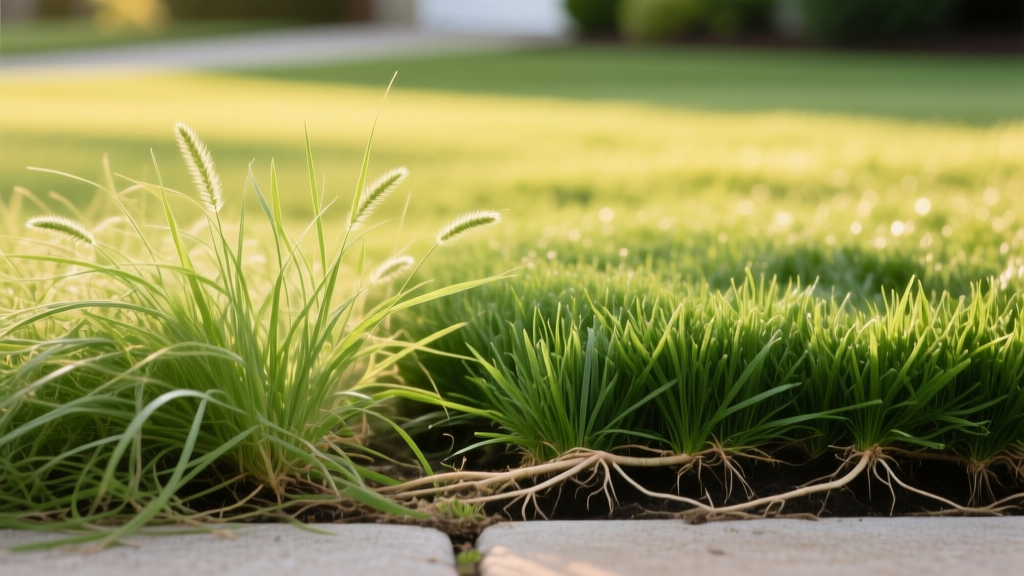
Crabgrass or Bermuda Grass? ID and Spot-Treatment Guide
Homeowners managing warm-season lawns frequently face a frustrating diagnostic dilemma: is that coarse, rapidly spreading patch in the yard their desired turf, or an invasive weed? Misidentifying the species leads to disastrous chemical applications. While both species thrive in summer heat and spread via above-ground stolons, confusing the two can result in either killing your lawn with the wrong herbicide or allowing a weed to choke out your turf. This guide provides the exact morphological identifiers and professional-grade spot-treatment protocols to resolve the crabgrass or bermuda grass debate and protect your landscape.
The Visual Showdown: Morphological Identification
Before mixing any chemicals, you must confirm the species. Relying on leaf color or general growth habit is insufficient, as nitrogen-deficient Bermuda grass can mimic the pale, yellowish-green hue of crabgrass. Instead, inspect the ligule (the membrane where the leaf blade meets the sheath) and the rooting nodes.
| Diagnostic Feature | Hairy Crabgrass (Digitaria sanguinalis) | Common Bermuda Grass (Cynodon dactylon) |
|---|---|---|
| Ligule Structure | Membranous, jagged, and pointed (looks like a torn piece of paper). | Short fringe of white hairs (no membrane). |
| Leaf Sheath | Covered in dense, long hairs. | Smooth, hairless, often slightly flattened. |
| Rooting Habit | Stolons root at nodes, but lacks underground rhizomes. | Spreads via both above-ground stolons and deep underground rhizomes. |
| Seed Head | 2 to 6 finger-like spikes emerging from a single point (windmill shape). | 3 to 7 slender spikes, often purplish at the tips, arranged in a whorl. |
| Winter Behavior | Annual: Dies completely after the first hard frost, leaving brown gaps. | Perennial: Goes dormant and turns uniformly brown, but root system survives. |
The "Tug Test" Verification
If visual inspection of the ligule is difficult due to mowing height, perform the tug test. Grab a handful of the stolons and pull firmly. If the grass pulls up easily with shallow, fibrous roots and no underground runners, it is likely crabgrass. If it resists heavily and snaps, revealing thick, scaly underground rhizomes (which look like pale, jointed roots), you are dealing with Bermuda grass.
The Spot-Treatment Decision Tree
Once you have confirmed the presence of crabgrass in a Bermuda lawn, your treatment protocol depends entirely on the weed's growth stage. Applying the wrong chemical at the wrong stage wastes money and risks phytotoxicity to the desirable turf.
Stage 1: Pre-Emergent Defense (Soil Temp < 55°F)
Scenario: Early spring. Crabgrass seeds are in the soil, waiting for consistent 55°F soil temperatures at a 2-inch depth to germinate.
Action: Apply Prodiamine 65 WDG at a rate of 0.115 oz per 1,000 sq ft. This creates a chemical barrier in the top inch of soil that stops cell division in germinating seeds. Water in with 0.5 inches of irrigation immediately. Do not apply if Bermuda grass is just breaking dormancy, as heavy pre-emergent loads can slightly stunt initial spring stolon growth.
Stage 2: Early Post-Emergent (1 to 3 Tillers)
Scenario: Late spring. Crabgrass seedlings are visible, small, and have not yet developed lateral branching (tillering).
Action: Spot-treat with Fenoxaprop-p-ethyl (Acclaim Extra). Mix at 0.3 to 0.4 fl oz per 1,000 sq ft. This herbicide is exceptionally safe for Bermuda grass and highly lethal to young crabgrass. It does not require a surfactant. Expect yellowing of the crabgrass within 7 days and complete necrosis in 14 to 21 days.
Stage 3: Late Post-Emergent (Mature, Tillered, & Seeding)
Scenario: Mid-to-late summer. Crabgrass is large, spreading laterally, and producing seed heads.
Action: Fenoxaprop will fail here. You must switch to Quinclorac (Drive XLR8). Mix at 0.73 fl oz per 1,000 sq ft. Critical: You must add a Methylated Seed Oil (MSO) surfactant at 1% v/v (1.3 fl oz per gallon of spray solution) for the chemical to penetrate the mature, waxy cuticle of the weed. Drive XLR8 is safe for established Bermuda grass but may cause temporary tip-burn if applied when daytime temperatures exceed 90°F.
Chemical Protocols: Pricing and Application Specifics
Professional-grade herbicides require an upfront investment but offer vastly superior efficacy and lower long-term costs compared to consumer-grade ready-to-spray bottles. Below is the 2026 pricing and coverage matrix for the active ingredients mentioned above.
| Active Ingredient | Brand Example | Avg. Cost (2026) | Coverage per Gallon | Cost per 1,000 sq ft |
|---|---|---|---|---|
| Quinclorac (37.5%) | Drive XLR8 | $145.00 / Gal | ~1.5 Acres (65,000 sq ft) | $0.22 |
| Fenoxaprop-p-ethyl | Acclaim Extra | $115.00 / Gal | ~2.0 Acres (87,000 sq ft) | $0.13 |
| Prodiamine (65%) | Prodiamine 65 WDG | $130.00 / 5 lb Jug | ~2.5 Acres (108,000 sq ft) | $0.12 |
Critical Warning: Herbicides That Will Destroy Bermuda
When searching for crabgrass solutions, you will encounter several popular herbicides that are highly toxic to Bermuda grass. Applying these will result in severe bleaching, stunting, or total turf death.
- Mesotrione (Tenacity): While excellent for killing crabgrass in cool-season fescue or Kentucky bluegrass, Tenacity bleaches Bermuda grass white and causes severe necrosis. Never use this on a Bermuda lawn.
- MSMA: Once the industry standard for crabgrass, MSMA (monosodium methanearsonate) is heavily restricted. It causes severe phytotoxicity to Bermuda grass when temperatures exceed 85°F and is largely unavailable to residential users.
- Fluazifop-p-butyl (Ornamec/Fusilade II): These are grass-specific herbicides designed to kill annual grassy weeds in broadleaf landscapes. They will indiscriminately kill your Bermuda grass alongside the crabgrass.
For comprehensive safety data and state-specific regulations on restricted-use herbicides, always consult your local cooperative extension office, such as the Texas A&M Agrilife Extension or equivalent regional authority.
Cultural Practices to Outcompete Crabgrass
Chemical spot-treatments are a reactive measure. True turf management relies on cultural practices that exploit the biological weaknesses of crabgrass. Crabgrass is an opportunistic annual that requires high light levels at the soil surface to trigger seed germination. Bermuda grass, conversely, is a dense, shade-casting perennial when managed correctly.
- Optimize Mowing Height: Maintain your Bermuda grass at exactly 1.0 to 1.5 inches during peak summer growth. Mowing higher than 2.0 inches causes Bermuda to become stemmy and thin at the base, allowing sunlight to penetrate the canopy and trigger crabgrass germination. Mowing lower than 0.75 inches scalps the turf, stressing the Bermuda and opening bare soil for weed invasion.
- Strategic Nitrogen Timing: Do not apply high-nitrogen fertilizers in early spring (March/April). At this stage, Bermuda grass is still utilizing stored root carbohydrates and cannot efficiently uptake nitrogen. The crabgrass, however, is actively germinating and will consume the fertilizer, accelerating its growth. Wait until the Bermuda lawn is 100% green and actively growing (typically late May) to apply your first heavy nitrogen application (1.0 lb N per 1,000 sq ft).
- Deep, Infrequent Irrigation: Crabgrass has a shallow, fibrous root system that thrives on frequent, light watering. Bermuda grass possesses deep rhizomes that excel in drought conditions. Water your lawn deeply (0.5 to 0.75 inches per session) only 2 to 3 times a week. This forces Bermuda roots deep while causing moisture stress to shallow-rooted crabgrass seedlings.
By combining precise morphological identification with stage-specific chemical protocols and aggressive cultural shading, you can effectively eliminate crabgrass without compromising the structural integrity of your Bermuda grass lawn.