
Grass Types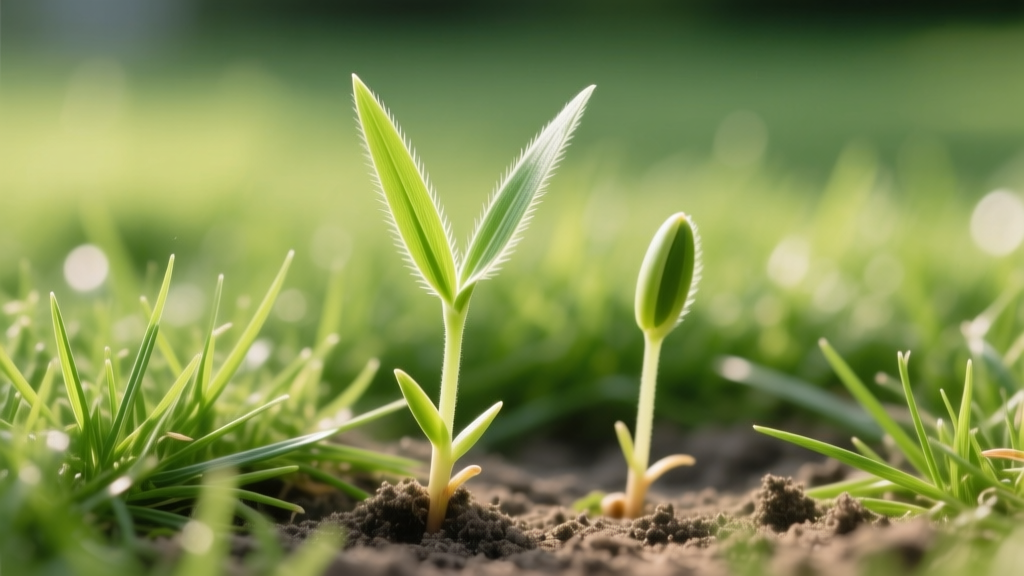
Crabgrass Seedling Pictures: Visual ID & Spot Treatment Guide
The Morphology of a Crabgrass Seedling
Catching large crabgrass (Digitaria sanguinalis) at the seedling stage is the single most effective way to prevent a localized infestation from becoming a full-lawn renovation project. A single mature crabgrass plant can produce up to 150,000 seeds, but before it reaches that stage, it begins as a highly vulnerable seedling. Because many homeowners rely on generic weed killers that fail on mature grassy weeds, early visual identification is critical.
When examining crabgrass seedling pictures and comparing them to your lawn, look for these specific morphological traits at the 1-leaf to 3-leaf stages:
- Cotyledon and First True Leaf: The initial leaf (cotyledon) is short, rounded, and pale green. The first true leaf emerges from the center, displaying a distinct light-green to yellowish-green hue that contrasts sharply with the darker, mature turfgrass surrounding it.
- The Ligule: This is the most definitive identification feature. Unroll the collar region of the seedling. Crabgrass features a prominent, membranous, jagged ligule that is tall and white or translucent. Cool-season turfgrasses like Tall Fescue or Kentucky Bluegrass have much shorter, less pronounced ligules.
- Stem and Sheath Hairs: Unlike smooth crabgrass (Digitaria ischaemum), large crabgrass seedlings develop distinct, fine hairs on the lower stem and leaf sheaths. If the stem is completely hairless, you are likely looking at smooth crabgrass or goosegrass.
Crabgrass Seedling Pictures vs. Common Lookalikes
Misidentifying a grassy weed at the seedling stage leads to incorrect herbicide selection. For example, applying a quinclorac-based product to goosegrass will result in poor control, as goosegrass requires specific PPO-inhibitors or glufosinate for effective post-emergent management. Use the comparison matrix below to differentiate young seedlings.
| Feature | Large Crabgrass | Goosegrass | Quackgrass | Desired Tall Fescue |
|---|---|---|---|---|
| Ligule Type | Membranous, tall, jagged | Membranous, short, toothed | Membranous, very short | Membranous, short |
| Stem/Sheath Base | Hairy, often flattened | Hairless, silver/white base | Hairless, reddish-purple base | Hairless, rounded |
| Leaf Blade Texture | Rough, wide, light green | Glossy near base, dark green | Smooth, narrow, blue-green | Ribbed, wide, dark green |
| Growth Habit (Early) | Prostrate, star-like rosette | Prostrate, tight clump | Upright, aggressive rhizomes | Bunch-type, upright |
For authoritative visual references and detailed botanical drawings, consult the University of California Statewide IPM Program weed identification database, which provides exhaustive macro-level imagery of the collar region and root structures.
The 3-Leaf Window: Why Timing Dictates Herbicide Success
The primary reason post-emergent crabgrass treatments fail is delayed application. Crabgrass undergoes a physiological shift known as tillering (producing lateral shoots from the base) typically between the 3-leaf and 5-leaf stages.
Warning: The Tillering Threshold
Once a crabgrass seedling develops its first tiller (usually around 45-60 days after germination, depending on soil temperatures), its vascular system matures and the waxy cuticle on the leaf blade thickens. Systemic herbicides like quinclorac struggle to translocate to the root zone past this stage, often resulting in top-growth burn followed by rapid regrowth.
Once a crabgrass seedling develops its first tiller (usually around 45-60 days after germination, depending on soil temperatures), its vascular system matures and the waxy cuticle on the leaf blade thickens. Systemic herbicides like quinclorac struggle to translocate to the root zone past this stage, often resulting in top-growth burn followed by rapid regrowth.
Spot-treating at the 1-leaf to 2-leaf stage ensures the herbicide is rapidly absorbed through the thin cuticle and translocated to the underdeveloped root system, achieving a 95% or higher kill rate with a single application.
Spot-Treatment Protocols by Turf Type
Selecting the correct active ingredient depends entirely on your desirable turfgrass species. Applying the wrong chemistry can cause severe phytotoxicity (chemical burn or stunting) to your lawn.
Cool-Season Lawns (Kentucky Bluegrass, Tall Fescue, Ryegrass)
Active Ingredient: Quinclorac (e.g., Drive XLR8, Quinclorac 75 DF)
Mode of Action: Synthetic auxin (Group 4) that causes uncontrolled growth and vascular collapse in broadleaf and certain grassy weeds.
Mixing Rate: 0.54 to 0.72 fluid ounces per 1,000 square feet.
Surfactant Requirement: Mandatory. Use a Methylated Seed Oil (MSO) at 1% v/v (approx. 1.3 fl oz per gallon of spray solution). Non-ionic surfactants (NIS) yield inferior control on crabgrass.
Cost Analysis: A 2.5-gallon jug of Drive XLR8 retails for approximately $85-$95 in 2026. Because spot-treating requires only ounces per application, a single jug can treat localized breakthroughs across 3+ acres of turf, making it highly cost-effective.
Warm-Season Lawns (Bermudagrass, Zoysiagrass)
Active Ingredient: Fenoxaprop-p-ethyl (e.g., Acclaim Extra)
Mode of Action: ACCase inhibitor (Group 1) that halts lipid biosynthesis in the weed.
Mixing Rate: 0.1 to 0.2 fluid ounces per 1,000 square feet.
Surfactant Requirement: Acclaim Extra is formulated with a built-in surfactant system; additional adjuvants are generally not required and can increase the risk of burning the desirable Bermuda or Zoysia.
Pro Tip for St. Augustinegrass:
St. Augustine is highly sensitive to both Quinclorac and Fenoxaprop. For spot-treating crabgrass seedlings in St. Augustine, rely on manual extraction at the 1-leaf stage or use Atrazine-based products (where legally permitted) strictly during cooler months, avoiding applications when temperatures exceed 85°F.
St. Augustine is highly sensitive to both Quinclorac and Fenoxaprop. For spot-treating crabgrass seedlings in St. Augustine, rely on manual extraction at the 1-leaf stage or use Atrazine-based products (where legally permitted) strictly during cooler months, avoiding applications when temperatures exceed 85°F.
Analyzing Pre-Emergent Failures
If you are searching for crabgrass seedling pictures because you are seeing weeds despite applying a pre-emergent like Prodiamine (Barricade) or Dithiopyr (Dimension), analyze the following failure points:
- Soil Temperature Miscalibration: Pre-emergents must be applied before soil temperatures at a 2-inch depth consistently reach 53°F to 55°F. Applying after this threshold allows the radicle (first root) to penetrate the chemical barrier.
- Barrier Disruption: Core aeration, heavy foot traffic, or aggressive raking after application physically breaks the chemical barrier in the top 1/2 inch of soil, creating micro-environments for seeds to germinate.
- Thatch Accumulation: A thatch layer exceeding 0.5 inches will intercept the pre-emergent spray, preventing it from reaching the soil surface where the germination zone exists. The herbicide binds to the organic matter and degrades before reaching the mineral soil.
For deeper insights into pre-emergent timing and soil thermodynamics, review the turfgrass management publications from the NC State University TurfFiles extension program, which provides real-time soil temperature tracking and application models.
Frequently Asked Questions
Can I just pull crabgrass seedlings by hand?
Yes, at the 1-leaf to 2-leaf stage, the root system is shallow and fibrous. Hand-pulling is highly effective and removes the plant entirely. However, once the plant develops a central taproot and begins tillering (usually past the 3-leaf stage), the roots anchor deeply, and pulling often snaps the crown, leaving the basal meristem intact to regrow.
Will mowing lower kill crabgrass seedlings?
No. Crabgrass has a prostrate growth habit, meaning its growing point (apical meristem) sits extremely low to the soil surface. Scalping your lawn to 1 inch will severely stress your desirable turfgrass, opening the canopy to more sunlight, which actually accelerates crabgrass germination and growth. Maintain your turf at the highest recommended height (e.g., 3.5 to 4 inches for Tall Fescue) to shade out seedlings.
How long does it take for Quinclorac to show results on seedlings?
When applied to 1-leaf or 2-leaf seedlings with an MSO surfactant, you will typically observe leaf curling and epinasty (abnormal downward bending) within 24 to 48 hours. Complete desiccation and death of the seedling occur within 7 to 14 days, depending on ambient temperatures and soil moisture levels.

