Grass Types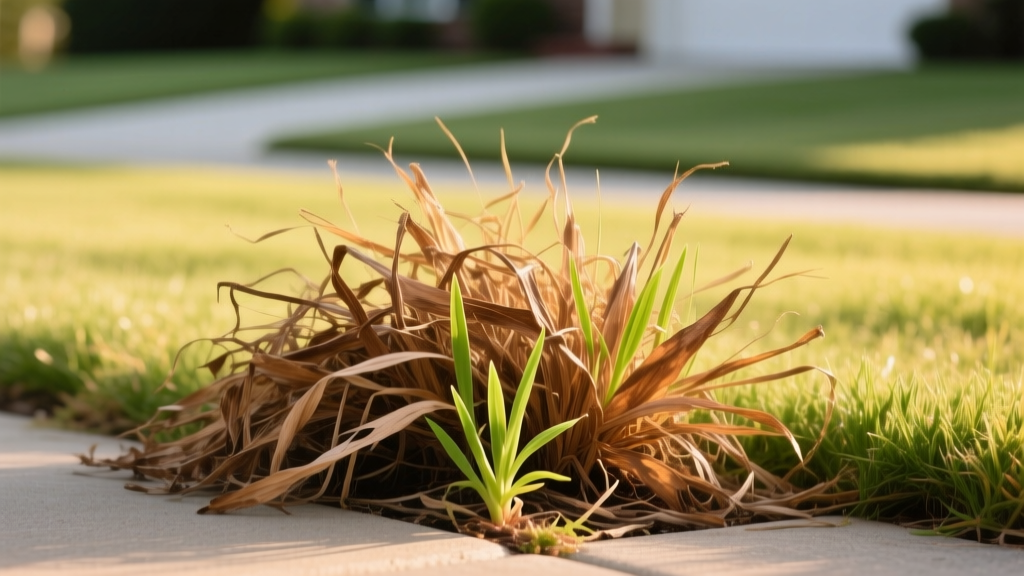
Is Your Dead St Augustine Grass Dormant? Diagnosis & Rescue
When St. Augustine grass turns brown, brittle, and thin, homeowners often assume the lawn is dead and begin pricing new sod. However, true turf death is far less common than severe dormancy, aggressive fungal pathogens, or localized insect predation. Before spending thousands on a full lawn replacement, you must accurately diagnose the underlying failure mode. Misidentifying Take-All Root Rot (TARR) as drought stress, or chinch bug damage as winter kill, will result in wasted time and dead grass.
The 60-Second 'Tug and Crown' Diagnostic Test
To determine if you are dealing with dead St Augustine grass or a recoverable lawn, perform these two physical tests at the margin where the brown grass meets the green grass.
Decision Matrix: Tug & Crown Results
- The Tug Test: Grab a handful of brown grass and pull straight up. If it lifts effortlessly with no roots attached and the base is black/mushy, you have a root disease (likely TARR). If it resists and breaks at the leaf blade, the roots are alive (dormancy or leaf-spot disease).
- The Crown Test: Use a pocket knife to slice horizontally through a stolon (the above-ground runner). If the center cross-section is firm, white, or pale green, the plant is alive and dormant. If the center is brown, hollow, or stringy, that specific stolon is dead.
Symptom Matrix: What is Actually Killing Your Lawn?
Visual symptoms alone are deceptive. Use this diagnostic matrix to cross-reference your lawn's physical appearance with the most common St. Augustine killers.
| Visual Symptom | Root / Stolon Condition | Primary Suspect | Immediate Action Required |
|---|---|---|---|
| Irregular yellow/brown patches expanding rapidly in heat | Roots are blackened, short, and rotting | Take-All Root Rot (TARR) | Apply Azoxystrobin; lower soil pH |
| Yellowing 'halos' around dead patches in sunny areas | Roots healthy; tiny black/white bugs at soil line | Southern Chinch Bugs | Apply Bifenthrin or Imidacloprid |
| Uniform browning across entire lawn during dry spells | Roots white and firm; stolons tough and dry | Drought Dormancy | Deep watering (1.5 inches/week) |
| Mottled yellow and green mosaic pattern on leaves | Roots generally healthy; no insects present | St. Augustine Decline (SAD) Virus | Replace with SAD-resistant cultivar |
Take-All Root Rot (TARR): The Silent Killer
According to Texas A&M AgriLife Extension, Take-All Root Rot (caused by the fungus Gaeumannomyces graminis var. graminis) is the most destructive disease of St. Augustine grass. It thrives in soils with a pH above 6.5 and high thatch layers. By the time the grass blades turn brown, the root system has already been decimated.
Chemical and Organic Rescue Protocol for TARR
Rescuing a TARR-infected lawn requires a two-pronged approach targeting both the pathogen and the soil environment.
- Acidify the Soil: TARR struggles in acidic environments. Apply a 1-inch layer of Canadian Sphagnum peat moss (approximately one 3.8 cu. ft. bale per 1,000 square feet). Rake it into the thatch layer and water deeply. This will drop the localized soil pH to the optimal 5.5–6.0 range.
- Targeted Fungicide Application: Apply a preventative fungicide containing Azoxystrobin (e.g., Scotts DiseaseEX or Heritage TL). The application rate is 2 to 4 fluid ounces per 1,000 square feet. You must apply this in the fall (when soil temperatures drop below 70°F) and again in early spring. Curative applications in the peak of summer are largely ineffective because the root damage is already done.
- Halt Nitrogen Spikes: Avoid high-nitrogen synthetic fertilizers (like 32-0-4) which force weak, succulent leaf growth. Switch to a slow-release organic fertilizer with a 1-1-1 or 1-2-1 NPK ratio to encourage root rebuilding.
Chinch Bug Devastation: Spotting the 'Halo' Effect
The Southern Chinch Bug (Blissus insularis) injects a toxin into the grass blade while feeding, causing a distinct yellowing 'halo' around the perimeter of dead patches. They heavily target sunny, heat-stressed areas near driveways and sidewalks.
The Coffee Can Test: Remove both ends of a metal coffee can, push it 2 inches into the soil at the edge of a damaged patch, and fill it with water. Wait 5 minutes. If more than 20 chinch bugs float to the surface, you have an economic threshold infestation requiring immediate chemical intervention.
Warning: Insecticide Resistance
Chinch bugs have developed severe resistance to pyrethroids in many southern states. If Bifenthrin (Talstar P, Bifen XTS) fails to halt the damage within 7 days, immediately rotate to a neonicotinoid like Imidacloprid (Merit) or a diamide like Chlorantraniliprole (Acelepryn) to break the genetic resistance cycle.
Step-by-Step 30-Day Rescue Action Plan
If your tug and crown tests confirm the grass is alive but severely stressed, execute this 30-day rehabilitation schedule to restore canopy density.
- Days 1-3 (Hydration Shock): Apply exactly 1.5 inches of water across the lawn. Use empty tuna cans placed in different zones to measure output. Watering must occur between 4:00 AM and 6:00 AM to minimize evaporation and prevent fungal leaf spot diseases.
- Day 7 (Thatch Management): Measure the thatch layer. If it exceeds 0.5 inches, rent a vertical mower (dethatcher) and set the blades to exactly 0.25 inches deep. St. Augustine is highly sensitive to aggressive dethatching; cutting too deep will sever the vital stolons and kill the lawn.
- Day 14 (Targeted Nutrition): Apply a liquid kelp extract (e.g., SeaHume G) combined with a low-nitrogen, high-potassium fertilizer (like a 5-10-30 blend). Potassium regulates stomatal opening and drastically improves the grass's drought and heat tolerance during recovery.
- Day 21 (Mowing Calibration): Raise your mower deck. St. Augustine requires a mowing height of 3.5 to 4.0 inches in shaded areas and 2.5 to 3.0 inches in full sun. Cutting it shorter than 2.5 inches exposes the stolons to UV scorch and invites weed invasion.
- Day 30 (Aeration): Perform core aeration using 3-inch tines. Do not use liquid aeration products or spike aerators, as they do not physically relieve the soil compaction that restricts St. Augustine's shallow root system.
The Financial Reality: Rehab vs. Resodding
According to University of Georgia Extension, maintaining proper cultural practices is vastly more cost-effective than total lawn replacement. When evaluating dead St Augustine grass, run the numbers before calling a landscaper.
Cost Breakdown for a 5,000 Sq. Ft. Lawn
Full Rehabilitation (Chemicals, Peat Moss, Aeration): $250 – $400 total. Requires 60-90 days of consistent labor and monitoring.
Total Resodding (Tear-out, Soil Prep, New Sod): $3,500 – $5,500 installed. If the underlying soil pathology (like TARR or severe compaction) is not corrected before laying new sod, the new St. Augustine will die within 12 to 18 months, resulting in a total loss of capital.
Accurate diagnosis is the only bridge between a dead lawn and a thriving one. By isolating the exact biological or environmental failure point, you can deploy precise, cost-effective treatments rather than relying on guesswork and expensive replacements.