Grass Types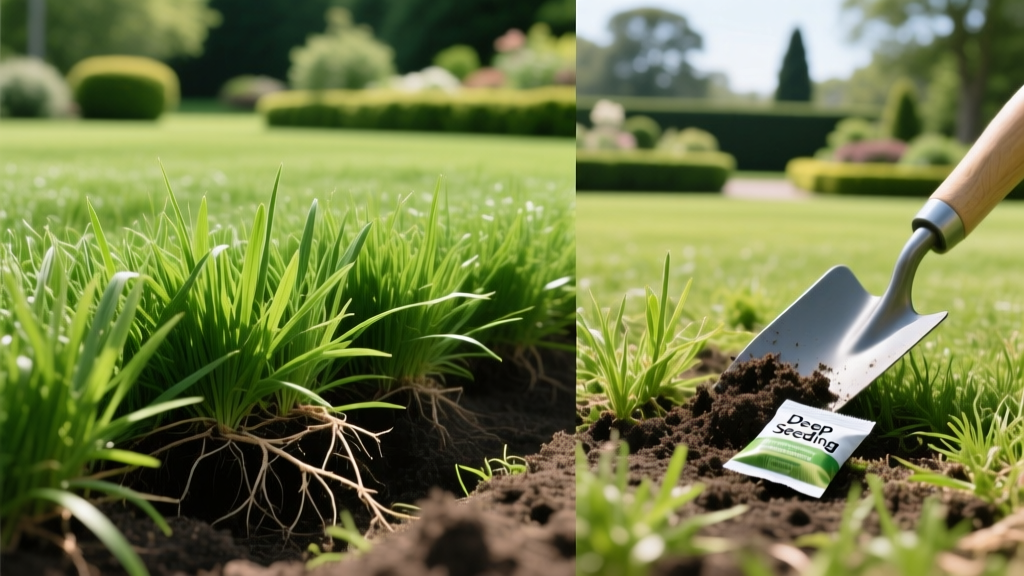
Why Deep Seeding Kills Turfgrass Germination (And How to Fix It)
When establishing a new lawn or overseeding thin turf, a common and fatal homeowner mistake is burying the seed too deeply. Driven by the logic that deeper planting protects seeds from birds, wind, and drying out, many DIYers rake grass seed under a half-inch or more of topsoil. In the world of turfgrass agronomy, this practice is known as deep seeding, and it is one of the primary causes of total germination failure.
Unlike large-seeded agricultural crops or native prairie grasses, turfgrass species possess microscopically small seeds with severely limited energy reserves. Understanding the biological constraints of these seeds is critical for successful lawn establishment. According to University of Minnesota Extension, proper seed-to-soil contact requires shallow placement, and burying turf seed beyond its maximum emergence depth guarantees failure.
The Biology of Seed Emergence: Why Depth Matters
Every grass seed contains an endosperm—a finite packet of stored carbohydrates and proteins that fuels the embryo's initial growth. The seed relies entirely on this energy to push its coleoptile (the protective sheath around the first leaf) through the soil crust and into the sunlight. Once the seedling reaches the surface and begins photosynthesis, it becomes self-sustaining. If the seed is buried too deeply, the endosperm is exhausted before the shoot reaches the light, and the seedling dies underground.
The 1/4-Inch Rule for Turfgrass:
As a universal standard, turfgrass seed should never be buried deeper than 1/4 inch. For smaller seeds, 1/8 inch is optimal. The goal is not to bury the seed, but to press it into the soil surface so it is surrounded by moisture while still receiving light and oxygen.
As a universal standard, turfgrass seed should never be buried deeper than 1/4 inch. For smaller seeds, 1/8 inch is optimal. The goal is not to bury the seed, but to press it into the soil surface so it is surrounded by moisture while still receiving light and oxygen.
The tolerance for depth is directly correlated to seed size. Kentucky Bluegrass (KBG) is exceptionally small, yielding approximately 1.3 million seeds per pound. Because each individual seed is tiny, its energy reserve is minimal; KBG planted at a depth of 1/2 inch will almost universally fail. Conversely, Tall Fescue yields roughly 225,000 seeds per pound. Its larger size provides slightly more energy, allowing it to occasionally emerge from 3/8 inch deep, but it still struggles significantly at 1/2 inch.
Symptoms of Deep Seeding Failure
Homeowners often misdiagnose deep seeding failure as bad seed, poor soil, or inadequate watering. If you have seeded deeply, look for these specific physiological and environmental symptoms:
- Delayed and Patchy Emergence: Instead of the expected 7 to 14 days for perennial ryegrass or tall fescue, you may see sparse, isolated sprouts emerging at 21 to 28 days. These are the rare seeds that happened to be in a surface crevice.
- Etiolation (Spindly, Pale Shoots): Seedlings that manage to push through deep soil are often pale yellow, abnormally thin, and weak. They have exhausted their chlorophyll-producing capabilities fighting through the dark soil profile.
- Damping-Off Disease: Deep soil layers remain cooler and wetter than the surface. Buried seeds sitting in prolonged moisture are highly susceptible to Pythium and Rhizoctonia fungi, which rot the seed or kill the emerging root (radicle) before it can establish.
- Soil Crusting Entrapment: Heavy clay soils form a hard crust after watering. A seed buried 1/2 inch deep lacks the mechanical force to fracture this crust from below, trapping the shoot in a subterranean air pocket.
Deep Seeding vs. Slit Seeding: Clearing the Confusion
A major source of confusion in lawn care is the conflation of 'deep seeding' with 'slit seeding' (or slice seeding). NC State University's TurfFiles highly recommends slit seeding for overseeding because it ensures perfect seed-to-soil contact, but the mechanics are entirely different from simply burying seed.
| Feature | Deep Seeding (The Mistake) | Slit Seeding (The Best Practice) |
|---|---|---|
| Soil Disturbance | Tilling or raking seed under 1/2'+ of soil | Steel blades cut 2-3' slits into the thatch/soil |
| Seed Placement Depth | 1/2 inch to 2 inches deep | Calibrated to drop seed at 1/8' to 1/4' |
| Seed-to-Soil Contact | Poor (seed surrounded by loose, dry dirt clods) | Excellent (seed rests firmly at the bottom of the slit) |
| Germination Success | Extremely Low (High rot and energy exhaustion) | Very High (Optimal moisture and emergence path) |
When using a machine like the Ryan Ren-O-Thin SL-18 or a similar slit seeder, the blades cut deep into the soil to break up compaction and thatch, but the seed drop tube is positioned to release the seed precisely at the 1/4-inch mark. The slit closes slightly around the seed, providing the moisture retention of deep planting without the fatal emergence depth.
How to Correct a Deep Seeding Mistake
If you have already broadcasted seed and aggressively raked it under an inch of soil, or if a landscaping crew improperly top-dressed your newly seeded lawn, you must act before the seeds rot or exhaust their endosperm. Follow this remediation protocol:
- Assess the Soil Moisture and Crust: If the soil has dried and formed a hard crust over the buried seed, water the area lightly to soften the top layer. Do not flood it, which will cause further seed rot.
- Perform Shallow Core Aeration or Dethatching: Run a dethatcher (power rake) over the area with the blades set high, or use a core aerator. This will pull up plugs of soil and thatch, effectively exposing the buried seed to the surface and creating micro-channels for light and oxygen.
- Drag and Level: Use a piece of chain-link fence or a specialized lawn drag mat to lightly scarify the surface. This breaks up the soil clods that are smothering the seed and brings the deepest seeds back to the 1/4-inch zone.
- Overseed the Bare Spots: Inevitably, some deep seed will be lost to fungal rot. Identify the thinnest areas after 14 days and apply a fresh layer of seed, this time simply broadcasting it on the surface and pressing it in with a heavy lawn roller or by walking over it with flat-soled shoes.
Warning on Pre-Emergent Herbicides: If your deep-seeded lawn fails and you decide to start over, remember that the decaying organic matter and disturbed soil can invite weeds. However, you cannot apply standard pre-emergent herbicides (like Prodiamine) to a newly seeded area, as they will halt the cell division of your new grass seed just as effectively as crabgrass. Stick to post-emergent spot treatments for broadleaf weeds once the new turf has been mowed three times.
Exceptions: When Deeper Planting is Acceptable
It is important to note that the strict 1/4-inch rule applies specifically to turfgrass (Kentucky Bluegrass, Tall Fescue, Perennial Ryegrass, Bermudagrass, Zoysia). If you are establishing a native prairie, a pasture, or an erosion-control zone using large-seeded forage or native grasses, deep seeding is often required.
Species like Switchgrass (Panicum virgatum), Big Bluestem (Andropogon gerardii), and certain annual ryegrass forage varieties possess massive endosperms. These are typically planted using agricultural no-till drill seeders calibrated to drop the seed at depths of 1/2 inch to 1 inch. At these depths, the larger seed has the mechanical strength and energy reserves to fracture heavy agricultural clay and reach the surface. Always verify the specific planting depth requirements on the seed tag, as the agronomic rules for turf do not apply to forage or native restoration projects.