Grass Types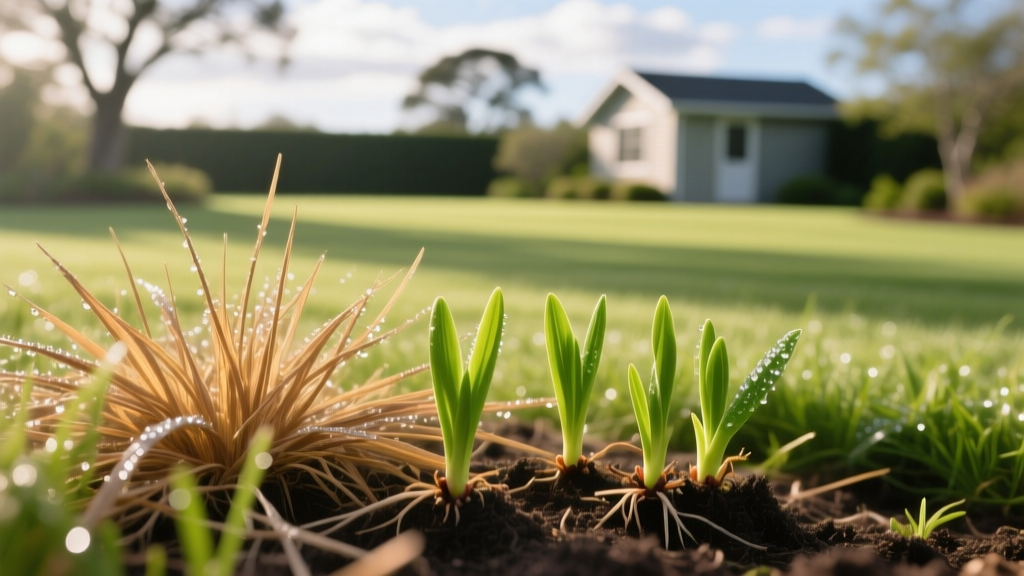
Dormant Bermuda Grass Care: Spring Green-Up and Weed Control
The Science of Bermuda Dormancy and Spring Green-Up
Bermuda grass (Cynodon dactylon) is a resilient warm-season perennial that survives winter by shifting its metabolic processes from the leaves to the crown and root system. When soil temperatures at a two-inch depth consistently drop below 55°F, the grass enters true dormancy, presenting a pale brown or straw-like canopy. While the above-ground tissue appears dead, the crown remains alive, storing carbohydrates necessary for spring recovery.
Critical Soil Temperature Thresholds for Bermuda Grass:
- Below 55°F: Full dormancy. Top growth ceases; roots survive on stored starches.
- 55°F to 60°F: Root system begins slow metabolic activity. Crown tissue prepares for cellular division.
- 65°F+ (Sustained): Active spring green-up initiates. Leaf blades emerge from the crown.
Managing dormant Bermuda requires a fundamental shift in perspective: you are not caring for the brown leaves you see; you are protecting the microscopic crown tissue and root mass hidden below the soil surface. According to turfgrass researchers at NC State Extension, premature applications of high-nitrogen fertilizers during late winter can force the grass to break dormancy too early, leaving the newly emerged shoots highly vulnerable to late spring frost kill.
Pre-Emergent Weed Control on Dormant Bermuda
The dormant phase is the most critical window for weed control. Because the Bermuda canopy is thin and brown, winter annuals like henbit, chickweed, and Poa annua (annual bluegrass) can establish rapidly, stealing water and nutrients just as the Bermuda grass attempts to wake up.
Selecting the Right Herbicide Chemistry
For homeowners managing dormant Bermuda, granular pre-emergents containing Prodiamine (e.g., Prodiamine 65 WDG or Barricade) or Dithiopyr (e.g., Dimension) are the industry standards. Prodiamine provides a long residual barrier (up to 4 months) against crabgrass and goosegrass, while Dithiopyr offers early post-emergent control of crabgrass that has already germinated but hasn't tillered.
- Application Rate: For Prodiamine 65 WDG, apply at a rate of 0.5 oz per 1,000 square feet for a standard 3-month barrier.
- Watering In: Pre-emergents require exactly 0.5 inches of irrigation or rainfall within 48 hours to activate the chemical barrier in the top 1.5 inches of soil.
WARNING: Root Pruning Risk
Do not apply pre-emergent herbicides if your local soil temperatures are within 4 weeks of the sustained 65°F green-up threshold. Pre-emergents work by inhibiting root cell division (mitosis). If applied too close to spring green-up, the chemical will stunt the Bermuda grass's new spring root development, resulting in a thin, weak lawn that struggles through summer heat.
Do not apply pre-emergent herbicides if your local soil temperatures are within 4 weeks of the sustained 65°F green-up threshold. Pre-emergents work by inhibiting root cell division (mitosis). If applied too close to spring green-up, the chemical will stunt the Bermuda grass's new spring root development, resulting in a thin, weak lawn that struggles through summer heat.
Step-by-Step Spring Wake-Up Protocol
Transitioning dormant Bermuda back to an active, green state requires a phased approach. Follow this exact sequence to maximize canopy density without triggering fungal pathogens.
- Canopy Scalping (Late Winter): Once the threat of hard freezes has passed but before green-up begins, lower your mower deck to 1.0 inch. Bag the clippings to remove the dead brown canopy. This allows sunlight to reach the soil surface, warming the crown tissue up to 5°F faster than unscaled lawns.
- Soil Amendment (Early Spring): Apply a liquid humic acid and fulvic acid blend (e.g., 3 oz per 1,000 sq ft). This chelates bound nutrients in the soil, making them bioavailable to the waking root system without the risk of nitrogen burn.
- Initial Fertilization (Mid-Spring): Wait until the lawn is 75% green. Apply a starter fertilizer with a low-nitrogen, high-phosphorus ratio (e.g., 10-18-10) at a rate of 0.5 lbs of actual nitrogen per 1,000 sq ft. This fuels rhizome expansion rather than vertical leaf growth.
- Irrigation Calibration: Dormant and transitioning Bermuda requires minimal water. Apply 0.25 inches of water twice a week to keep the crown hydrated. Overwatering during this phase invites Large Patch disease (Rhizoctonia solani).
Overseeing Dormant Bermuda: Pure vs. Ryegrass
Many homeowners overseed dormant Bermuda with Perennial Ryegrass in the fall to maintain a green lawn year-round. However, the spring transition out of ryegrass is notoriously difficult and can severely damage the underlying Bermuda. The Oklahoma State University Extension notes that ryegrass competes aggressively for sunlight and nitrogen during the exact window Bermuda needs to break dormancy.
| Metric | Pure Dormant Bermuda (No Overseed) | Overseeded with Perennial Ryegrass |
|---|---|---|
| Spring Aesthetics | Brown/Straw colored for 4-6 weeks | Lush green throughout winter and early spring |
| Water Requirements | Minimal (natural rainfall usually sufficient) | High (requires 1+ inches per week to sustain ryegrass) |
| Spring Competition | Zero. Bermuda has exclusive access to soil nutrients. | Severe. Ryegrass steals nitrogen, delaying Bermuda green-up. |
| Transition Strategy | N/A | Must aggressively lower mowing height and reduce water in May to stress ryegrass to death. |
| Estimated Spring Cost | $15 (Humic acid + starter fertilizer) | $65+ (Extra water bills + transition herbicides + extra mowing fuel) |
Expert Insight: If you choose to overseed, use Annual Ryegrass instead of Perennial. Annual ryegrass naturally dies off when daytime temperatures consistently hit 80°F, removing the competition just as the Bermuda grass hits its peak summer growth phase.
Troubleshooting Delayed Green-Up and Failure Modes
If your soil temperatures have been above 65°F for three weeks and your Bermuda grass remains patchy or entirely brown, you are likely dealing with one of three specific failure modes:
1. Spring Dead Spot (Ophiosphaerella korrae)
This soil-borne fungus attacks the roots, stolons, and crowns of Bermuda grass in the fall, but the damage only becomes visible when the grass attempts to green up in spring. You will see distinct, sunken, circular patches of dead grass ranging from 6 inches to 3 feet in diameter.
- The Fix: Fungicide applications in spring are entirely ineffective for Spring Dead Spot. You must map the spots in spring, then apply preventative fungicides containing Azoxystrobin or Flutolanil in September and October when soil temperatures drop below 70°F.
2. Severe Soil Compaction
Heavy winter rains and foot traffic can compress the clay-heavy soils often associated with Bermuda lawns, suffocating the crown. If a screwdriver cannot be easily pushed 4 inches into the soil, compaction is delaying green-up.
- The Fix: Perform core aeration only after the lawn is 100% green and actively growing. Aerating dormant or semi-dormant Bermuda opens the crown to desiccation and weed invasion.
3. Winter Kill from Extreme Desiccation
In regions with low winter humidity and high winds, the crown tissue can dry out and die, even if soil temperatures never dropped to lethal freezing levels.
- The Fix: Rake out the dead tissue aggressively, apply a 1/4 inch layer of topdressing sand to protect the remaining stolons, and apply a balanced 16-4-8 fertilizer to force new node growth.