
Grass Types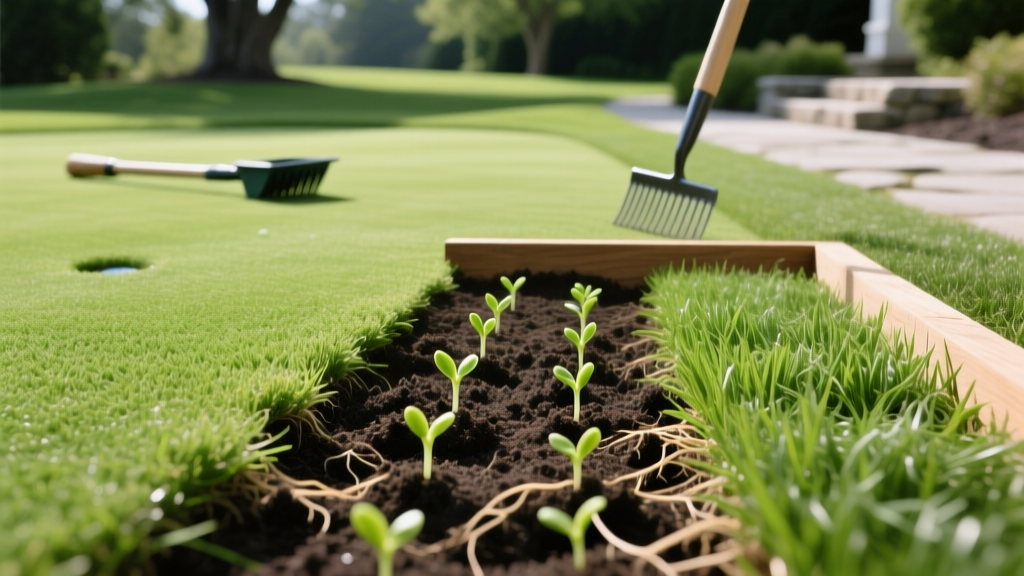
How to Establish Golf Green Grass Seed for Home Putting Greens
The Agronomy of Backyard Putting Greens
Establishing a true backyard putting green requires a radical departure from standard lawn care. When you purchase premium golf green grass seed, you are investing in highly bred cultivars designed to survive extreme mowing heights, intense foot traffic, and ultra-firm surfaces. Standard Kentucky Bluegrass or Tall Fescue will scalp, thin, and die when mowed below 0.5 inches. To achieve tour-quality ball roll (stimpmeter readings of 10+), you must pair the correct seed genetics with a USGA-specification root zone and a meticulous 60-day establishment protocol.
This guide details the exact species selection, soil engineering, and daily agronomic routines required to successfully establish golf green grass seed at home.
Selecting the Right Golf Green Grass Seed
The term 'golf green grass seed' generally refers to three distinct species categories, dictated entirely by your climate zone and maintenance budget. True ultradwarf bermudagrasses (like TifEagle) are vegetative and cannot be grown from seed, so seeded warm-season options are limited to fairway-height bermudagrasses. For actual putting green heights, cool-season options dominate the seed market.
| Species / Cultivar | Climate Zone | Target Mowing Height | Seeding Rate (per 1,000 sq ft) | Maintenance Level |
|---|---|---|---|---|
| Creeping Bentgrass (Penn A-4, ProCup) | Cool / Transition | 0.100' - 0.150' | 1.5 - 2.0 lbs | Extreme (Daily mowing, high fert) |
| Colonial Bentgrass (007, Authority) | Cool / Maritime | 0.125' - 0.180' | 1.5 - 2.0 lbs | High (Tolerates lower fertility) |
| Fine Fescue Blends (Chewings, Creeping Red) | Cool / Shade | 0.250' - 0.375' | 3.0 - 4.0 lbs | Moderate (Low water, slow growth) |
| Seeded Bermudagrass (Princess 77, Yukon) | Warm / Tropical | 0.250' - 0.375' | 1.0 - 2.0 lbs | High (Requires full sun, heavy N) |
Agronomist Tip: For most homeowners in the northern two-thirds of the US, Penn A-4 or 007 Colonial Bentgrass are the undisputed champions for seeded putting greens. They offer the densest tillering and the finest leaf texture, which translates directly to truer ball roll.
Site Preparation: Engineering the Root Zone
The most common reason golf green grass seed fails is poor soil architecture. Bentgrass roots will suffocate and succumb to Pythium root rot in heavy native clay. According to the USGA Green Section, a proper putting green requires a specific sand-based root zone to ensure rapid drainage and prevent compaction.
The USGA-Spec Backyard Build
- Excavation: Dig out the green area to a depth of 16 inches. Ensure a minimum slope of 1% to 2% for surface drainage.
- Gravel Base: Lay 4 inches of washed, angular gravel (0.25 to 0.375-inch diameter). Install perforated PVC drain pipes in a herringbone pattern within this layer, tying into a daylight exit.
- Root Zone Mix: Top with 12 inches of USGA-spec sand mix. This mix must be 85-90% coarse sand (particle size 0.25-1.0mm) and 10-15% sphagnum peat moss by volume. Do not use masonry sand or topsoil.
- Grading: Laser-grade or carefully screed the surface to eliminate any undulations. A 10-foot straightedge should show no more than 0.25 inches of deviation.
Sowing Techniques for Uniform Germination
Golf green grass seed is exceptionally fine. Creeping bentgrass contains roughly 12 million seeds per pound. Because the seeds are so small, they must be sown on the surface or barely covered; burying them deeper than 1/8 inch will prevent emergence.
The Cross-Hatch Sowing Method
Calibrate a high-quality drop spreader (like a Scotts AccuGreen) to deliver exactly half of your target seeding rate. For Penn A-4, this means setting the spreader to drop 0.75 lbs per 1,000 sq ft per pass.
- Pass 1: Walk North-to-South, overlapping wheel tracks by exactly one inch.
- Pass 2: Walk East-to-West with the remaining half of the seed.
- Topdressing: Apply a micro-thin layer (1/16 inch) of screened, dry topdressing sand or calcined clay (like Profile POROUS CERAMIC) over the seed. This protects the seed from wind and birds while allowing light penetration.
- Rolling: Use a lightweight water-filled roller (approx. 150 lbs) to press the seed firmly into the sand profile. Seed-to-soil contact is non-negotiable for bentgrass.
The 60-Day Establishment Protocol
Once the seed is in the ground, your daily routine shifts to intensive nursery management. Research from Purdue University Turfgrass Science emphasizes that the first 30 days dictate the long-term density of the green.
Days 1-14: Germination and Hydration
Bentgrass germinates in 5 to 10 days. During this window, the seed must never dry out, but the sand must never flood.
Action: Syringe the green 3 to 5 times daily for 1 to 2 minutes. The goal is to keep the top 0.5 inches of sand moist. If you see standing water, reduce frequency. Apply a starter fertilizer (e.g., 18-24-12) at 0.1 lbs of Nitrogen per 1,000 sq ft on Day 3.
Days 15-30: Tillering and Rooting
Seedlings will transition from a single shoot to multiple tillers. Roots will begin to anchor into the sand.
Action: Transition from syringing to deeper, less frequent watering (10 minutes once daily in the early morning). Apply a preventative fungicide. Pythium blight can wipe out a young bentgrass green in 24 hours during humid weather. Use a metalaxyl-based product (like Subdue MAXX) at 1.0 fl oz per 1,000 sq ft.
Days 30-60: The First Mows
Do not mow until the grass has firmly rooted (test by gently tugging the blades; if they resist, roots have anchored).
Action: Set a dedicated reel mower to 0.250 inches for the first cut. Never remove more than 1/3 of the leaf blade. Drop the mowing height by 0.020 inches every third mow until you reach your target height of 0.125 inches. Begin a weekly soluble fertilizer program (20-20-20) at 0.1 lbs N per 1,000 sq ft.
'Patience during the first mows is critical. Scalping a 40-day-old bentgrass green will shock the plant, open the canopy to Poa annua invasion, and set your establishment back by weeks.'
Troubleshooting Common Establishment Failures
Warning: Algae and Localized Dry Spot
Symptom: Black/green slippery film on the sand surface, or water beading up and running off dry patches.
Cause: Overwatering combined with high surface temperatures creates algae, which seals the sand and causes hydrophobic localized dry spot (LDS).
Fix: Hand-water dry spots with a wetting agent (like Cascade Plus) mixed at 2 oz per gallon of water. Break up algae crusts with a stiff push broom and apply a light dusting of dry sand to absorb surface moisture.
Long-Term Maintenance Realities
Establishing golf green grass seed is only the beginning. Maintaining a bentgrass or fine fescue putting green requires a commercial-grade reel mower (rotary mowers cannot cut at 0.125 inches), weekly aeration (needle-tining), and frequent topdressing to manage thatch. Budget approximately $1,500 to $3,000 annually for specialized fertilizers, wetting agents, and fungicides required to keep a home bentgrass green at tournament standards. If this maintenance profile exceeds your capacity, pivot to a Fine Fescue blend mowed at 0.375 inches, which offers a rustic, eco-friendly alternative with a fraction of the chemical and water inputs.

