Grass Types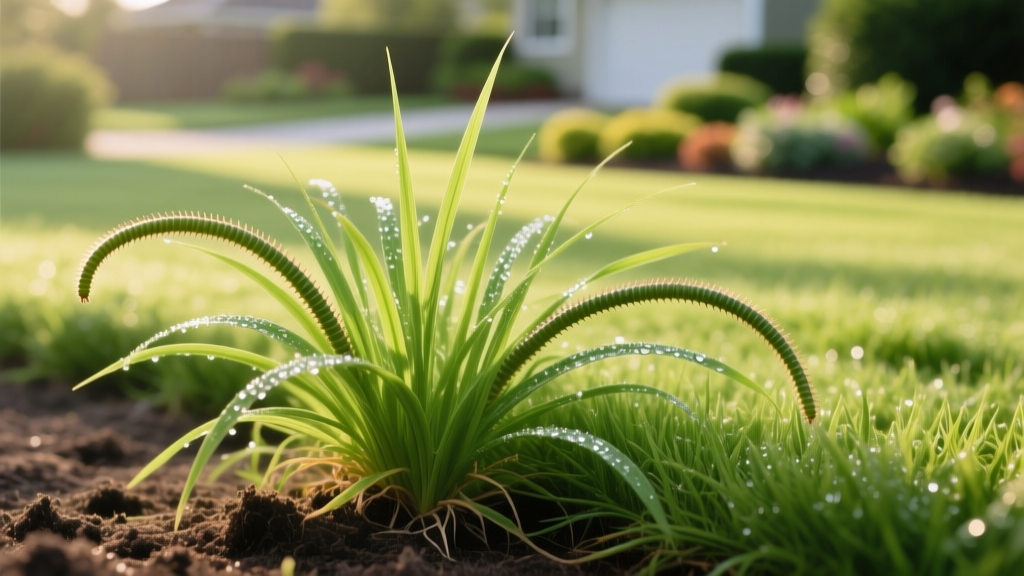
Fertilizing Centipede Grass: Exact NPK Ratios, Timing, and Costs
Centipede grass (Eremochloa ophiuroides) is famously dubbed the "lazy man's grass" due to its slow growth and low maintenance requirements. However, this moniker leads to a fatal homeowner mistake: over-fertilization. Unlike aggressive warm-season grasses such as Bermuda or Zoysia, centipede is highly sensitive to excessive nutrients, particularly phosphorus and high nitrogen loads. Applying standard turf fertilizers to centipede grass triggers thatch accumulation, centipede decline, and severe iron chlorosis.
This guide provides the exact agronomic parameters, NPK formulations, and real-world cost breakdowns required to maintain a dense, dark-green centipede lawn without triggering nutrient toxicity.
The Centipede Soil Profile: Why Standard Fertilizers Fail
Centipede grass evolved in the acidic, nutrient-poor soils of Southeast Asia. Consequently, its root system is uniquely adapted to extract micronutrients in low-pH environments. The optimal soil pH for centipede is strictly between 5.0 and 6.0.
⚠️ Critical pH Warning: If your soil pH creeps above 6.5, iron and manganese become chemically locked in the soil profile. No amount of iron-rich fertilizer will cure the resulting yellowing (chlorosis) until the pH is lowered using elemental sulfur. Always request a Mehlich-1 or Mehlich-3 extractant soil test, which is calibrated for acidic Southeastern soils.
Furthermore, centipede grass has an unusually low phosphorus requirement. High-phosphorus fertilizers (the middle number in the NPK ratio) compete with zinc and iron uptake at the root zone. According to the Clemson University Home & Garden Information Center, applying phosphorus to centipede lawns without a verified soil deficiency actively starves the grass of vital micronutrients.
Decoding the Ideal NPK Ratio for Centipede
Walk into any big-box garden center, and you will find fertilizers labeled "For All Lawns" with ratios like 24-8-16 or 30-5-10. These are formulated for high-traffic, high-nitrogen grasses and will slowly kill a centipede lawn. Below is a comparison of common market formulations against the agronomic ideal for centipede.
| Fertilizer Type | NPK Ratio Example | Verdict for Centipede | Primary Risk |
|---|---|---|---|
| Standard Turf Builder | 24-8-16 | Avoid | Phosphorus toxicity, iron lockout |
| Southern Centipede Blend | 15-0-15 | Ideal | None (Zero phosphorus, balanced N-K) |
| High-Nitrogen Quick Green | 32-0-10 | Use Sparingly | Excessive thatch, centipede decline |
| Organic Slow-Release | 6-4-0 (Milorganite) | Moderate | Contains phosphorus; use only if soil test shows P deficiency |
The gold standard for centipede grass is a 15-0-15 or 16-4-8 ratio (only if a soil test confirms phosphorus is needed). The NC State University TurfFiles database emphasizes that centipede requires only 1 to 2 pounds of actual nitrogen per 1,000 square feet annually—less than half of what Bermuda grass demands.
Seasonal Application Calendar & Exact Rates
Timing is just as critical as formulation. Applying nitrogen too early in the spring forces the grass to push tender top-growth while the root system is still dormant, making it highly susceptible to late-spring frost kill and Gaeumannomyces graminis (take-all root rot).
Spring: The Green-Up Phase (Late April to Mid-May)
Do not fertilize at the first sign of green. Wait until the lawn is 100% green and soil temperatures at a 2-inch depth consistently exceed 65°F.
- Target Rate: 0.5 to 1.0 lb of actual nitrogen per 1,000 sq. ft.
- Product Example: Scotts Turf Builder Southern Lawn Food (32-0-10).
- Application Math: To apply 1 lb of N using a 32% nitrogen product, apply 3.1 lbs of product per 1,000 sq. ft.
Summer: The Maintenance Phase (July)
A summer application is strictly optional and should only be executed if a soil test indicates severe nutrient leaching from heavy rains. If applied, use a slow-release, sulfur-coated urea (SCU) or methylene urea to prevent fertilizer burn during peak heat.
- Target Rate: 0.5 lb of actual nitrogen per 1,000 sq. ft.
- Potassium Boost: If your soil test shows low potassium, apply a 0-0-60 (Muriate of Potash) treatment at 1 lb per 1,000 sq. ft. to increase drought and heat tolerance.
Fall: The Hard Cutoff (August 15)
Stop all nitrogen applications by mid-August. Late-season nitrogen prevents the grass from hardening off and storing carbohydrates in its stolons for winter dormancy, directly leading to winter-kill and delayed spring green-up.
Top Formulations & Real-World Cost Analysis
When budgeting for lawn care, professionals calculate the cost per pound of actual nitrogen, not the cost per bag. Here is a breakdown of premium formulations suitable for centipede grass based on current market pricing.
1. Lesco 15-0-15 Professional Turf Fertilizer (50 lb bag)
Profile: Zero phosphorus, balanced potassium, 50% slow-release nitrogen. Ideal for maintaining steady growth without thatch spikes.
Bag Cost: ~$48.00
Nitrogen Yield: 50 lbs × 0.15 = 7.5 lbs of actual N.
True Cost: $6.40 per lb of N. Covers roughly 7,500 sq. ft. at the 1 lb/1k rate.
2. Scotts Turf Builder Southern Lawn Food (28 lb bag)
Profile: 32-0-10 ratio. High fast-release nitrogen for rapid spring green-up. Contains no phosphorus, making it safe for centipede.
Bag Cost: ~$38.00
Nitrogen Yield: 28 lbs × 0.32 = 8.96 lbs of actual N.
True Cost: $4.24 per lb of N. Covers up to 8,960 sq. ft. at the 1 lb/1k rate.
Troubleshooting Centipede Decline & Iron Chlorosis
Because centipede grass is so reactive to its chemical environment, visual symptoms often mimic one another. Use this diagnostic framework to identify the exact failure mode before applying any amendments.
Symptom 1: Interveinal Chlorosis (Yellow leaves with distinct green veins)
- Cause: Iron deficiency, almost always triggered by soil pH rising above 6.2.
- The Fix: Apply a liquid chelated iron (Fe-EDDHA is superior to Fe-EDTA in higher pH soils) for immediate cosmetic relief. Simultaneously, apply elemental sulfur at 1 lb per 1,000 sq. ft. to permanently lower the soil pH back to 5.5.
Symptom 2: Overall Pale Green/Yellowing & Thatch > 0.5 inches
- Cause: Centipede Decline Syndrome. Caused by chronic over-fertilization (exceeding 2 lbs N/year) and high soil pH.
- The Fix: Rent a power dethatcher (verticutter) and set the blades to slice exactly 1/4 inch into the soil to sever stolons and remove the thatch mat. Halt all nitrogen applications for the remainder of the year. Top-dress with 1/4 inch of acidic pine bark compost.
Symptom 3: Brown, Sunken Patches with Dark Margins in Late Spring
- Cause: Large Patch disease (Rhizoctonia solani), exacerbated by excessive nitrogen and poor drainage.
- The Fix: Apply a systemic fungicide containing Azoxystrobin (e.g., Scotts DiseaseEX or Heritage G) at the curative rate of 4 lbs per 1,000 sq. ft. Do not apply nitrogen until the fungus is eradicated, as nitrogen feeds the pathogen.
Frequently Asked Questions
Can I use weed-and-feed products on centipede grass?
Proceed with extreme caution. Many broadleaf herbicides, particularly 2,4-D, cause severe phytotoxicity (stunting and yellowing) in centipede grass. If you must use a combination product, ensure the active ingredient is Atrazine or Metsulfuron-methyl, which are safe for centipede when applied at labeled rates.
Should I lime my centipede lawn?
Almost never. Centipede requires acidic soil. Applying dolomitic or calcitic lime raises the pH, locking up iron and triggering chlorosis. Only apply lime if a verified laboratory soil test explicitly recommends it to correct a pH below 4.8.