
Grass Types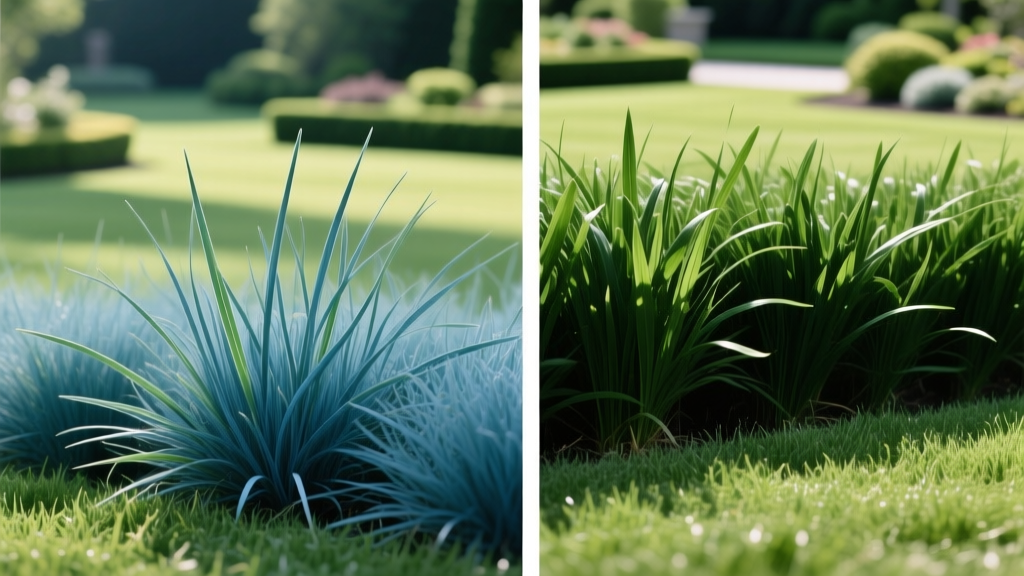
Fescue vs Ryegrass: A Practical Guide to Choosing and Seeding Turf
The Core Differences: Tall Fescue vs Perennial Ryegrass
Choosing between tall fescue and perennial ryegrass dictates your lawn's long-term resilience, water bill, and maintenance schedule. While both are cool-season grasses thriving in USDA Hardiness Zones 3 through 8, their physiological structures demand entirely different establishment and care protocols. Tall fescue (Festuca arundinacea) relies on a deep, extensive root system reaching up to 3 feet, granting it superior drought tolerance and shade adaptability. Perennial ryegrass (Lolium perenne), conversely, features a fibrous, shallow root system but compensates with aggressive lateral growth, unmatched wear tolerance, and the fastest germination rate of any cool-season turfgrass.
According to turfgrass researchers at NC State University's TurfFiles, tall fescue remains the premier choice for transition-zone lawns where summer heat stress decimates shallow-rooted alternatives. However, perennial ryegrass is the industry standard for high-traffic athletic fields and rapid erosion control due to its 5-to-7-day germination window.
Decision Matrix: Which Grass Fits Your Site?
| Criteria | Tall Fescue | Perennial Ryegrass |
|---|---|---|
| Germination Time | 10 to 14 days | 5 to 7 days |
| Seeding Rate | 6 to 8 lbs / 1,000 sq ft | 5 to 7 lbs / 1,000 sq ft |
| Drought Tolerance | Excellent (deep taproots) | Poor to Fair (shallow roots) |
| Traffic/Wear Tolerance | Good (bunch-type growth) | Excellent (aggressive tillering) |
| Shade Tolerance | Good (requires 4+ hrs sun) | Fair (requires 6+ hrs sun) |
| Ideal Mowing Height | 3.0 to 4.0 inches | 2.0 to 3.0 inches |
| Seed Cost (Approx.) | $5.00 to $8.00 per lb | $6.00 to $10.00 per lb |
Warning: Annual vs. Perennial Ryegrass
Do not confuse perennial ryegrass with annual ryegrass (Lolium multiflorum). Annual ryegrass is a cheap, temporary nurse crop used for winter overseeding on dormant warm-season lawns (like Bermuda or Zoysia). It will die off in late spring. If you want a permanent cool-season lawn, ensure the seed tag explicitly states Perennial Ryegrass with a purity of 98% or higher and a weed seed content of 0.0%.
Do not confuse perennial ryegrass with annual ryegrass (Lolium multiflorum). Annual ryegrass is a cheap, temporary nurse crop used for winter overseeding on dormant warm-season lawns (like Bermuda or Zoysia). It will die off in late spring. If you want a permanent cool-season lawn, ensure the seed tag explicitly states Perennial Ryegrass with a purity of 98% or higher and a weed seed content of 0.0%.
Cultivar Selection: What to Buy in 2026
Generic "contractor grade" seed blends often contain outdated forage varieties that succumb quickly to brown patch (Rhizoctonia solani) and gray leaf spot (Pyricularia grisea). Always purchase certified turf-type cultivars bred for residential density and disease resistance.
Top Tall Fescue Cultivars
- Titan Ultra: Exceptional heat tolerance and dark green color; ideal for the lower transition zone.
- Rebel IV: A proven, fine-blended variety with high resistance to net blotch and brown patch.
- Hemi: Features aggressive lateral rhizome growth, a rare trait in tall fescue that aids in self-repair.
Top Perennial Ryegrass Cultivars
- Manhattan 7: The gold standard for wear tolerance; contains beneficial endophytes that deter surface-feeding insects like chinch bugs.
- Apple 3: Outstanding gray leaf spot resistance, critical for humid summer climates.
- Palmer V: Rapid establishment and fine texture, blending well when overseeding into existing Kentucky bluegrass stands.
Step-by-Step Seeding Guide for Maximum Germination
Whether you are establishing a new tall fescue lawn or overseeding a damaged area with perennial ryegrass, precise soil preparation dictates success. Follow this exact protocol for cool-season establishment.
Step 1: Soil Testing and Amendment (Weeks 1-2)
Before buying seed, pull 10 to 15 core samples from the top 4 inches of your soil and send them to a university extension lab (such as Penn State Extension). Both grasses require a pH between 6.0 and 6.8. If your pH is below 6.0, apply pelletized calcitic lime at a rate of 25 to 50 lbs per 1,000 sq ft to raise the baseline. Incorporate a starter fertilizer with a high phosphorus ratio (e.g., 10-18-10 NPK) at a rate of 1 lb of actual phosphorus per 1,000 sq ft to stimulate early root development.
Step 2: Site Preparation and Grading (Week 3)
For new lawns, rototill the soil to a depth of 4 to 6 inches. Remove all debris, rocks larger than 1 inch, and existing weed root systems. Grade the site to ensure a minimum 2% slope away from your home's foundation to prevent water pooling, which will rot fescue crowns. Rake the surface smooth and use a heavy lawn roller filled halfway with water to firm the seedbed, preventing future settling and ankle-rolling divots.
Step 3: Seed Calibration and Sowing (Week 4)
Calibrate your broadcast spreader according to the specific seed bag's settings. Divide your total seed volume in half. Apply the first half walking in horizontal passes, and the second half in vertical passes (a crisscross pattern). This eliminates streaking and bare strips. For tall fescue, aim for 8 lbs per 1,000 sq ft for new lawns; for perennial ryegrass, aim for 6 lbs per 1,000 sq ft.
Step 4: Seed-to-Soil Contact and Mulching
Seed left on the surface will be eaten by birds or dry out. Lightly rake the seeded area with a flexible leaf rake to bury the seed exactly 1/8 to 1/4 inch deep. Apply a thin layer of certified weed-free straw mulch (not hay, which contains weed seeds) at a rate of 1 bale per 1,000 sq ft. The straw should be thin enough that you can still see 50% of the soil beneath it; this retains moisture without suffocating the emerging shoots.
Step 5: The 21-Day Germination Watering Schedule
Cool-season seeds require constant surface moisture to germinate. Program your irrigation controller to water the lawn 3 to 4 times a day for 5 to 10 minutes per zone. The goal is to keep the top 1 inch of soil damp, not saturated. Once the grass reaches 2 inches tall (usually day 14 for ryegrass, day 21 for fescue), transition to watering once daily for 20 minutes to encourage roots to chase the moisture downward.
Ongoing Maintenance and Cost Realities
The long-term financial and labor commitments differ significantly between these two species.
- Mowing: Tall fescue must be kept at 3.0 to 4.0 inches to shade its own shallow crown and prevent crabgrass invasion. Perennial ryegrass can be mowed shorter (2.0 to 3.0 inches), making it preferable for homeowners who want a manicured, golf-course aesthetic.
- Fertilization: Both grasses require 3 to 4 lbs of nitrogen per 1,000 sq ft annually. However, perennial ryegrass demands more frequent, lighter applications (every 4 weeks) to prevent rapid, weak flushes of growth that invite disease. Tall fescue handles slow-release nitrogen applications (every 6 to 8 weeks) much better.
- Aeration: Because tall fescue is a bunch-type grass that does not spread via rhizomes, it requires annual core aeration and overseeding in the fall to fill in thin spots. Perennial ryegrass tillers aggressively, meaning it recovers from compaction faster and may only need aeration every 2 to 3 years.
Frequently Asked Questions
Can I mix tall fescue and perennial ryegrass seed together?
It is generally not recommended for a primary lawn. Perennial ryegrass germinates in 5 days, while tall fescue takes 14 days. The ryegrass will quickly establish, canopy over the soil, and block sunlight from the slower-germinating fescue seed, resulting in a patchy, ryegrass-dominant lawn that lacks the deep drought tolerance you originally wanted. If mixing, keep ryegrass to less than 10% of the total seed weight by volume as a temporary nurse crop.
Which grass survives dog urine and heavy foot traffic better?
Perennial ryegrass is the clear winner for high-traffic areas and dog runs. Its aggressive tillering habit allows it to recover from physical wear and tear much faster than the bunch-type growth of tall fescue. However, neither grass is immune to the nitrogen burn caused by dog urine; training pets to use a specific mulched area is the only permanent solution.
When is the exact window to plant these grasses?
The optimal planting window for both tall fescue and perennial ryegrass is late summer to early fall, specifically when soil temperatures drop to between 60°F and 70°F. In most northern and transition zones, this falls between August 15th and September 30th. Planting in spring is highly discouraged, as the shallow, immature root systems will be killed by summer heat stress and outcompeted by crabgrass.

