
Grass Types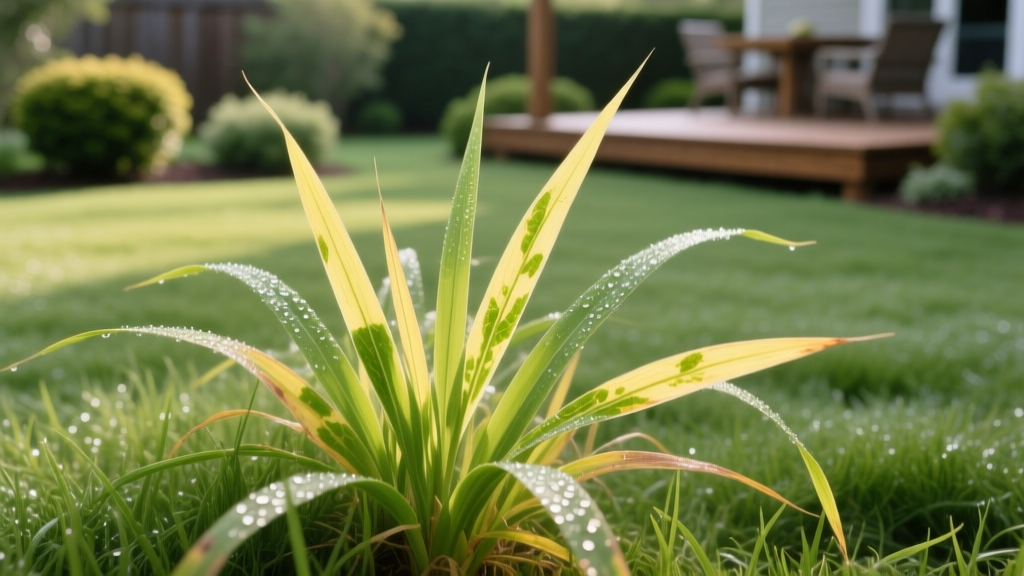
Iron Deficiency in St. Augustine Grass: Signs and Fixes
Diagnosing Iron Chlorosis vs. Nitrogen Deficiency
St. Augustine grass (Stenotaphrum secundatum) is highly susceptible to iron chlorosis, a condition where the turf cannot synthesize chlorophyll due to a lack of available iron. However, homeowners frequently misdiagnose this micronutrient deficiency as a nitrogen shortage, leading to the application of high-nitrogen fertilizers that only exacerbate the underlying problem.
The Visual Test: Iron is an immobile nutrient in plants. Because the grass cannot translocate iron from older tissue to new growth, iron deficiency always manifests on the newest, youngest leaves at the top of the canopy. The tissue between the veins turns bright yellow or white, while the veins themselves remain distinctly green (interveinal chlorosis). Conversely, nitrogen is a mobile nutrient; a nitrogen deficiency causes uniform yellowing that starts on the older, lower leaves first.
If your St. Augustine lawn is pushing pale, yellow-veined new growth in the spring or early summer, you are dealing with iron lockout, not a nitrogen deficit. According to turfgrass researchers at the University of Florida IFAS Extension, applying excess nitrogen to an iron-deficient lawn forces rapid, weak cellular expansion that further dilutes the plant's internal iron concentration, worsening the chlorosis.
The Root Causes: Why St. Augustine Locks Out Iron
Iron is abundant in most soils, but it frequently exists in forms that St. Augustine grass cannot absorb. The root causes of iron deficiency are almost always chemical, not quantitative.
1. The Soil pH Threshold
St. Augustine grass thrives in a soil pH range of 5.0 to 8.5. However, as soil pH climbs above 7.0 (alkaline), soluble iron (Fe2+) rapidly oxidizes into insoluble iron (Fe3+) and precipitates as iron hydroxide. In soils with a pH above 7.5, iron becomes virtually unavailable to the root system, regardless of how much iron is physically present in the dirt.
2. Phosphorus Lockout
Heavy applications of phosphorus-rich fertilizers (like those used for fall root-building or cheap synthetic blends) cause phosphate ions to bind with iron ions in the soil solution. This creates iron phosphate, an insoluble compound that the grass roots cannot absorb. If your soil test shows excessive phosphorus levels, iron chlorosis is an expected secondary symptom.
3. Soil Compaction and Poor Drainage
Iron uptake requires active, healthy root respiration. Compacted, waterlogged soils become anaerobic, suffocating the root system and halting the active transport mechanisms required to pull micronutrients into the plant.
Selecting the Right Iron Chelate (The EDDHA Advantage)
When treating high-pH soils, the type of iron supplement you choose dictates your success rate. Raw iron sulfate is useless in alkaline soils because it immediately oxidizes and locks up. You must use a chelated iron—a molecule where the iron is bound to an organic ring that protects it from soil chemistry until the plant absorbs it.
Not all chelates are created equal. As noted in micronutrient research by UF/IFAS soil scientists, the chelating agent determines the maximum pH at which the iron remains available.
| Chelate Type | Max Effective pH | Best Use Case | Relative Cost |
|---|---|---|---|
| Fe-EDTA | 6.0 - 6.5 | Acidic soils; hydroponics | Low |
| Fe-DTPA | Up to 7.0 | Neutral soils; mild alkalinity | Medium |
| Fe-EDDHA | Up to 9.0 | Alkaline soils; high pH lockout | High |
If your soil pH is 7.5 or higher, buying standard Fe-EDTA liquid iron is a waste of money. You must source a product specifically formulated with Fe-EDDHA (often identifiable by its dark red or black color when mixed in water) to guarantee the iron remains bioavailable in the alkaline environment.
Step-by-Step Foliar Treatment Protocol
Because soil applications of iron can take weeks to show results and are subject to pH lockout, foliar spraying is the fastest way to green up St. Augustine grass. The leaves can absorb chelated iron directly, bypassing the soil chemistry entirely.
- Test and Mix: Purchase a high-quality Fe-EDDHA or Fe-DTPA liquid iron product (e.g., LawnStar Chelated Liquid Iron or Southern Ag Chelated Iron). Mix at a rate of 3 to 5 fluid ounces per 1,000 square feet, diluted in 1 to 2 gallons of water.
- Add a Surfactant: St. Augustine grass leaves have a thick, waxy cuticle. You must add a non-ionic surfactant (0.5% v/v, roughly 1 teaspoon per gallon) to break the surface tension and allow the iron solution to spread evenly across the leaf blade rather than beading up and rolling off.
- Timing the Application: Spray in the early morning or late evening. Never apply foliar iron when ambient temperatures exceed 85°F (29°C) or during peak sunlight, as the combination of liquid and solar radiation will cause severe phytotoxicity (leaf burn).
- Post-Application Watering: Do not irrigate the lawn for at least 24 hours after spraying. The foliage needs time to absorb the micronutrients. Expect visible greening within 48 to 72 hours.
Warning on Concrete and Hardscapes: Chelated iron solutions will permanently stain concrete driveways, pavers, and pool decks with deep rust-colored spots. Always rinse your sprayer on the grass, and avoid overlapping spray patterns onto hardscape edges.
Long-Term Soil Remediation Strategy
Foliar sprays are a band-aid. To permanently resolve iron deficiency in St. Augustine grass, you must alter the soil environment to restore natural root uptake.
Lowering Soil pH with Elemental Sulfur
If your soil test confirms a pH above 7.2, apply elemental sulfur (not aluminum sulfate, which can lead to heavy metal toxicity). Elemental sulfur relies on soil bacteria (Thiobacillus) to oxidize into sulfuric acid, gradually lowering the pH. Apply at a rate of 1 to 1.5 lbs per 1,000 square feet in the spring and fall. This biological process takes 3 to 6 months to reflect on a soil test, so patience is required.
Adjusting the Fertilizer Regimen
Transition to a fertilizer with a low or zero phosphorus middle-number (e.g., 15-0-15 or 16-4-8) unless a soil test explicitly indicates a phosphorus deficiency. Utilizing slow-release nitrogen sources, like methylene urea or sulfur-coated urea, prevents the rapid growth flushes that dilute internal iron stores. For comprehensive cultural practices and mowing heights that support deep root growth, refer to the NC State TurfFiles St. Augustinegrass guide.
By combining immediate Fe-EDDHA foliar applications with a long-term elemental sulfur and low-phosphorus fertility program, you can eliminate iron chlorosis and maintain a dense, dark-green St. Augustine lawn year-round.

