Grass Types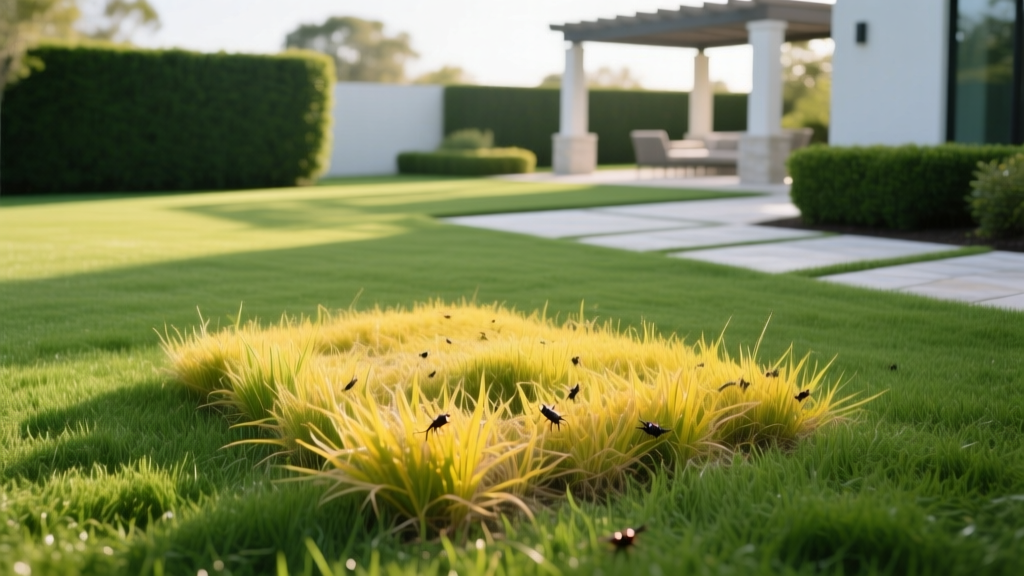
How to Fix Yellowing in St. Augustine Grass: Rescue Guide
St. Augustine grass (Stenotaphrum secundatum) is a dominant warm-season turf in coastal and southern regions, prized for its shade tolerance and dense growth habit. However, it is highly susceptible to rhizosphere stress. When homeowners notice yellowing in St. Augustine grass, it is rarely a simple watering issue. Yellowing is a primary symptom of nutrient lockout, fungal root decay, or severe pest pressure. Applying a generic lawn fertilizer without diagnosing the specific failure mode will waste money and accelerate turf decline.
This diagnostic guide isolates the exact cause of your turf discoloration and provides targeted, chemical-specific rescue protocols to restore deep green color and root viability.
The Diagnostic Matrix: Pinpointing the Cause
Before purchasing amendments, map your lawn's symptoms to the matrix below. St. Augustine grass exhibits distinct visual cues depending on whether the stressor is chemical, biological, or environmental.
| Visual Symptom | Leaf/Root Clue | Primary Suspect | Immediate Field Test |
|---|---|---|---|
| Yellow leaves with green veins | Newest leaves affected first; roots are white and firm | Iron Chlorosis (High pH Lockout) | Test soil pH; look for readings above 7.0 |
| Uniform pale green to yellow | Older leaves yellow first; thinning canopy | Nitrogen Deficiency | Review recent fertilization; check for leaching in sandy soils |
| Yellowing patches with black roots | Stolons pull up easily; roots are short, black, and brittle | Take-All Root Rot (TARR) | Dig up a 4x4 inch plug and inspect the root mass |
| Yellow halo around bite marks | Notched leaf blades; bugs visible at soil line | Chinch Bug Infestation | Use a coffee can filled with water to force bugs to the surface |
Nutrient Lockout: Iron Chlorosis vs. Nitrogen Starvation
The most common cause of yellowing in St. Augustine grass is iron chlorosis, heavily driven by soil alkalinity. St. Augustine thrives in a soil pH between 5.0 and 6.5. When pH exceeds 7.0, iron becomes chemically bound in the soil and unavailable to the plant, even if iron is physically present.
The Iron Chlorosis Rescue (High pH Fix)
If your soil test confirms a pH above 7.0 and your grass shows interveinal chlorosis (yellow tissue with distinct green veins), standard iron sulfate or Fe-EDTA products will fail. Fe-EDTA oxidizes and becomes useless in soils with a pH above 6.5.
The Rescue Fix: You must apply Fe-EDDHA (Ethylene diamine-N,N'-bis(2-hydroxyphenylacetic acid)). This specific chelate remains stable and bioavailable in soils with a pH up to 9.0.
- Product Recommendation: Sequestrene 138 or Miller's Ferriplus.
- Application Rate: 2 to 4 ounces of product per 1,000 square feet.
- Method: Dissolve in 2 gallons of water and apply as a foliar spray for 48-hour greening, followed by a soil drench for long-term uptake. Do not water in immediately; allow the foliage to absorb the solution.
- Long-term Correction: Apply elemental sulfur at 1 to 2 lbs per 1,000 sq ft in the fall to gradually lower soil pH.
The Nitrogen Deficiency Rescue
If the yellowing is uniform across the entire blade and older leaves are affected first, your turf is nitrogen-starved. This frequently occurs in sandy soils after heavy spring rains leach mobile nutrients.
The Rescue Fix: Apply a fast-acting nitrogen source to halt the decline, followed by a slow-release formulation.
- Immediate Fix: Apply Urea (46-0-0) at a rate of 0.25 lbs of actual nitrogen per 1,000 sq ft. Water in lightly to prevent foliar burn.
- Sustained Recovery: Follow up 7 days later with Methylene Urea or Milorganite (slow-release organic) to provide a steady 8-week nutrient drip without triggering excessive top growth that outpaces root development.
Fungal Nightmares: Take-All Root Rot (TARR)
Take-All Root Rot, caused by the soil-borne fungus Gaeumannomyces graminis, is the most destructive pathogen affecting St. Augustine grass in the Gulf Coast and Southeast. According to the Texas A&M AgriLife Extension, TARR thrives in soils with a pH above 6.5 and is exacerbated by excessive thatch and frequent, shallow irrigation.
Unlike nutrient deficiencies, TARR destroys the root system. If you pull on a yellowing stolon and it snaps off easily, revealing black, rotted roots, you are dealing with TARR. Fertilizer will not cure this; it will only feed the fungus.
Expert Insight: Fungicides alone will not cure TARR if the soil pH remains alkaline. The pathogen is suppressed by acidic environments. Cultural acidification of the rhizosphere is mandatory for long-term control.
The TARR Rescue Protocol:
- Fungicide Application: Apply Azoxystrobin (active ingredient in Syngenta Heritage G or Scotts DiseaseEx). Apply at the curative rate of 4.0 lbs per 1,000 sq ft. Water in with exactly 0.25 inches of irrigation to move the chemical into the root zone.
- Rhizosphere Acidification: Topdress the affected areas with a 1/4-inch layer of Sphagnum Peat Moss. Research from the University of Florida IFAS demonstrates that peat moss topdressing lowers the localized soil pH, creating an environment hostile to G. graminis while promoting new root initiation.
- Irrigation Audit: Immediately switch to deep, infrequent watering. Water only when the grass shows footprinting (wilting), applying 0.5 to 0.75 inches per cycle.
Pest Pressure: Chinch Bugs and Herbicide Burn
The Southern Chinch Bug (Blissus insularis) injects a salivary toxin into St. Augustine stolons as it feeds, blocking the plant's vascular system. This results in yellowing that rapidly turns brown and dies, typically starting in the hottest, driest areas of the lawn near driveways or sidewalks.
The Pest Rescue Fix: Chinch bugs have developed severe resistance to pyrethroids like Bifenthrin. To achieve a rescue kill, you must use a neonicotinoid or a rotation product.
- Primary Treatment: Apply Clothianidin (Arena 50 WDG) at 0.3 to 0.5 oz per 1,000 sq ft. This systemic insecticide is absorbed by the roots and kills bugs as they feed on the stolons.
- Knockdown Agent: If the infestation is severe and immediate knockdown is required, tank-mix with Imidacloprid (Merit 0.5 G) or a rotation chemical like Sulfoxaflor to prevent further resistance buildup.
Herbicide Burn Warning: St. Augustine is highly sensitive to certain broadleaf weed killers. If yellowing appeared 3 to 5 days after applying an herbicide containing 2,4-D, Dicamba, or MSMA, the turf is suffering from chemical phytotoxicity. There is no chemical reversal for this. Apply 1 lb of nitrogen per 1,000 sq ft and irrigate heavily to flush the chemical profile and push new, unaffected growth.
The 14-Day St. Augustine Rescue Protocol
If your lawn is rapidly declining and you have identified the stressor, follow this strict 14-day timeline to force recovery without overwhelming the compromised root system.
Day 1: Diagnosis and Chemical Intervention
Perform the coffee can test for chinch bugs and dig a soil plug to inspect roots for TARR. Apply the targeted curative product (Fe-EDDHA for chlorosis, Azoxystrobin for TARR, or Clothianidin for pests). Do not mow for 48 hours to allow maximum foliar and soil absorption.
Day 3: Hydration and Flushing
Apply exactly 0.5 inches of water. If treating for TARR, apply the Sphagnum peat moss topdressing immediately after watering while the soil is moist. This ensures the peat makes direct contact with the soil surface and stolons.
Day 7: The Nitrogen Push
Once the initial chemical or biological stressor is neutralized, the grass needs energy to rebuild tissue. Apply a slow-release nitrogen source (like Milorganite or XCU) at 0.75 lbs of N per 1,000 sq ft. Avoid high-nitrogen synthetic blends at this stage, as forcing rapid, weak top growth will collapse a recovering root system.
Day 14: Mowing and Thatch Management
Resume mowing, but raise the deck to the highest setting (3.5 to 4.0 inches). St. Augustine relies on above-ground stolons for lateral spread; scalping the lawn removes the photosynthetic factory required for recovery. If thatch exceeds 0.5 inches, schedule a core aeration for the following month once the turf has re-established its green canopy.