Grass Types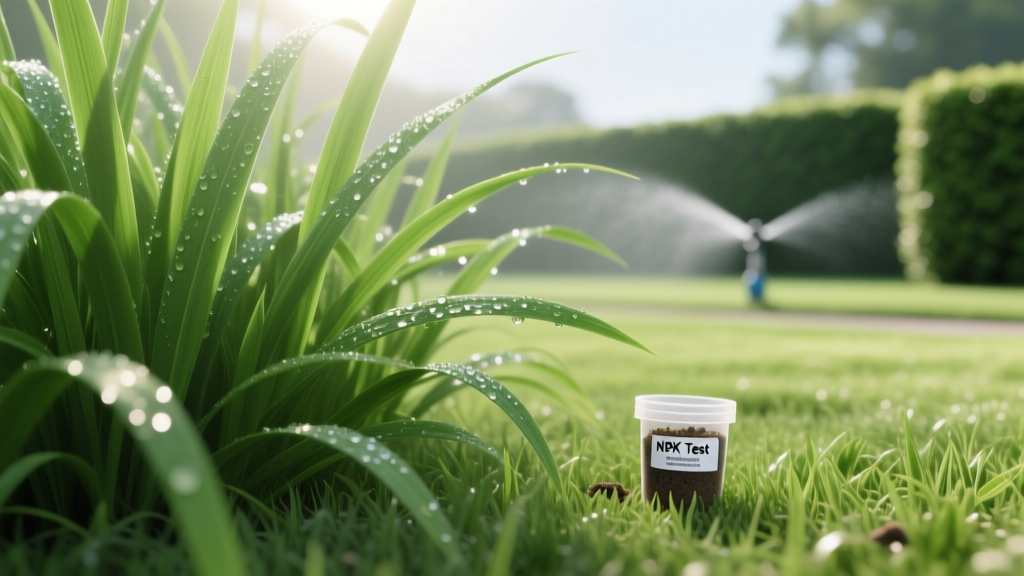
What Makes a Good Fertilizer for St Augustine Grass? NPK Guide
St. Augustinegrass (Stenotaphrum secundatum) dominates coastal and southern lawns due to its exceptional salt tolerance and aggressive stolon growth. However, its unique physiology demands a highly specific nutritional approach. Applying the wrong nutrient balance—particularly excess phosphorus or late-season nitrogen—rapidly triggers thatch accumulation, iron chlorosis, and devastating fungal outbreaks like brown patch.
Finding a good fertilizer for St Augustine grass requires moving beyond generic 'weed and feed' products. You must match the Nitrogen-Phosphorus-Potassium (NPK) ratio to your specific soil profile, account for micronutrient lockouts in high-pH coastal soils, and strictly time applications to the grass's active growth windows.
The Ideal NPK Ratio for St. Augustine Grass
St. Augustine requires 2 to 4 pounds of actual Nitrogen per 1,000 square feet annually, depending on your soil type and clipping management. But the secondary and tertiary numbers in the NPK ratio are where most homeowners make critical errors.
Nitrogen (N): The Growth Engine
Nitrogen drives the vigorous stolon (runner) expansion and deep green color characteristic of healthy St. Augustine. For optimal results, utilize fertilizers with slow-release nitrogen sources like sulfur-coated urea (SCU) or methylene urea. These prevent the rapid flush of growth that weakens cell walls and invites Rhizoctonia solani (brown patch fungus).
Phosphorus (P): The Hidden Threat
Established St. Augustine lawns rarely need phosphorus. In fact, many southern states have restricted phosphorus in turf fertilizers due to runoff concerns. Unless a recent soil test explicitly shows a phosphorus deficiency, the middle number on your fertilizer bag should be 0. Excess phosphorus competes with iron and zinc uptake, directly causing micronutrient deficiencies.
Potassium (K): The Stress Shield
Potassium is non-negotiable for St. Augustine. It regulates stomatal opening, improving drought resistance and winter hardiness. A good fertilizer for St Augustine grass will feature a Potassium level that is at least 30% to 50% of the Nitrogen level (e.g., a 15-0-15 or 32-0-10 ratio). Avoid fertilizers relying entirely on muriate of potash (KCl) in high-salt coastal zones, as the added chloride can compound soil salinity issues; opt for sulfate of potash (K2SO4) instead.
Expert Tip: Calculate Your Exact Application Rate
To apply exactly 1 pound of Nitrogen per 1,000 square feet, divide 100 by the first number on the fertilizer bag. For a 32-0-10 product, calculate 100 ÷ 32 = 3.12 pounds of product per 1,000 sq ft. Set your rotary spreader to match this exact output to prevent salt burn.
To apply exactly 1 pound of Nitrogen per 1,000 square feet, divide 100 by the first number on the fertilizer bag. For a 32-0-10 product, calculate 100 ÷ 32 = 3.12 pounds of product per 1,000 sq ft. Set your rotary spreader to match this exact output to prevent salt burn.
Top Rated Fertilizer Formulations for St. Augustine
Based on current 2026 agronomic formulations and regional availability, these three products consistently deliver the correct nutrient profiles for St. Augustinegrass.
| Product Name | NPK Ratio | Best Use Case | Est. Price (2026) |
|---|---|---|---|
| Scotts Turf Builder Southern Lawn Food | 32-0-10 | Primary spring/summer feeding; contains 2% iron for color. | $38 - $45 (10k sq ft) |
| Milorganite Organic Nitrogen Fertilizer | 5-2-0 | Sandy soils; low burn risk; excellent for microbial activity. | $22 - $26 (2.5k sq ft) |
| Lesco Professional St. Augustine 15-0-15 | 15-0-15 | High-stress areas; 1:1 N-to-K ratio for maximum drought/cold tolerance. | $45 - $55 (12k sq ft) |
The Hidden Requirement: Iron and Micronutrients
St. Augustinegrass prefers a soil pH between 6.0 and 6.5. However, many coastal and southern lawns are situated on calcareous soils with a pH of 7.5 or higher. At this alkaline level, iron becomes chemically locked in the soil, unavailable to the grass roots. This manifests as iron chlorosis—distinct yellowing of the leaf blades while the veins remain green.
If your soil pH is above 7.0, applying standard granular iron sulfate is largely ineffective. The iron will immediately oxidize and lock up in the alkaline soil. Instead, you must use chelated liquid iron (such as Southern Ag Chelated Liquid Iron 5% Fe or Fe-EDDHA formulations). The chelation process wraps the iron molecule in an organic ring, protecting it from soil reactions and allowing the St. Augustine to absorb it directly through the foliar tissue.
- Dosage: Apply 2 to 3 ounces of chelated liquid iron per 1,000 square feet, diluted in 1 gallon of water.
- Timing: Spray in the early morning when temperatures are below 85°F to prevent foliar burn.
- Adjuvant: Add a non-ionic surfactant (1/2 teaspoon per gallon) to break the surface tension of the waxy St. Augustine leaf cuticle.
Seasonal Application Calendar & Rates
Timing is just as critical as the nutrient profile. According to turfgrass extension guidelines from the Clemson Home and Garden Information Center, St. Augustine should never be fertilized while dormant or during environmental stress.
- Early Spring (April): Wait until the grass has fully greened up and you have mowed it at least twice. Apply 1 lb of Nitrogen per 1,000 sq ft using a slow-release 32-0-10 formulation.
- Early Summer (June): Apply a second dose of 1 lb Nitrogen per 1,000 sq ft. If soil tests indicate low potassium, switch to a 15-0-15 blend to prepare the stolons for summer heat stress.
- Mid-Summer (August): Do not apply Nitrogen. High nitrogen combined with late-summer humidity creates the perfect environment for brown patch fungus. If the lawn looks pale, apply liquid chelated iron only.
- Early Fall (September/October): Apply a 'winterizer' fertilizer high in Potassium (e.g., 0-0-20 or 15-0-15) at a rate of 1 lb Potassium per 1,000 sq ft. This increases carbohydrate storage in the roots for winter survival.
Warning: The Late-Summer Nitrogen Trap
Applying high-nitrogen fertilizers after August 15th in most southern zones forces the St. Augustine to produce tender, succulent growth just as nighttime temperatures drop and dew persists. This specific microclimate triggers severe Rhizoctonia (brown patch) infections that can destroy large sections of the lawn before winter dormancy.
Applying high-nitrogen fertilizers after August 15th in most southern zones forces the St. Augustine to produce tender, succulent growth just as nighttime temperatures drop and dew persists. This specific microclimate triggers severe Rhizoctonia (brown patch) infections that can destroy large sections of the lawn before winter dormancy.
Common Fertilization Mistakes & Troubleshooting
1. Accelerated Thatch Buildup
St. Augustine naturally produces thick thatch due to its robust stolon network. Over-applying nitrogen (exceeding 4 lbs per 1,000 sq ft annually) forces the grass to produce biomass faster than soil microbes can decompose it. If your thatch layer exceeds 0.5 inches, water and air cannot penetrate to the root zone. Fix: Switch to organic, slow-release nitrogen sources like Milorganite, which feed soil microbes and accelerate thatch decomposition, and schedule core aeration in late spring.
2. Centipede Grass Decline (Misidentification)
Many southern homeowners mistake Centipede grass for St. Augustine, or have lawns where both compete. Centipede grass is highly sensitive to phosphorus and excess nitrogen, which causes 'Centipede decline' (a fatal yellowing and dieback). Always confirm your grass species via a local university extension guide before applying high-nitrogen St. Augustine formulations.
3. Fertilizer Burn on Leaf Tips
If the tips of your St. Augustine blades turn brown and crispy 24 to 48 hours after application, you have experienced salt burn. This occurs when quick-release synthetic fertilizers (like standard urea) are applied to dry soil and not immediately watered in. Fix: Always irrigate the lawn with 0.25 inches of water immediately after applying granular synthetic fertilizers to wash the salts off the leaf tissue and into the soil profile.
Soil Testing: The Non-Negotiable First Step
You cannot accurately manage St. Augustine nutrition without a baseline soil test. A standard University of Florida IFAS extension soil test costs roughly $15 to $25 and will reveal your exact pH, phosphorus levels, and cation exchange capacity (CEC). Sandy soils with low CEC require frequent, smaller fertilizer applications (spoon-feeding), whereas clay-loam soils can handle larger, less frequent applications. Relying on guesswork rather than soil chemistry is the primary reason St. Augustine lawns fail to thrive despite heavy fertilizer investments.