
Grass Types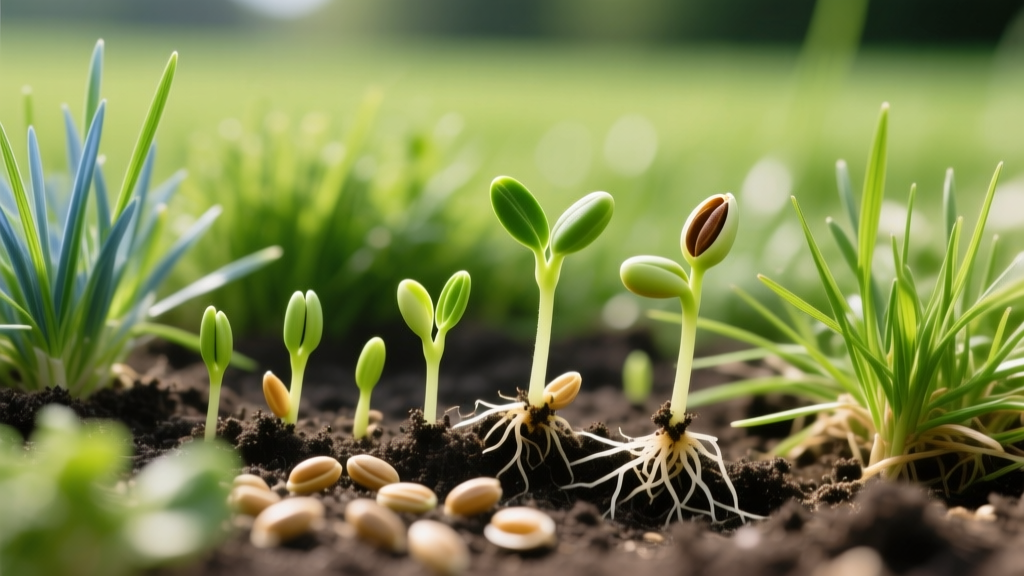
Grass Seed After 2 Weeks: Germination Stages and Troubleshooting Guide
The 14-day mark is a critical psychological and biological milestone for any new lawn. When evaluating grass seed after 2 weeks, homeowners often panic if they see patchy growth, while others mistakenly assume their lawn is fully established. In reality, day 14 represents a transitional phase where the initial germination window closes for fast-growing species, but remains wide open for slower-maturing cultivars. Understanding exactly what your lawn should look like—and how to pivot your care routine at this exact juncture—is the difference between a dense, drought-tolerant turf and a thin, weed-prone disappointment.
The 14-Day Mark: Where Should Your Grass Seed Be?
Germination is not a uniform event; it is entirely dictated by seed genetics and soil thermodynamics. According to turfgrass research from the University of Minnesota Extension, soil temperature and moisture consistency dictate the metabolic awakening of the seed embryo. If you planted a mix, you will see staggered emergence.
| Grass Species / Cultivar | Expected Germination Window | Typical Status at Day 14 |
|---|---|---|
| Perennial Ryegrass | 5-10 days | 1.5 to 2.5 inches tall; developing secondary tillers. |
| Tall Fescue (Turf-type) | 7-14 days | 0.5 to 1.5 inches tall; establishing deep radicle roots. |
| Kentucky Bluegrass (e.g., 'Midnight') | 14-28 days | Swelling embryos or very fine, thread-like initial sprouts. |
| Bermudagrass (Seeded) | 10-21 days | Sprouting if soil is consistently >70°F; dormant if cooler. |
| Fine Fescue (Creeping Red) | 7-14 days | Thin, needle-like blades emerging; highly sensitive to heat. |
If you seeded a pure Kentucky Bluegrass (KBG) lawn and see bare dirt at day 14, do not reseed. KBG requires up to 28 days to break dormancy, provided the soil temperature remains between 50°F and 65°F. Conversely, if your Perennial Ryegrass hasn't sprouted by day 14, you have a systemic failure in your seedbed or watering protocol.
Visual Diagnostics: Interpreting Your Lawn at Day 14
At two weeks, a healthy lawn should exhibit a distinct 'fuzz' of green when viewed from a distance, even if it looks sparse up close. The root structure is currently the priority; the plant is expending 80% of its energy pushing the radicle (primary root) into the topsoil to anchor itself before pushing significant top growth.
⚠️ Warning: The 'Fuzz' vs. 'Fungus' Mistake
Homeowners often mistake early morning dew clinging to the microscopic root hairs of new seedlings for fungal mycelium. True Pythium blight (a common seedling disease) will present as distinct, water-soaked, grayish-green circular patches that turn brown and mat down by midday. If the white fuzz disappears by noon, it is just dew and root hairs—a sign of excellent health.
Adjusting Your Care Routine at Day 14
The most common mistake at the two-week mark is maintaining the exact same watering schedule used during week one. As the radicle deepens, shallow, frequent watering becomes detrimental, encouraging shallow root growth and inviting fungal pathogens.
The Watering Taper Strategy
Your goal is to train the roots to chase moisture deeper into the soil profile. Transition your irrigation as follows:
- Days 1-14 (Establishment): 3 to 4 light waterings daily, applying roughly 1/8 inch per session to keep the top 1/2 inch of soil perpetually moist.
- Days 15-28 (Transition): Reduce frequency to 2 times daily (morning and early afternoon), but increase the volume to 1/4 inch per session. This pushes water 1 to 1.5 inches deep.
- Days 29+ (Deep Rooting): Shift to once-daily or every-other-day watering, applying 1/2 inch to encourage roots to penetrate 3+ inches into the subsoil.
Fertilizer and Herbicide Restrictions
If you applied a high-phosphorus starter fertilizer (like a 24-25-4 NPK ratio) at the time of seeding, the seedling has sufficient nutrients for the first 4 to 6 weeks. Do not apply additional nitrogen now; it will force rapid, weak top growth at the expense of root development. Furthermore, the Royal Horticultural Society (RHS) strictly advises against applying any pre-emergent or broadleaf herbicides until the new turf has been mowed at least three to four times. Chemical applications at day 14 will severely stunt or kill the fragile seedlings.
Troubleshooting: Why Isn't My Grass Seed Germinating After 2 Weeks?
If your fast-germinating species (Ryegrass, Tall Fescue) have failed to emerge after 14 days, execute this diagnostic checklist to identify the failure mode:
- Soil Temperature Mismatch: Air temperature is irrelevant to seed germination; soil temperature dictates metabolic activity. Use a 6-inch soil probe thermometer. If your soil is below 50°F, cool-season seeds will remain dormant. If it is above 85°F, KBG and Fine Fescues will experience heat-induced dormancy.
- Seed Desiccation (The Point of No Return): Once a seed absorbs water and cracks its hull (imbibition), it must never dry out. If you missed a watering cycle on day 6 and the topsoil baked in the sun for even four hours, the fragile radical likely desiccated and died. The seed is now dead, even if it looks intact.
- Buried Too Deep: Grass seed requires light to trigger germination hormones. If you raked the seed under more than 1/4 inch of soil, or if heavy rain washed topsoil over the seed bed, the seedlings cannot reach the surface. Fix this by lightly scarifying the surface with a bamboo rake.
- Pre-Emergent Residue: If you or a lawn service applied a pre-emergent crabgrass preventer (like Prodiamine or Dithiopyr) within the last 4 months, the chemical barrier will inhibit the cell division required for grass seed roots to form.
- Bird and Rodent Foraging: Inspect the bare patches closely. If you see tiny, V-shaped scratch marks in the soil, birds or rodents have eaten the seed. You will need to reseed these specific areas and cover them with a germination blanket.
Preparing for the First Mow
For fast-germinating grasses, day 14 often coincides with the need for the first mow. Never mow based on a calendar schedule; mow based on height. The golden rule of turfgrass management is the 'Rule of One-Third': never remove more than 1/3 of the total blade height in a single pass.
Before starting the mower, perform the Tug Test. Grab a handful of the new grass blades and pull gently upward. If the seedlings pull out of the soil easily, the roots are not anchored enough to withstand the lateral shear force of a mower blade. Wait another 3 to 5 days. If they resist and the soil holds firm, you are ready to mow. Set your deck to 2.5 or 3 inches, ensure your blade is razor-sharp to avoid tearing the tender tissue, and mow when the grass is completely dry.
Frequently Asked Questions
Can I walk on grass seed after 2 weeks?
No. At 14 days, the root system is incredibly shallow and fragile. Foot traffic will compact the moist topsoil, crush the developing crowns, and snap the radicle roots. Limit all foot traffic to the absolute minimum required for watering and equipment maintenance until after the third mow.
Should I add more seed if it looks patchy at 2 weeks?
Do not overseed a 14-day-old lawn. The existing seedlings are highly susceptible to competition. Furthermore, the act of spreading new seed and raking the soil will uproot the fragile 2-week-old seedlings. Wait until the lawn has been mowed three times, evaluate the true density, and perform a targeted overseeding in the following season if necessary.

