Grass Types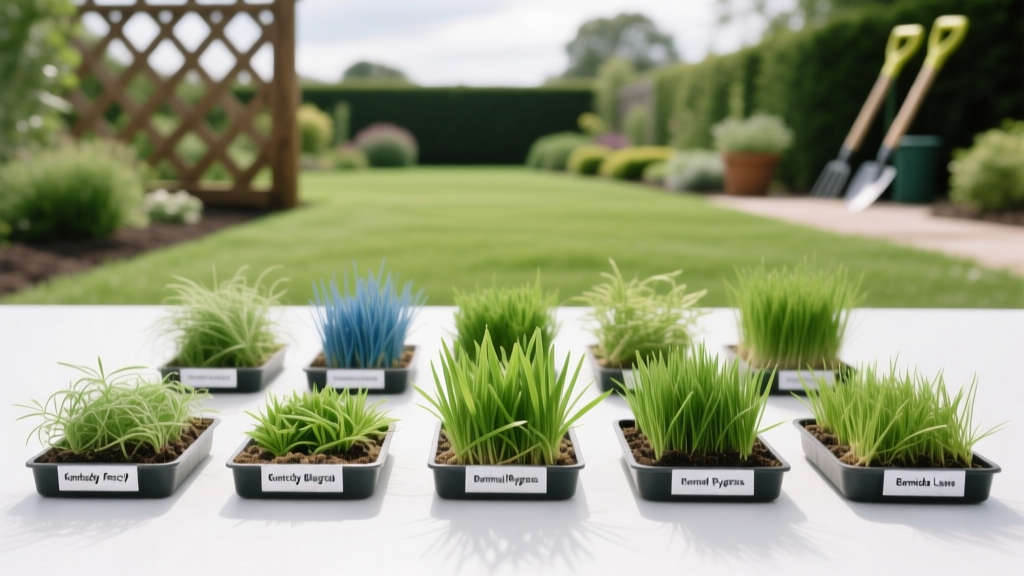
Grass Seed Fertilizer Guide: Best NPK Ratios for New Lawns
Establishing a new lawn from seed requires a fundamentally different nutritional approach than maintaining an existing turf. Standard maintenance fertilizers prioritize nitrogen for blade growth, but germinating seeds and young seedlings demand high phosphorus to develop robust root systems before environmental stress sets in. Using the wrong grass seed fertilizer is the primary reason new lawns thin out, succumb to drought, or fail to germinate uniformly.
This guide breaks down the exact NPK (Nitrogen-Phosphorus-Potassium) ratios required for seed establishment, the chemical forms of nitrogen that prevent seedling burn, and the precise application timelines used by professional turf managers.
The Science of Starter Fertilizers: Why Phosphorus is Non-Negotiable
When grass seed imbibes water and breaks dormancy, its first biological imperative is not to push green shoots upward, but to anchor downward. Phosphorus (the 'P' in NPK) is the catalyst for ATP (adenosine triphosphate) production, which fuels cellular division in the root meristem. Without readily available phosphorus in the top 1 to 2 inches of soil, the radicle (embryonic root) stalls, leaving the seedling vulnerable to desiccation.
According to turfgrass research from the University of Minnesota Extension, starter fertilizers should contain a minimum of 1.0 lb of phosphorus pentoxide (P2O5) per 1,000 square feet to ensure adequate root establishment. However, because phosphorus is relatively immobile in soil, it must be incorporated into the top inch of the soil profile during seeding, not merely broadcast over the top of existing thatch.
Regulatory Warning: Many states and municipalities have banned or restricted the use of phosphorus in lawn fertilizers to prevent aquatic runoff and algae blooms. However, nearly all jurisdictions include a specific exemption for 'starter fertilizers' used when establishing new lawns or overseeding. Always keep your soil test results or seed purchase receipts on hand to prove compliance if questioned by local environmental authorities.
Decoding the Ideal NPK Ratio for Grass Seed
The optimal grass seed fertilizer ratio shifts depending on your baseline soil test and the specific grass species you are planting. Cool-season grasses (Kentucky bluegrass, tall fescue) generally require higher phosphorus bursts than warm-season grasses (bermudagrass, zoysia) during establishment.
| Grass Species | Ideal NPK Ratio | Target Application (per 1,000 sq ft) | Soil Condition Requirement |
|---|---|---|---|
| Kentucky Bluegrass | 24-25-4 or 18-24-12 | 1.0 lb Nitrogen / 1.0 lb P2O5 | Loam to Clay, pH 6.0-7.0 |
| Tall Fescue | 18-24-12 or 10-18-10 | 0.8 lb Nitrogen / 1.0 lb P2O5 | Adaptable, pH 5.5-7.5 |
| Bermudagrass (Seed) | 15-15-15 or 10-20-10 | 0.5 lb Nitrogen / 0.5 lb P2O5 | Sandy Loam, pH 6.0-6.5 |
| Fine Fescue | 10-18-10 | 0.5 lb Nitrogen / 0.9 lb P2O5 | Well-drained, slightly acidic |
If you have not conducted a soil test, a balanced 18-24-12 starter fertilizer is the safest, most universally effective formulation for cool-season grasses. For warm-season grasses seeded in late spring, a 15-15-15 formulation prevents excessive nitrogen from pushing blade growth before the deep roots can support it.
Quick-Release vs. Slow-Release Nitrogen
New seedlings are highly susceptible to fertilizer burn (osmotic stress caused by high salt indices). Therefore, the nitrogen source in your grass seed fertilizer matters as much as the ratio.
- Quick-Release (Ammonium Sulfate, Urea): Provides immediate nutrition but carries a high salt index. If used, it should comprise no more than 30% of the total nitrogen in a starter blend, and must be watered in immediately with at least 0.25 inches of irrigation.
- Slow-Release (Methylene Urea, Polymer-Coated Urea): The ideal primary nitrogen source for seeding. It feeds the seedling gradually over 4 to 6 weeks, matching the natural growth curve of the developing root system without risking salt burn.
The Mesotrione Advantage: Weed Control During Seeding
One of the most significant challenges when planting grass seed is crabgrass and broadleaf weed competition. Traditional pre-emergent herbicides (like prodiamine or dithiopyr) prevent weed seeds from germinating, but they will also kill your new grass seed.
Professional turf managers solve this by using starter fertilizers that include Mesotrione (the active ingredient in Tenacity). Mesotrione is a unique HPPD-inhibitor herbicide that is safe to apply at the exact time of seeding for Kentucky bluegrass, tall fescue, and perennial ryegrass. It bleaches emerging weeds white, stopping their photosynthesis, while leaving your new grass seed unharmed.
Critical Exception: Do NOT use mesotrione-based starter fertilizers if you are seeding Fine Fescue, Bermudagrass, or Zoysiagrass. Mesotrione will cause severe injury or death to these specific species during germination. Always verify the herbicide label against your exact seed cultivar.
Step-by-Step Application Timeline
Timing your grass seed fertilizer application correctly ensures nutrients are available exactly when the seed's internal endosperm reserves are depleted.
- Day 0 (Seeding Day): Apply your starter fertilizer (e.g., 18-24-12) at the recommended rate. Rake it lightly into the top 0.5 inches of soil before broadcasting your grass seed. This places the immobile phosphorus directly in the root zone.
- Day 14 to 21 (First Mow): The seedlings have utilized the initial nitrogen burst. Do not apply more fertilizer yet. Focus purely on maintaining consistent soil moisture.
- Day 30 to 45 (Establishment Phase): Apply a second round of fertilizer. This time, switch to a high-nitrogen, zero-phosphorus formulation (like 24-0-10 or 30-0-0) with 50% slow-release nitrogen. The root system is now established enough to forage for existing soil phosphorus, and the turf needs nitrogen to tiller (spread laterally) and thicken.
Top Grass Seed Fertilizer Formulations & Costs
Pricing for professional-grade starter fertilizers has stabilized in 2026, though bag weights have decreased to offset raw material costs. Here is a breakdown of the most reliable formulations currently on the market:
- Lesco Professional Starter Fertilizer (18-24-12): The industry standard for cool-season seeding. Contains fast-acting ammonium sulfate and sulfur-coated urea. A 50 lb bag covers roughly 12,500 sq ft and retails for $48 to $55 at SiteOne or John Deere Landscape stores. Cost per 1,000 sq ft: $3.84 - $4.40.
- Scotts Turf Builder Starter Food for New Grass (24-25-4): Highly accessible at big-box retailers. Excellent phosphorus content, but relies heavily on fast-release nitrogen, requiring strict adherence to watering schedules to avoid burn. A 14 lb bag covers 5,000 sq ft and costs $32 to $38. Cost per 1,000 sq ft: $6.40 - $7.60.
- Jonathan Green Green-Up Starter Fertilizer (12-18-8): A lower-nitrogen option ideal for late-summer overseeding where excessive nitrogen could promote snow mold or brown patch. A 25 lb bag covers 5,000 sq ft for about $35. Cost per 1,000 sq ft: $7.00.
For comprehensive soil health data and localized nutrient recommendations, always consult your local cooperative extension office, such as the resources provided by UMass Extension.
Frequently Asked Questions
Can I use regular lawn fertilizer instead of a starter fertilizer for new seed?
No. Regular lawn fertilizers (typically 30-0-4 or similar) contain zero phosphorus. While mature grass can extract residual phosphorus from the soil, germinating seeds lack the root mass to forage for it. Skipping the high-phosphorus starter fertilizer will result in weak root systems that die off during the first summer heatwave.
Should I apply fertilizer before or after spreading the grass seed?
Apply the starter fertilizer before spreading the seed. Because phosphorus does not move easily through the soil profile, the fertilizer granules need to be raked into the top inch of dirt. If you spread seed first and then rake fertilizer in, you will disrupt your seed-to-soil contact and bury your seeds too deeply.
How much should I water after applying grass seed fertilizer?
Immediately after applying starter fertilizer and seed, water the area with 0.1 to 0.25 inches of water. This is enough to dissolve the fertilizer granules and initiate the seed imbibition process without washing the seeds away or causing the nutrients to leach below the root zone. Continue watering lightly 2 to 3 times daily for the first 14 days to keep the top inch of soil constantly moist.