
Grass Types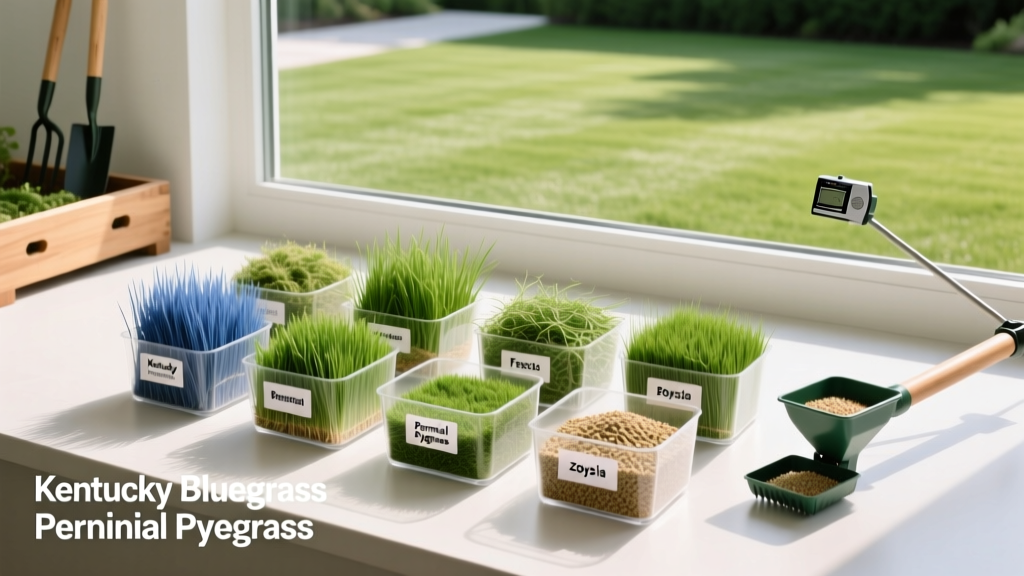
Best Grass Seeder Types and Calibration Guide for Lawn Establishment
The Anatomy of Lawn Establishment: Why Your Spreader Choice Matters
Establishing a lawn from seed requires precise seed-to-soil contact and uniform distribution, which hinges entirely on using the correct grass seeder. A variance of just 10% in seed distribution can result in patchy germination, increased weed competition, and wasted materials. Whether you are overseeding an existing cool-season turf or establishing a warm-season lawn on bare soil, the mechanical delivery system you choose dictates your success rate.
Pro Tip: Never rely on the factory settings printed on the side of a grass seeder hopper. Manufacturing tolerances, seed coating variations, and local humidity levels drastically alter flow rates. Always calibrate your equipment before the first pass.
Drop vs. Broadcast: Choosing the Right Grass Seeder
The two primary categories of mechanical seeders operate on fundamentally different distribution principles. Selecting the wrong type for your specific property layout is the most common cause of establishment failure.
| Feature | Drop Seeder | Broadcast (Rotary) Seeder |
|---|---|---|
| Distribution Pattern | Directly downward in a defined swath | 360-degree centrifugal fan pattern |
| Accuracy | Extremely high (ideal for borders) | Moderate (requires overlapping passes) |
| Speed / Efficiency | Slow (requires precise wheel tracking) | Fast (covers wide areas quickly) |
| Wind Vulnerability | Low (seed drops directly to soil) | High (light seeds drift in crosswinds) |
| Best Use Case | Small urban lawns, near garden beds | Large open areas, rural properties, overseeding |
Top Grass Seeder Models for 2026: Pricing and Specifications
Consumer-grade plastic spreaders often suffer from warped hoppers and degraded gears after a single season of exposure to fertilizer salts and UV light. For reliable establishment, invest in commercial-grade or premium residential models.
1. Lesco High Wheel Fertilizer Spreader (Broadcast)
Price: $149 - $165
Capacity: 80 lbs
Key Feature: Enclosed gearbox and stainless steel frame. The Lesco high-wheel model is the industry standard for lawn care professionals. The enclosed gearbox prevents seed dust and corrosive fertilizer salts from destroying the internal gears, a common failure point in cheaper models. The 14-inch pneumatic tires prevent rutting in soft, freshly graded topsoil.
2. Earthway 2170 Commercial Broadcast Spreader
Price: $125 - $140
Capacity: 50 lbs
Key Feature: EVAP (Even Volume Application Pattern). Earthway's proprietary impeller design ensures that heavy, coated seeds and light, raw seeds are distributed with equal lateral consistency. It features a unique side-spread control lever that allows you to shut off the right side of the spread pattern when edging along driveways.
3. Scotts Classic Drop Spreader
Price: $50 - $65
Capacity: 50 lbs (approx. 2,250 sq ft coverage)
Key Feature: Fully assembled, pre-calibrated out of the box for Scotts branded seeds. While the 22-inch drop width makes it slow for large properties, its precision is unmatched for tight suburban lots where seed spillage into adjacent landscaping mulch is a concern.
Seed Coatings and Flow Rate Adjustments
A critical variable most homeowners overlook is seed coating. Modern grass seeds are frequently coated with clay, fungicides, or water-retention polymers (e.g., Pennington Smart Seed or Scotts Turf Builder Grass Seed).
Coated seeds are physically larger and up to 30% heavier by volume than raw seeds. If your seed bag recommends a spreader setting of '4' for raw Kentucky Bluegrass, you will typically need to open the hopper to setting '5.5' or '6' to achieve the exact same pounds-per-square-foot application rate with coated seed.
Always perform a physical calibration test rather than trusting the bag's printed dial settings, which are only accurate for the specific brand's proprietary coating thickness.
The 100-Square-Foot Calibration Method
Stop guessing and start measuring. The University of Minnesota Turfgrass Science program recommends the 100-square-foot catch method for precise calibration. You will need a digital kitchen scale, a catch bucket, and a tape measure.
- Measure the Test Area: Mark off a 10 ft x 10 ft (100 sq ft) area on your driveway or a tarp. (Do not calibrate on soil, as you cannot recover the seed).
- Weigh the Empty Bucket: Place your plastic catch bucket on the digital scale and tare it to zero.
- Load the Hopper: Fill your grass seeder with the exact seed you plan to use.
- Execute the Pass: Set the dial to your estimated setting. Walk at your normal, steady mowing pace (approx. 3 mph) across the 100 sq ft area, allowing the seed to fall into the bucket. (Tip: Have a helper hold the bucket under the drop zone, or tape a collection bag to the underside of the hopper).
- Weigh the Catch: Weigh the collected seed in ounces.
- Calculate the Rate: Multiply the ounces caught by 0.625. The result is your exact application rate in pounds per 1,000 square feet.
Example: You catch 3.2 ounces of Tall Fescue seed over 100 sq ft. 3.2 x 0.625 = 2.0 lbs per 1,000 sq ft.
Target Seed Rates for Bare Soil vs. Overseeding
Your grass seeder must be calibrated to match the specific establishment scenario. Overseeding requires roughly 50% of the seed volume used for bare soil establishment, as the existing turf canopy intercepts a significant portion of the seed.
| Grass Species | Bare Soil Rate (lbs / 1,000 sq ft) | Overseeding Rate (lbs / 1,000 sq ft) | Optimal Seeder Type |
|---|---|---|---|
| Tall Fescue | 6.0 - 8.0 | 3.0 - 4.0 | Broadcast |
| Kentucky Bluegrass | 2.0 - 3.0 | 1.0 - 1.5 | Drop or Broadcast |
| Perennial Ryegrass | 5.0 - 7.0 | 2.5 - 3.5 | Broadcast |
| Bermudagrass (Hulled) | 2.0 - 3.0 | 1.0 - 1.5 | Drop (due to wind drift) |
| Centipedegrass | 0.5 - 1.0 | 0.25 - 0.5 | Drop (requires high precision) |
For highly specific regional cultivar recommendations and soil preparation protocols, consult the Penn State Extension Lawn and Garden resources, which provide localized planting windows based on your exact hardiness zone.
Troubleshooting Uneven Germination Patterns
If your lawn emerges with visible stripes, clumps, or bare patches, diagnose the failure mode using this matrix:
- Alternating Dark and Light Green Stripes: Caused by improper overlap with a broadcast seeder. The impeller throws seed in a bell curve (heavy in the center, light on the edges). You must overlap your wheel tracks by exactly 50% on every pass to create a uniform distribution layer.
- Clumping at the Start/Stop Points: You opened the hopper gate while standing still. Always begin walking before engaging the spreader lever, and release the lever before you stop moving.
- Bare Stripes Along Driveways: Wind drift or failure to use the edge-guard feature. Switch to a drop seeder for perimeter passes, or engage the side-spread deflector on your broadcast model.
- Seed Washouts on Slopes: The seeder worked perfectly, but hydraulic erosion moved the seed. On slopes greater than a 15% grade, you must use a hydraulic tackifier or straw erosion control blankets immediately after seeding.
Frequently Asked Questions
Can I use a fertilizer spreader to sow grass seed?
Yes, but you must clean it thoroughly first. Residual fertilizer salts, particularly from pre-emergent herbicides (like Prodiamine or Dithiopyr), will chemically burn emerging grass radicles and halt germination. Wash the hopper and agitator with warm water and a mild degreaser, then dry completely to prevent rust on metal components.
Does walking speed affect the seed application rate?
Yes. Most mechanical grass seeders are ground-driven, meaning the gear turns based on wheel rotation. However, the pattern of a broadcast spreader changes with speed. Walking too slowly causes the seed to drop in a tight, heavy circle. Walking too fast throws the seed too far, creating a thin, wide pattern. Maintain a consistent 2.5 to 3.0 mph pace (a brisk, purposeful walk) for optimal distribution.
How do I store my grass seeder between seasons?
Empty the hopper completely. Vacuum out fine seed dust, which absorbs moisture and turns into a cement-like paste that seizes the agitator plate. Apply a dry silicone spray lubricant to the axle, gearbox, and rate-control dial. Store indoors away from UV light to prevent the plastic hopper from becoming brittle.