Grass Types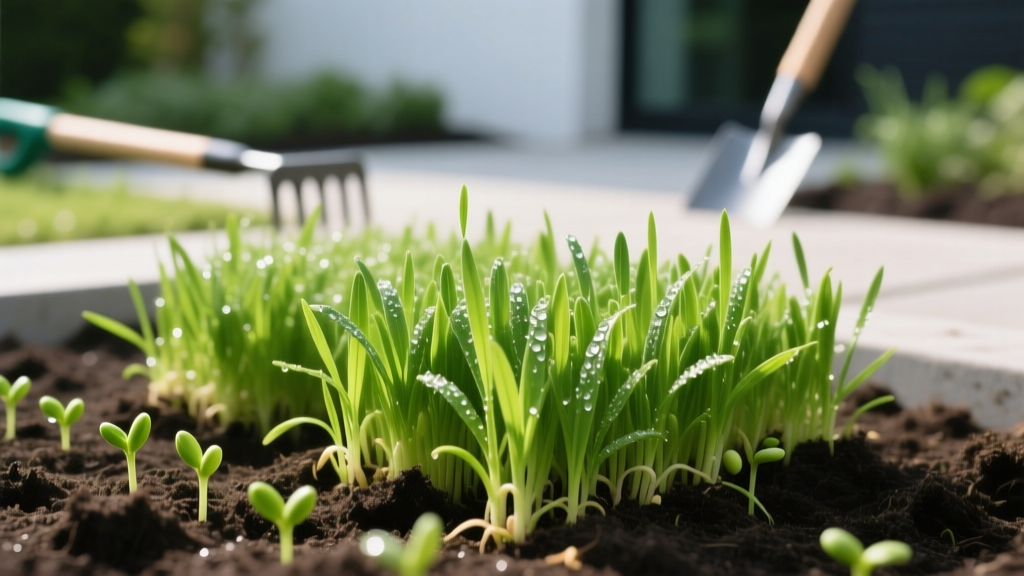
Grass Seeds Fast Growing: Quick Lawn Establishment Guide
When bare patches, erosion risks, or upcoming property sales demand immediate turf coverage, standard lawn seeding timelines are insufficient. Homeowners searching for grass seeds fast growing enough to provide visual results in under two weeks must understand the biological limits of turfgrass. Germination (the initial sprout) and establishment (a mature, traffic-tolerant root network) are two distinct phases. While no grass species achieves full maturity in a week, specific cultivars can push green shoots through the soil in 3 to 7 days under optimal conditions.
This guide breaks down the exact species, cultivars, soil temperatures, and starter fertilizer ratios required to accelerate establishment, alongside real-world 2026 seed pricing to help you budget your rapid-repair project.
The Biological Speed Limit: Germination vs. Establishment
Marketing claims on seed bags often conflate germination speed with full lawn readiness. According to University of Minnesota Extension, a newly germinated seedling is highly vulnerable to desiccation, foot traffic, and fungal pathogens like Pythium blight. True establishment—defined as a root mass deep enough to survive a 5-day drought without supplemental irrigation—takes 6 to 10 weeks, even for the fastest-growing species.
Critical Distinction:
- Germination: The seed absorbs water, the coleoptile breaks the soil surface, and the first true leaf appears. (Timeline: 3–14 days).
- First Mow: The turf reaches 3 inches and is rooted securely enough to withstand mower wheels without uprooting. (Timeline: 14–30 days).
- Full Establishment: Rhizomes or tillers form a dense mat; roots reach 4+ inches deep. (Timeline: 60–90 days).
Top Fast-Growing Grass Species Ranked by Speed
Not all rapid growers are created equal. Choosing between cool-season and warm-season genetics dictates your planting window and long-term lawn viability.
1. Perennial Ryegrass (Lolium perenne)
The undisputed speed king of cool-season turf. Perennial ryegrass germinates in 5 to 7 days. It is heavily used for overseeding dormant warm-season lawns and for rapid erosion control. However, it lacks rhizomes (underground runners), meaning it cannot spread to fill in bare spots on its own; it relies entirely on tillering. For disease resistance against brown patch and gray leaf spot, avoid generic bulk seed and opt for improved cultivars like 'Palmer IV' or 'Caddieshack'.
2. Annual Ryegrass (Lolium multiflorum)
Germinates in an astonishing 3 to 5 days. Annual ryegrass is strictly a temporary nurse crop. It will die off when summer heat peaks, but it exhibits allelopathy—releasing biochemicals that inhibit the germination of other seeds. Do not mix annual ryegrass with slower-germinating Kentucky Bluegrass, as the ryegrass will chemically suppress the bluegrass seedlings.
3. Turf-Type Tall Fescue (Festuca arundinacea)
Germinates in 7 to 12 days. While slightly slower than ryegrass, Tall Fescue establishes a significantly deeper root system (up to 3 feet in mature lawns), offering superior drought and heat tolerance. Rhizomatous Tall Fescue (RTF) varieties, such as 'Titan Ultra', produce short rhizomes that allow the lawn to recover from minor damage, a trait lacking in standard fescues.
4. Seeded Bermudagrass (Cynodon dactylon)
The fastest warm-season option, germinating in 10 to 14 days if using hulled seed (the outer casing is mechanically removed). Bermudagrass spreads aggressively via both stolons and rhizomes, creating a highly traffic-tolerant surface. According to Clemson University Extension, seeded varieties like 'Yukon' or 'Sundance Pro' offer cold tolerance that extends the warm-season growing zone further north.
Species Comparison & Cost Matrix
| Species | Germination Window | Days to First Mow | Traffic Tolerance | Avg. Seed Cost (2026) |
|---|---|---|---|---|
| Perennial Ryegrass | 5–7 Days | 14–21 Days | High | $6.00 – $9.00 / lb |
| Tall Fescue (TTTF) | 7–12 Days | 21–28 Days | Moderate-High | $4.50 – $7.00 / lb |
| Bermudagrass (Hulled) | 10–14 Days | 21–30 Days | Very High | $12.00 – $18.00 / lb |
| Annual Ryegrass | 3–5 Days | 10–14 Days | Low-Moderate | $2.00 – $3.50 / lb |
Step-by-Step Protocol for Maximizing Germination Speed
Even the fastest genetics will stall if environmental triggers are absent. Follow this exact sequence to compress your germination window.
- Verify Soil Temperature, Not Air Temperature: Cool-season seeds require a sustained soil temperature of 50°F to 65°F at a 2-inch depth. Warm-season seeds demand 65°F to 75°F. Use a digital soil probe thermometer; guessing based on the weather app leads to seed rot or dormant seeding.
- Maximize Seed-to-Soil Contact: Broadcasting seed over existing thatch or compacted soil wastes up to 40% of your seed. For bare soil, use a core aerator or power rake. For overseeding, rent a slit-seeder (dropping the seed directly into 1/4-inch soil grooves).
- Apply a Phosphorus-Heavy Starter Fertilizer: Rapid root development requires immediate phosphorus access. Apply a starter fertilizer with an N-P-K ratio of 10-18-10 or 18-24-12 at the exact rate specified on the bag (typically 3 to 4 lbs per 1,000 sq ft). Phosphorus is the primary catalyst for early seedling energy.
- Implement Continuous Moisture Cycles: Seed must remain constantly moist, but not waterlogged, to trigger the enzyme activity that breaks dormancy. Program your irrigation controller for 3 to 4 daily cycles of 5 minutes each, rather than one 20-minute deep soak, which will wash seeds away or cause fungal rot.
Warning: The Mulch Trap
Many homeowners apply wheat straw to retain moisture. While effective, straw often contains viable weed seeds that will germinate alongside your turf, creating a weeding nightmare in month two. For rapid establishment, use a sterile hydromulch or a specialized peat-based seed accelerator (like Penn Mulch) which holds 4x its weight in water and introduces zero weed competition.
Many homeowners apply wheat straw to retain moisture. While effective, straw often contains viable weed seeds that will germinate alongside your turf, creating a weeding nightmare in month two. For rapid establishment, use a sterile hydromulch or a specialized peat-based seed accelerator (like Penn Mulch) which holds 4x its weight in water and introduces zero weed competition.
Recommended 2026 Seed Blends for Rapid Repair
When purchasing seed, always read the NTEP (National Turfgrass Evaluation Program) data tags on the bag. Avoid blends containing "Crop Seed" or over 0.5% weed seed.
- Pennington Smart Seed Perennial Ryegrass: Coated with MYCO Advantage (mycorrhizal fungi) which accelerates root nutrient uptake by up to 30%. Ideal for high-traffic cool-season repair. Requires 7 lbs per 1,000 sq ft for new lawns.
- Scotts Turf Builder Grass Seed Rapid Grass Mix: A proprietary blend of fast-germinating perennial ryegrass and fine fescues. Best for patching dog spots or localized erosion where a pure ryegrass stand is undesirable.
- Jonathan Green Black Beauty Ultra Tall Fescue: Contains deep-rooting TTTF cultivars alongside a small percentage of Kentucky Bluegrass for rhizome spreading. Slower to germinate than ryegrass, but provides a vastly superior, permanent drought-tolerant lawn.
Frequently Asked Questions
Can I walk on the lawn once the fast-growing seeds sprout?
No. At the 1-week mark, the seedling consists of a single shoot and a fragile primary root (radicle) barely 1 inch deep. Foot traffic will sever the root from the soil profile, killing the seedling instantly. Restrict all traffic until the turf has been mowed at least three times, indicating a secondary root network has anchored the plant.
How much seed is too much?
Over-seeding is a common mistake that leads to catastrophic failure. Applying double the recommended rate (e.g., 15 lbs per 1,000 sq ft of ryegrass instead of 7 lbs) causes intense competition for light and water. The resulting seedlings will be spindly, weak, and highly susceptible to damping-off disease, which can wipe out an entire overseeded area in 48 hours. Always measure your square footage and weigh the seed on a digital scale.
Do I need to cover the seed with topsoil?
Turfgrass seed requires light to germinate. Burying the seed under more than 1/4 inch of topsoil will prevent emergence. The ideal placement is directly on the soil surface, lightly dragged in with a leaf rake so that 10% of the seed is visible and 90% is nestled in soil crevices.
For further reading on long-term turf maintenance and disease prevention post-establishment, consult the NCSU TurfFiles database on Perennial Ryegrass to understand the specific fungicide rotation schedules required to keep rapid-growth lawns alive through their first summer.