
Grass Types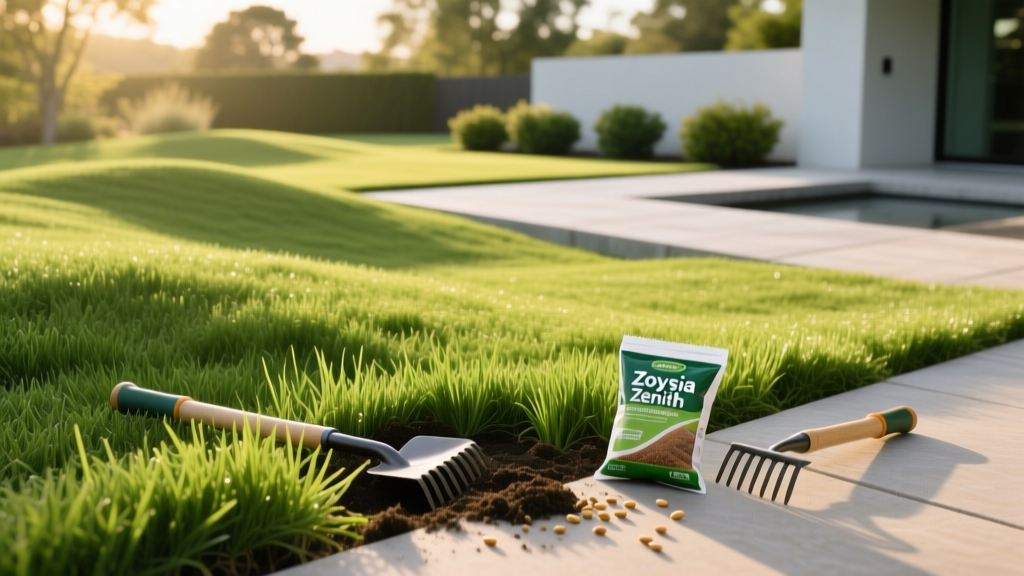
Growing Zoysia Zenith Seed: Establishment and Care Guide
Zenith Zoysia (Zoysia japonica) represents a major breakthrough for homeowners who want the dense, weed-choking durability of a premium warm-season lawn without the exorbitant costs of vegetative sod or plugs. Unlike older cultivars such as Meyer Z-52, which must be established vegetatively, Zenith was specifically bred for high germination rates and genetic stability from seed. However, establishing zoysia zenith seed requires strict adherence to soil temperature thresholds and moisture protocols. A single misstep during the 21-day germination window can result in total seed loss.
This guide provides a comprehensive, step-by-step framework for successfully planting, germinating, and maintaining a Zenith Zoysia lawn, utilizing current agronomic data and 2026 market pricing.
Why Choose Zoysia Zenith Seed Over Vegetative Plugs?
Historically, achieving a high-quality Zoysia lawn meant paying $0.40 to $0.80 per square foot for sod, or waiting up to three years for vegetative plugs to fill in. Zenith seed bridges this gap, offering a middle ground that balances cost with establishment speed.
Cost Comparison (Per 5,000 sq. ft. Lawn):
• Zenith Seed: $85 – $115 (Requires 2.5 to 3 lbs of seed at current 2026 retail rates of $35–$45/lb).
• Meyer Z-52 Plugs: $250 – $400 (Plus 12-18 months of aggressive weed management while filling in).
• Zeon or Meyer Sod: $1,500 – $2,200 (Plus delivery and professional installation fees).
• Zenith Seed: $85 – $115 (Requires 2.5 to 3 lbs of seed at current 2026 retail rates of $35–$45/lb).
• Meyer Z-52 Plugs: $250 – $400 (Plus 12-18 months of aggressive weed management while filling in).
• Zeon or Meyer Sod: $1,500 – $2,200 (Plus delivery and professional installation fees).
While seed is significantly cheaper, it demands more intensive labor during the first 30 days. According to NC State University TurfFiles, seed-grown Z. japonica cultivars like Zenith exhibit excellent cold tolerance, surviving winter temperatures that would severely damage finer-bladed Zoysia matrella varieties.
Pre-Planting Soil Preparation and Timing
Zoysia zenith seed is notoriously unforgiving if sown into cold soil or compacted clay. The seed lacks the aggressive seedling vigor of tall fescue or bermudagrass, meaning the seedbed must be virtually perfect.
Timing and Temperature Thresholds
Do not rely on air temperature. You must measure soil temperature at a 2-inch depth. Germination will not initiate until the soil consistently reads between 65°F and 70°F for at least 72 consecutive hours. In most transitional and warm-season zones, this aligns with late May through early July.
Seedbed Grading and Amendment
- Kill Existing Vegetation: Apply a non-selective glyphosate herbicide 14 days prior to tilling. Wait for complete browning.
- Till and Rake: Rototill the top 4 inches of soil. Rake out all debris, rocks, and old root masses.
- Amend Based on Soil Test: Zenith prefers a pH between 6.0 and 6.5. If your pH is below 5.8, incorporate pelletized lime at a rate of 50 lbs per 1,000 sq. ft. before seeding.
- Starter Fertilizer: Apply a high-phosphorus starter fertilizer (e.g., 10-18-10) at a rate of 0.5 lbs of actual nitrogen per 1,000 sq. ft. to fuel early root development.
Seeding Rates, Sowing Techniques, and Germination
Proper seed-to-soil contact is the single most critical factor in Zenith establishment. The seed must not be buried deeply, or it will exhaust its endosperm reserves before reaching the surface.
| Parameter | Specification | Notes / Tolerances |
|---|---|---|
| Seeding Rate | 1.5 to 2.0 lbs / 1,000 sq. ft. | Use the higher rate for slopes or shaded areas. |
| Sowing Depth | 1/8 to 1/4 inch maximum | Broadcast on surface and lightly drag with a leaf rake. |
| Germination Window | 14 to 21 days | Can extend to 28 days if soil temps hover near 65°F. |
| Seed Type | Raw (uncoated) preferred | Pelleted seed reduces the number of live seeds per pound. |
The 21-Day Germination Watering Protocol
Zenith seed will die if it germinates and then dries out, but it will rot (damping-off disease) if it sits in standing water. Follow this strict watering matrix:
- Days 1–10 (Pre-Germination): Water 3 to 4 times daily for 3 to 5 minutes per zone. The goal is to keep the top 1/2 inch of soil constantly glistening, but never muddy.
- Days 11–18 (Emergence): As green fuzz appears, reduce frequency to 2 times daily, but increase duration to 8 minutes to encourage roots to chase the moisture downward.
- Days 19–30 (Establishment): Transition to once-daily watering for 15–20 minutes. This hardens the seedlings and prepares them for standard deep-and-infrequent irrigation.
Crucial Pre-Emergent Warning: Never apply a pre-emergent herbicide (like prodiamine or dithiopyr) before planting zoysia zenith seed. Furthermore, do not apply pre-emergents to a newly seeded Zenith lawn until the grass has been mowed at least three times. Applying weed preventers too early will chemically halt the root development of your new Zoysia seedlings, causing massive turf death.
First-Year Maintenance and Mowing Heights
According to Clemson University Home & Garden Information Center, Zoysiagrass requires specific mowing practices to maintain density and prevent thatch buildup. Zenith has a medium-coarse leaf texture and performs best when maintained slightly higher than finer Zoysia varieties.
Mowing Strategy
Execute the first mow when the seedlings reach 2.5 inches in height. Set your mower deck to 2.0 inches and ensure the blade is razor-sharp; dull blades will tear young Zoysia shoots, inviting fungal pathogens. For the remainder of the first growing season, maintain a height of 1.5 to 2.0 inches. Never remove more than one-third of the leaf blade in a single pass.
Fertilization Schedule
Zenith is a relatively low-feeding turfgrass compared to bermudagrass. During the establishment year, apply a total of 1.5 to 2.0 lbs of actual nitrogen per 1,000 sq. ft. spread across the summer months (June through August). Use a slow-release, polymer-coated urea or sulfur-coated urea to prevent rapid, weak top-growth that outpaces root development.
Troubleshooting Common Zenith Establishment Failures
Even with meticulous planning, environmental variables can disrupt establishment. Use this diagnostic framework to correct issues early.
- Symptom: Seed sprouts but turns yellow and collapses at the soil line.
Cause: Pythium blight (damping-off) caused by overwatering and poor drainage.
Fix: Reduce watering frequency immediately. Improve surface drainage. If severe, apply a preventive fungicide containing azoxystrobin. - Symptom: Uneven germination; bare patches in sunny areas, good growth in shade.
Cause: Rapid moisture evaporation in full sun zones during the pre-germination phase.
Fix: Increase watering frequency in sunny zones to 5 times a day for 2 minutes. Consider applying a thin layer of weed-free straw mulch (1 bale per 1,000 sq. ft.) to retain surface moisture. - Symptom: Aggressive broadleaf and crabgrass competition choking out seedlings.
Cause: Inability to use pre-emergents during the seedling phase.
Fix: Hand-pull large weeds carefully to avoid uprooting Zoysia. Once the lawn has been mowed three times, apply a selective post-emergent herbicide containing quinclorac and 2,4-D (ensure the label explicitly states it is safe for young, established Zoysia).
Frequently Asked Questions
Can I overseed an existing lawn with Zoysia Zenith seed?
No. Zoysia zenith seed requires bare, prepared soil and full sunlight to germinate. If you attempt to overseed it into an existing fescue or bermudagrass lawn, the seedlings will be completely shaded out and will fail to establish. Zenith is strictly for new lawn installations or complete lawn renovations.
How long until a Zenith Zoysia lawn is fully mature and traffic-tolerant?
While the lawn will look visually complete by the end of the first summer (roughly 90 to 120 days post-germination), the deep rhizome and stolon root network requires a full 12 to 14 months to mature. Avoid heavy foot traffic, pet use, or playing sports on the lawn until the second growing season.
Does Zenith Zoysia go dormant in the winter?
Yes. Like all warm-season grasses, Zenith will turn brown after the first hard frost in autumn. However, its superior cold tolerance means it is one of the last warm-season grasses to go dormant in the fall, and one of the first to green up in the spring, often beating bermudagrass out of dormancy by 2 to 3 weeks.

