Grass Types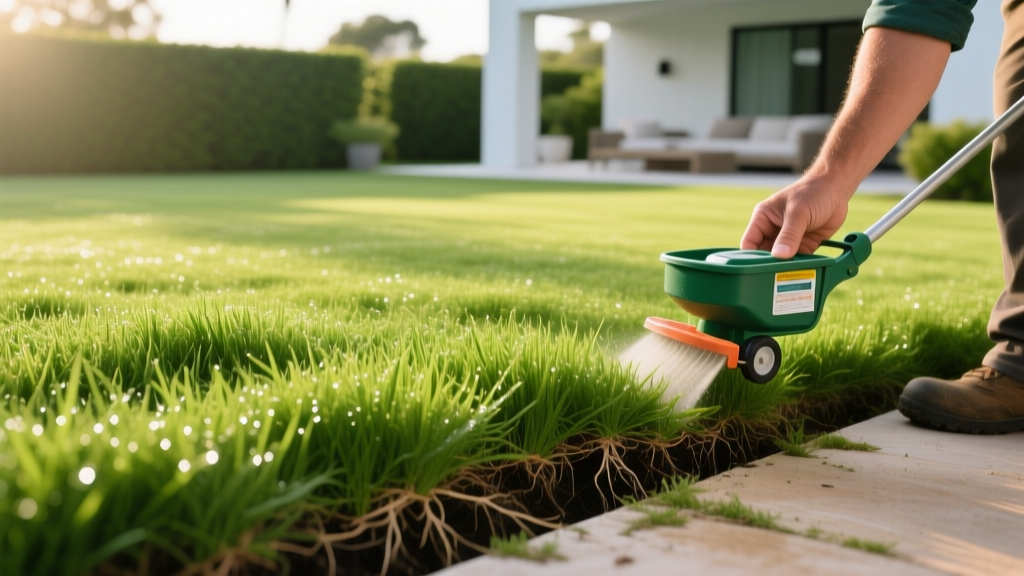
High Nitrogen Fertilizer for Bermuda Grass: Application Guide
Why Bermuda Grass Demands High Nitrogen
Bermuda grass (Cynodon dactylon) is a aggressive, warm-season perennial that thrives on heavy feeding. Unlike cool-season grasses that require balanced, moderate nutrition, Bermuda utilizes massive amounts of nitrogen to fuel its rapid lateral stolon growth and dense canopy recovery during peak summer temperatures. According to NC State TurfFiles, hybrid Bermuda varieties can require up to 4 pounds of actual nitrogen per 1,000 square feet annually to maintain a dark green, golf-course-quality density.
Applying a high nitrogen fertilizer for bermuda grass is not merely about making the lawn look green; it is a biological necessity for outcompeting weeds, recovering from summer traffic stress, and building the carbohydrate reserves required for winter dormancy. However, indiscriminately dumping high-N products on your turf without understanding release rates, soil pH interactions, and seasonal timing will result in severe thatch accumulation, disease susceptibility, and root burn.
Decoding N-P-K Ratios and Application Math
The three numbers on a fertilizer bag represent the percentage by weight of Nitrogen (N), Phosphorus (P), and Potassium (K). For established Bermuda lawns, phosphorus is rarely needed unless a soil test indicates a severe deficiency. Therefore, high nitrogen fertilizers for Bermuda grass typically feature N-P-K ratios where the first number is dominant, such as 28-0-3, 32-0-10, or even 46-0-0 (pure urea).
| Fertilizer Ratio (N-P-K) | Nitrogen Source | Release Speed | Best Use Case |
|---|---|---|---|
| 46-0-0 | Urea | Quick Release (1-2 weeks) | Rapid green-up, agricultural use, liquid spraying |
| 28-0-0 | Stabilized Liquid N | Moderate (2-4 weeks) | Spoon-feeding programs, foliar uptake |
| 30-0-4 | Methylene Urea / Polymer Coated | Slow Release (6-8 weeks) | Standard granular broadcast, summer maintenance |
| 21-0-0 | Ammonium Sulfate | Quick Release + Acidifying | Alkaline soils (pH > 7.0), rapid push |
The Application Math Framework:
Never apply fertilizer based on the bag's square footage claim alone. Calculate the exact weight of product needed based on the nitrogen percentage.
Formula: (Desired lbs of N per 1,000 sq ft ÷ % of N in decimal form) = lbs of product per 1,000 sq ft.
Example: To apply 1.0 lb of N using a 46-0-0 Urea product:
1.0 ÷ 0.46 = 2.17 lbs of product per 1,000 sq ft.
If your lawn is 5,000 sq ft, you will set your spreader to deliver exactly 10.85 lbs of urea across the entire area.
Never apply fertilizer based on the bag's square footage claim alone. Calculate the exact weight of product needed based on the nitrogen percentage.
Formula: (Desired lbs of N per 1,000 sq ft ÷ % of N in decimal form) = lbs of product per 1,000 sq ft.
Example: To apply 1.0 lb of N using a 46-0-0 Urea product:
1.0 ÷ 0.46 = 2.17 lbs of product per 1,000 sq ft.
If your lawn is 5,000 sq ft, you will set your spreader to deliver exactly 10.85 lbs of urea across the entire area.
Quick-Release vs. Stabilized Slow-Release Formulations
When selecting a high nitrogen fertilizer for bermuda grass, the release mechanism dictates your application frequency and burn risk.
Granular Urea (46-0-0) and Ammonium Sulfate (21-0-0)
These are inexpensive, highly soluble, quick-release nitrogen sources. They provide an explosive green-up within 48 to 72 hours. However, they carry a high salt index. If applied to dry soil or without immediate, deep irrigation (at least 0.5 inches of water), they will cause severe foliar burn. Ammonium sulfate is particularly useful for Bermuda grass growing in highly alkaline soils (pH above 7.2) because its nitrification process releases hydrogen ions, gradually lowering the soil pH to the optimal 6.0–6.5 range.
Stabilized and Polymer-Coated Nitrogen
Products utilizing NBPT (a urease inhibitor) or polymer coatings, such as 30-0-4 formulations, feed the grass steadily over 6 to 8 weeks. This prevents the massive flush of top-growth that forces you to mow every three days and minimizes nitrogen leaching during heavy summer thunderstorms. For residential lawns, stabilized slow-release granular fertilizers are vastly superior to quick-release options, providing consistent color without the feast-or-famine growth cycles.
The Seasonal Application Calendar
Timing is the most critical variable in Bermuda grass nutrition. Applying high nitrogen too early feeds spring weeds and promotes cool-weather fungal pathogens like dollar spot. Applying it too late prevents the grass from hardening off for winter.
- Spring Green-Up (Mid-April to May): Do not apply high nitrogen until soil temperatures at a 4-inch depth are consistently above 65°F. Apply 0.5 to 1.0 lbs of N per 1,000 sq ft using a slow-release granular product. According to Clemson HGIC, premature nitrogen application is the leading cause of spring dead spot severity.
- Peak Summer (June through August): This is the heavy feeding window. Apply 1.0 lbs of N per 1,000 sq ft every 4 to 6 weeks. If you are managing a highly manicured hybrid Bermuda (like Tifway 419 or Celebration), switch to a liquid 28-0-0 spoon-feeding program, applying 0.25 lbs of N every 10 to 14 days to maintain tight internode spacing and a dense carpet.
- Early Fall (September): Apply a final, lighter application of 0.5 lbs of N per 1,000 sq ft no later than 4 to 6 weeks before your region's average first frost date. This allows the grass to store carbohydrates in its rhizomes without pushing tender, frost-susceptible new leaf tissue.
- Winter (November through March): Zero nitrogen. The grass is dormant. Any nitrogen applied now will only feed Poa annua (annual bluegrass) and henbit.
The pH Bottleneck: Why High Nitrogen Fails in Acidic Soil
A common failure mode among homeowners is applying expensive high nitrogen fertilizer for bermuda grass, only to see the lawn remain pale and thin. The culprit is almost always soil pH. Bermuda grass requires a soil pH between 6.0 and 6.5 for optimal nutrient uptake.
When soil pH drops below 5.5, aluminum toxicity increases and the cation exchange capacity (CEC) of the soil collapses. In highly acidic soils, the grass's root system physically cannot absorb the nitrogen you are applying, regardless of the formulation. Furthermore, heavy use of ammonium-based fertilizers accelerates soil acidification. Before purchasing any high-N product, invest in a professional lab soil test (available through local university extension offices for roughly $15 to $25). If your pH is below 6.0, you must apply pelletized dolomitic lime at the rate of 25 to 50 lbs per 1,000 sq ft to correct the baseline before your nitrogen applications will yield results.
Troubleshooting: Thatch Buildup and Nitrogen Burn
Expert Warning: High nitrogen applications directly correlate with increased thatch production. Bermuda grass naturally produces dense stolons and rhizomes. When you force rapid top-growth with heavy nitrogen, the lower stems die and accumulate faster than soil microbes can decompose them.
If your thatch layer exceeds 0.5 inches, water and fertilizer will be trapped above the soil line, leading to shallow roots and severe drought stress. To mitigate this when running a high-nitrogen program:
- Core Aeration: Perform deep-tine core aeration in June or July. This introduces oxygen to the soil profile, accelerating the microbial breakdown of thatch.
- Vertical Mowing (Dethatching): For hybrid Bermudas maintained at heights below 1 inch, use a verticutter in late spring to physically slice through the thatch mat and remove decaying organic matter.
- Potassium Balancing: If you are pushing heavy nitrogen, ensure your late-summer applications include potassium (the 'K' in N-P-K). Potassium thickens cell walls, increases drought tolerance, and counteracts the soft, lush growth induced by high nitrogen, making the turf more resilient to traffic and disease.
By adhering to precise application mathematics, respecting soil temperature thresholds, and monitoring your thatch layer, you can leverage high nitrogen fertilizers to transform a sparse, weedy yard into a dense, resilient Bermuda grass lawn capable of withstanding the harshest summer conditions.