
Grass Types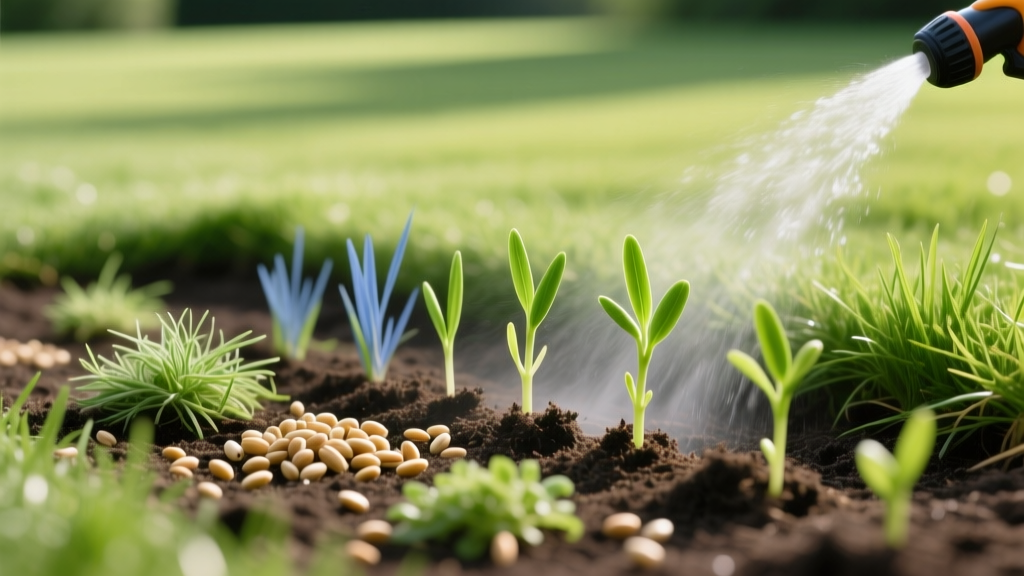
How to Grow Grass Seeds: Step-by-Step Lawn Establishment Guide
The Science of Seed Germination: Why Timing Dictates Success
Understanding how to grow grass seeds successfully requires moving beyond calendar dates and focusing on soil thermodynamics. Grass seed germination is triggered by consistent soil temperature, not ambient air temperature. Cool-season grasses like Kentucky Bluegrass and Tall Fescue require soil temperatures between 50°F and 65°F for optimal enzymatic activity, while warm-season species like Bermudagrass and Zoysia demand soil temperatures above 65°F, ideally peaking at 70°F to 80°F.
Planting outside these thermal windows leads to seed dormancy or rot. A common failure mode is sowing cool-season seeds in late spring; the rapid air temperature spikes cause the topsoil to dry out before the radicle (first root) can establish, resulting in total crop failure. According to UC Davis Integrated Pest Management, monitoring soil temperature at a 2-inch depth for three consecutive mornings is the only reliable metric for scheduling your seed drop.
| Grass Species | Minimum Soil Temp | Optimal Soil Temp | Days to Germinate |
|---|---|---|---|
| Kentucky Bluegrass | 50°F | 59°F - 77°F | 14 - 30 days |
| Tall Fescue | 50°F | 68°F - 77°F | 7 - 12 days |
| Perennial Ryegrass | 45°F | 68°F - 86°F | 5 - 10 days |
| Bermudagrass | 65°F | 75°F - 90°F | 10 - 21 days |
| Centipedegrass | 70°F | 75°F - 85°F | 14 - 21 days |
Phase 1: Site Preparation and Soil Amendment
Seed-to-soil contact is the most critical mechanical factor in establishment. You cannot simply broadcast seed over compacted clay and expect survival. Begin by tilling the top 4 to 6 inches of soil. If your soil test reveals heavy clay, incorporate 2 cubic yards of organic compost per 1,000 square feet to improve drainage and cation exchange capacity (CEC).
⚠️ WARNING: The Pre-Emergent Herbicide Trap
Never apply standard pre-emergent herbicides (like prodiamine or dithiopyr) before seeding. These chemicals create a chemical barrier that stops cell division in all germinating seeds, including your new lawn. The only exception is mesotrione (the active ingredient in Tenacity), which selectively targets broadleaf weeds and crabgrass without harming germinating cool-season turf. Look for starter fertilizers that explicitly list mesotrione on the active ingredient label if weed pressure is a concern.
Apply a high-phosphorus starter fertilizer to fuel initial root development. A formulation with an N-P-K ratio of 18-24-12 is ideal. Apply exactly 1.0 pound of actual nitrogen per 1,000 square feet. For a 5,000 square foot lawn, this requires roughly 27 pounds of the 18-24-12 product. Penn State Extension emphasizes that phosphorus is immobile in soil; therefore, it must be tilled into the top 2 inches of the seedbed rather than left on the surface.
Phase 2: Seed Selection and Precise Calibration
When learning how to grow grass seeds, buying cheap seed is a false economy. Always check the seed tag for the 'Pure Live Seed' (PLS) percentage and ensure the 'Weed Seed' content is strictly 0.00%. Avoid any mixtures containing annual ryegrass, which is often used as a cheap filler and will outcompete your desired perennial turf before dying off in the summer heat.
Calibrating Your Spreader
Do not rely on the generic settings printed on the seed bag, as spreader mechanics vary wildly between brands. Calibrate your broadcast or drop spreader using the following method:
- Measure a 1,000 square foot test area (e.g., 20 ft x 50 ft).
- Weigh out the exact amount of seed required for 1,000 sq ft (see table below).
- Set your spreader to a low-medium setting and walk the test area at your normal, consistent pace.
- Weigh the remaining seed. If you have seed left over, open the spreader aperture slightly and repeat. If you run out early, close it slightly.
| Turf Species | Rate (lbs per 1,000 sq ft) | Overseeding Rate (lbs per 1,000 sq ft) |
|---|---|---|
| Kentucky Bluegrass | 1.5 - 2.0 | 0.75 - 1.0 |
| Tall Fescue | 6.0 - 8.0 | 3.0 - 4.0 |
| Bermudagrass (Hulled) | 2.0 - 3.0 | 1.0 - 1.5 |
| Perennial Ryegrass | 5.0 - 7.0 | 2.5 - 3.5 |
Phase 3: Sowing, Raking, and Rolling
For uniform coverage, split your total seed volume in half. Broadcast the first half walking north-to-south, and the second half walking east-to-west. This cross-hatching eliminates striping and bare spots.
Once sown, use a stiff-tined leaf rake to lightly work the seed into the top 1/8 to 1/4 inch of soil. Seeds buried deeper than 1/2 inch will exhaust their endosperm energy reserves before reaching the surface, resulting in subterranean germination failure. Finally, rent a water-filled lawn roller. Fill it to roughly 150 pounds and roll the entire area. This presses the seed firmly into the soil matrix, eliminating air pockets and ensuring the capillary action necessary for moisture uptake.
Phase 4: The Germination Watering Matrix
Watering newly sown seed is entirely different from watering an established lawn. The goal is to keep the top 1/2 inch of soil consistently moist without creating standing water, which causes seed washout and fungal pathogens like Pythium blight (damping-off).
💡 Pro Tip: Use Oscillating Sprinklers with Timers
Attach a digital hose timer to an oscillating sprinkler. Set it to deliver roughly 1/4 inch of water per session. You will need to run this 3 to 4 times a day (e.g., 8 AM, 12 PM, 4 PM, and 6 PM) for the first 14 days. Once the grass reaches 1 inch in height, reduce frequency to once daily but increase the volume to encourage deeper root diving.
Troubleshooting Common Establishment Failures
Even with meticulous preparation, environmental variables can disrupt germination. Here is how to diagnose and correct the most frequent issues encountered during lawn establishment.
1. Soil Crusting and Seedling Entrapment
Symptom: You see tiny green loops trapped beneath a hard, baked layer of topsoil, unable to break through.
Cause: Heavy soils with low organic matter form a crust when subjected to intense sun and shallow watering.
Fix: Lightly drag a piece of chain-link fence or a stiff push broom over the crusted area to fracture the surface tension. Do not use a metal rake, as this will uproot the fragile seedlings. Increase organic matter incorporation in future renovations.
2. Damping-Off Fungus (Pythium Blight)
Symptom: Seedlings emerge but quickly turn dark, water-soaked, and collapse at the soil line, often leaving circular bare patches.
Cause: Overwatering combined with high humidity and poor air circulation.
Fix: Immediately reduce watering frequency and allow the soil surface to dry slightly between cycles. If the outbreak is severe, apply a preventative fungicide containing azoxystrobin or propiconazole, ensuring the product label explicitly permits use on newly seeded turf.
3. Seed Washout and Erosion
Symptom: Bare streaks running down slopes, with seed accumulated at the bottom of the grade.
Cause: Watering volume exceeded the soil's infiltration rate, or heavy rain occurred before seed-to-soil contact was established.
Fix: For slopes greater than a 15% grade, standard watering will always cause washout. You must apply a hydraulically applied mulch (hydromulch) or lay down biodegradable jute erosion control netting immediately after sowing and rolling. Pin the netting securely with 6-inch landscape staples spaced every 2 feet.

