Grass Types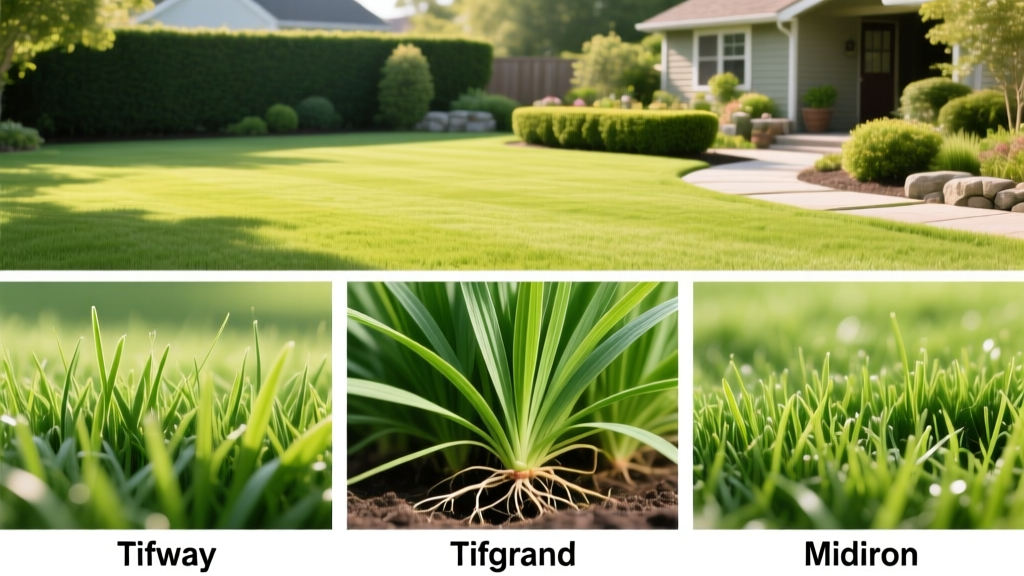
Hybrid Bermuda Grass Care: Top Cultivars and Maintenance Guide
The Science and Appeal of Hybrid Bermuda Grass
Hybrid Bermuda grass represents the pinnacle of warm-season turfgrass breeding. Developed by crossing African Bermuda (Cynodon transvaalensis) with common Bermuda (Cynodon dactylon), these sterile hybrids offer superior density, finer leaf texture, and deeper green coloration than their seeded counterparts. Because they are sterile triploids, hybrid Bermuda grass cannot be established from seed; it must be planted via sod, sprigs, or plugs.
Quick Fact: The Sterility Advantage
The sterility of hybrid Bermuda is actually its greatest asset for high-end lawns. Because it produces no viable seedheads, the plant directs all its energy into lateral stolon and rhizome growth, resulting in a carpet-like, ultra-dense turf that recovers rapidly from foot traffic and divots.
The sterility of hybrid Bermuda is actually its greatest asset for high-end lawns. Because it produces no viable seedheads, the plant directs all its energy into lateral stolon and rhizome growth, resulting in a carpet-like, ultra-dense turf that recovers rapidly from foot traffic and divots.
According to turfgrass researchers at NC State University's TurfFiles, hybrid Bermudas require significantly more intensive management than common varieties, but the aesthetic and functional payoff is unmatched for homeowners willing to commit to a precision maintenance schedule.
Top Hybrid Bermuda Cultivars Compared
Selecting the right cultivar is the most critical decision you will make, as it dictates your long-term water usage, cold tolerance, and mowing requirements. Below is a comparison of the top commercial and residential hybrid cultivars available today.
| Cultivar | Drought Tolerance | Shade Tolerance | Cold Hardiness | Best Use Case |
|---|---|---|---|---|
| Tifway 419 | Moderate | Poor | Good | The industry standard for sports fields and premium sun-baked lawns. |
| TifTuf | Exceptional | Poor | Excellent | Water-restricted regions; uses up to 38% less water than 419. |
| Celebration | High | Moderate | Good | Lawns with partial shade and a desire for deep blue-green color. |
| Latitude 36 | Moderate | Poor | Exceptional | Transition zones (e.g., Virginia, Tennessee) where winter kill is a risk. |
For homeowners in the deep South facing strict municipal water restrictions, University of Georgia turf breeders highly recommend TifTuf. Its genetic ability to maintain turgor pressure under severe drought stress makes it a superior choice for sustainable, high-performance landscapes.
Precision Maintenance: The Hybrid Bermuda Schedule
Hybrid Bermuda grass is not a "plant it and forget it" turf. It operates like a high-performance engine that requires specific inputs at exact intervals. Below is the exact operational framework for maintaining a golf-course-quality hybrid Bermuda lawn.
1. Mowing: The Reel Mower Requirement
The most common mistake homeowners make with hybrid Bermuda is attempting to mow it with a standard rotary mower at 2 inches. Hybrid Bermuda thrives at a Height of Cut (HOC) between 0.5 inches and 1.5 inches. Rotary mowers cannot achieve a clean cut at these heights; they will scalp the lawn, tear the leaf tissue, and invite disease.
- Equipment: Invest in a walk-behind reel mower (e.g., McLane 17" or Tru Cut H-20). A 7-blade reel is sufficient for 1-inch HOC, but a 9-blade or 11-blade reel is mandatory if you plan to maintain the turf at 0.5 inches.
- Frequency: During peak summer growth (soil temperatures above 75°F), you must mow every 3 to 5 days. Never remove more than one-third of the leaf blade in a single pass.
- Clipping Management: At low HOCs, clippings are tiny and decompose rapidly. Do not bag them unless you have missed a mowing cycle and the clippings are clumping heavily.
2. Fertilization: Feeding the Beast
Hybrid Bermuda is a heavy nitrogen feeder. To maintain dense, dark green turf, plan to apply 1.0 to 1.5 pounds of Nitrogen per 1,000 square feet per month during the active growing season (May through August).
Warning: The Fall Fertilization Trap
Stop all nitrogen applications at least 6 to 8 weeks before your region's historical first frost date. Late-season nitrogen promotes succulent, tender growth that is highly susceptible to Spring Dead Spot (SDS) and winter kill. Switch to a 0-0-25 Potassium-heavy fertilizer in early fall to harden the plant's cell walls for winter.
Stop all nitrogen applications at least 6 to 8 weeks before your region's historical first frost date. Late-season nitrogen promotes succulent, tender growth that is highly susceptible to Spring Dead Spot (SDS) and winter kill. Switch to a 0-0-25 Potassium-heavy fertilizer in early fall to harden the plant's cell walls for winter.
Recommended Product Stack:
- Early Summer (Green-up): Lesco Professional 39-0-0 (High nitrogen, slow-release methylene urea for steady feeding without massive flush growth).
- Mid-Summer (Maintenance): Scotts Turf Builder Southern 32-0-10 (Provides essential potassium for heat and drought stress mitigation).
- Micronutrients: Apply a chelated iron supplement (like LawnStar Chelated Liquid Iron) monthly to achieve the deep, dark blue-green hue without pushing excessive vertical leaf growth.
3. Irrigation: Deep, Infrequent, and Measured
Hybrid Bermuda requires approximately 1.0 to 1.25 inches of water per week during peak summer. However, how you deliver this water is more important than the total volume.
- Perform a Catch-Can Test: Place 5 identical tuna cans across your irrigation zones. Run your sprinklers for 15 minutes. Measure the water depth to calculate your system's exact precipitation rate (inches per hour).
- Cycle and Soak: If you have heavy clay soil, the ground cannot absorb 1 inch of water in a single sitting without runoff. Program your smart controller (like a Rachio 3 or Hunter Hydrawise) to split the watering into three 10-minute cycles, spaced 45 minutes apart.
- The Screwdriver Test: Push a 6-inch flathead screwdriver into the soil. If it slides in easily to the handle, your moisture depth is adequate. If it stops at 2 inches, your watering duration is too short.
Troubleshooting Common Hybrid Bermuda Issues
Even with perfect care, environmental factors can trigger specific pathogens and pests. Identifying the failure mode early is critical to saving the turf.
Spring Dead Spot (SDS)
SDS is the most destructive disease of hybrid Bermuda, particularly Tifway 419. It appears in the spring as circular, sunken, dead patches that fail to green up. The infection actually occurs in the fall. Preventative fungicide applications containing active ingredients like Penthiopyrad (Velista) or Azoxystrobin (Heritage/Headway) must be applied in September and October when soil temperatures drop to 70°F. Curative treatment in the spring is largely ineffective.
Bermuda Mite
If your grass stems look shortened, tufted, and resemble a "witches broom," you likely have Bermuda mites. These microscopic pests inject toxins into the leaf sheath. Standard broad-spectrum insecticides often fail. You must use a miticide containing Abamectin (such as Divinity or Avid), mixed with a penetrating surfactant to ensure the chemical reaches the mites hiding inside the leaf sheaths.
Thatch Accumulation
Because hybrid Bermuda spreads via aggressive stolons and rhizomes, thatch buildup is inevitable. When the thatch layer exceeds 0.5 inches, water and fertilizer cannot reach the soil profile. Rent a dedicated verticutter (power rake) and dethatch in late May when the grass is growing aggressively. Never use a standard spring-tine dethatching rake on hybrid Bermuda; it will tear the stolons out by the roots and cause massive damage.
Frequently Asked Questions
Can I overseed hybrid Bermuda grass to fill in bare spots?
No. Because hybrid Bermuda is sterile, there is no seed available for purchase. If you have bare spots, you must repair them by plugging or sprigging live material from a healthy area of your lawn or purchasing fresh sod. You can overseed with annual ryegrass in the fall for winter color, but this is purely cosmetic and will die off in late spring.
Why is my hybrid Bermuda grass turning brown at the tips?
Brown leaf tips are almost always a symptom of dull mower blades tearing the grass tissue rather than slicing it cleanly, or a potassium deficiency. Sharpen your reel mower blades immediately. If the blades are sharp, conduct a soil test to check your Potassium (K) levels and apply a sulfate of potash (0-0-50) if deficient.
How much sun does hybrid Bermuda actually need?
While cultivars like Celebration offer slightly improved shade tolerance, all hybrid Bermuda grasses require a minimum of 8 hours of direct, unfiltered sunlight daily. If your lawn receives less than this due to tree canopy or structural shade, the turf will thin out, become highly susceptible to weed invasion, and eventually die. In heavily shaded areas, transition to a shade-tolerant warm-season grass like Palisades Zoysia or St. Augustine.