
Grass Types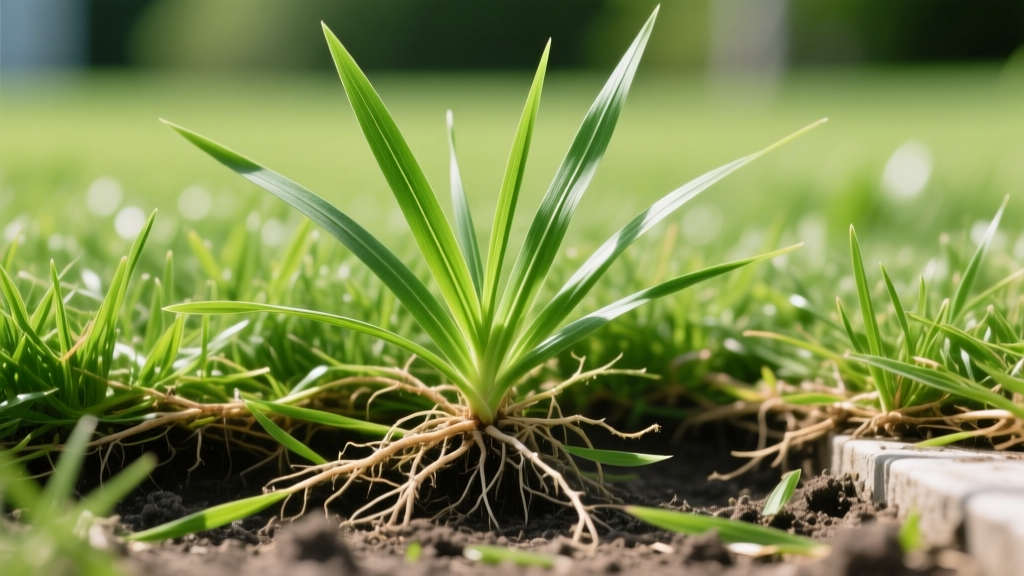
How to Identify Bermuda Grass: Leaf, Root & Growth Traits
The Botanical Fingerprint: How to Identify Bermuda Grass
Accurate turfgrass identification is the foundation of effective lawn care. Misidentifying a warm-season grass can lead to disastrous herbicide applications, incorrect mowing heights, and severe winterkill. Bermuda grass (Cynodon dactylon) possesses a distinct anatomical profile that separates it from other warm-season species and invasive weeds. To confidently identify bermuda grass, you must examine the collar region, the root architecture, and the growth habit.
Leaf Blade Anatomy and the Collar Region
The most reliable way to identify bermuda grass is by examining the collar region—the area where the leaf blade meets the leaf sheath. Professional agronomists rely on three specific structures here:
- Vernation: Bermuda grass exhibits folded vernation in the bud. When a new leaf emerges from the sheath, it is folded in half, unlike zoysiagrass or crabgrass, which emerge rolled.
- Ligule: The ligule on bermuda grass is a short, distinct fringe of white hairs, typically measuring between 0.5 and 1.5 millimeters in length. It is not a solid membrane like you would find on tall fescue or annual bluegrass.
- Collar: The collar is broad, slightly constricted, and often features fine hairs along the margins.
The leaf blades themselves are flat, typically 1/8 to 1/4 inch wide, and possess a rough texture when you run your fingers toward the base. The color ranges from medium to dark green during peak summer growth, depending on nitrogen availability.
The Tug-and-Tear Test: If you pull a mature bermuda grass blade away from the sheath, it will typically tear unevenly rather than snapping cleanly. This fibrous tearing is a quick field indicator of its aggressive, resilient cellular structure.
Root System: Stolons and Rhizomes
Bermuda grass is a dual-threat spreader. It propagates vegetatively through both above-ground stolons and below-ground rhizomes. The stolons are flattened, wiry, and root aggressively at the nodes when they touch bare soil. Below the surface, the rhizomes are scaly, tough, and can penetrate up to 6 inches deep in compacted clay soils. This deep rhizome network is why bermuda grass is notoriously difficult to eradicate when it invades cool-season lawns; pulling the above-ground stolons leaves the subterranean rhizomes intact to regenerate.
Bermuda Grass vs. Common Lookalikes
Homeowners frequently confuse bermuda grass with other stoloniferous grasses or aggressive weeds. Use this comparison matrix to isolate the exact species in your turf canopy.
| Trait | Bermuda Grass | Zoysiagrass | Crabgrass (Smooth) | Quackgrass |
|---|---|---|---|---|
| Vernation | Folded | Rolled | Rolled | Rolled |
| Ligule | Short fringe of hairs | Fringe of hairs (longer) | Membranous, smooth | Membranous, short |
| Stolons/Rhizomes | Both present | Both present | Stolons only (no rhizomes) | Rhizomes only (no stolons) |
| Blade Texture | Soft to medium, rough edges | Very stiff, high silica | Soft, smooth, wide | Medium, rough upper surface |
| Seed Head | 3-7 spikes (windmill shape) | Rare, single cylindrical spike | 2-6 finger-like spikes | Slender, wheat-like spike |
According to turfgrass experts at NC State University TurfFiles, the presence of both stolons and rhizomes is the primary vegetative trait that separates bermuda from smooth crabgrass, which lacks rhizomes entirely. Furthermore, quackgrass can be immediately ruled out by the presence of auricles (claw-like appendages at the collar), which bermuda grass completely lacks.
Seasonal Identification Cues: Dormancy vs. Active Growth
Bermuda grass is a warm-season perennial, meaning its visual profile shifts dramatically with soil temperatures. Identifying it during dormancy requires a different approach than identifying it in July.
The Dormant Phase (Late Fall to Early Spring)
Following the first hard frost, bermuda grass enters dormancy. The canopy turns a uniform straw-brown or tan color. Unlike cool-season grasses that remain green, dormant bermuda feels brittle and dry. During this phase, identification relies entirely on pulling back the dead thatch to examine the wiry, brown stolons and digging for the scaly, white-to-tan rhizomes beneath the soil surface.
Spring Green-Up
Bermuda grass breaks dormancy when soil temperatures at a 2-inch depth consistently reach 65°F. Green-up does not happen uniformly; it begins in microclimates near sidewalks, driveways, and south-facing slopes where radiant heat is highest. If you see patchy green islands emerging in a brown lawn in early spring, you are likely looking at bermuda grass initiating its active growth cycle.
Advanced Identification: Hybrid vs. Common Bermuda
Not all bermuda grass is created equal. The species you are identifying dictates its maintenance requirements, drought tolerance, and aesthetic ceiling.
- Common Bermuda (Cynodon dactylon): Typically seeded. It features a coarser leaf texture, wider blades, and produces abundant seed heads if mowed above 1.5 inches. It is highly aggressive and often classified as a weed in mixed turf stands.
- Hybrid Bermuda (e.g., TifTuf, Celebration, Latitude 36): These are sterile triploid crosses between C. dactylon and C. transvaalensis. They must be established vegetatively (sod or sprigs). Hybrids feature a much finer leaf texture, denser canopy, and superior shade tolerance. They do not produce viable seed, meaning you will never see mature seed heads on a properly maintained hybrid cultivar.
'The transition from common seeded bermuda to vegetatively propagated hybrids like TifTuf has fundamentally changed water management in the transition zone. Hybrids offer a 30% to 40% improvement in water use efficiency while maintaining a denser, finer-textured canopy that naturally outcompetes broadleaf weeds.'
— University of Georgia Turfgrass Breeding Program Research Notes
Troubleshooting Misidentification: When Herbicides Fail
The most costly mistake in lawn care is applying a selective herbicide to a misidentified grass. A common scenario occurs when bermuda grass invades a Tall Fescue lawn. Homeowners often mistake the invasive bermuda stolons for creeping bentgrass or nimblewill.
If you misidentify nimblewill and apply a standard crabgrass pre-emergent, the nimblewill will thrive. If you misidentify bermuda grass and apply Quinclorac (a standard crabgrass killer), the bermuda will simply absorb it and continue spreading. To selectively remove bermuda grass from a Tall Fescue lawn, you must use Fluazifop-butyl (found in products like Fusilade II) or Sethoxydim, applied in multiple low-dose applications during the active growing season. Always confirm the presence of folded vernation and hairy ligules before purchasing specialized graminicides. For definitive chemical control guidelines, consult the University of California Statewide IPM Program database.
Frequently Asked Questions
Can I identify bermuda grass by its seed heads?
Yes, but only if it is common bermuda grass and allowed to grow unmowed. The seed head resembles a windmill with 3 to 7 slender spikes radiating from a central stem. Hybrid bermudagrasses are sterile and will not produce viable seed heads.
Why does my bermuda grass look thin and weedy?
Bermuda grass requires full sun (minimum 8 hours of direct sunlight). If it is planted in shaded areas beneath tree canopies, the internodes on the stolons will elongate, the canopy will thin out, and it will become highly susceptible to weed invasion. In these scenarios, it is often misidentified as a weak, invasive weed rather than a struggling warm-season turf.
How deep do bermuda grass rhizomes grow?
In well-aerated soils, rhizomes typically reside in the top 2 to 3 inches. However, in heavily compacted clay soils or during severe drought, they can drive as deep as 6 inches to access subsoil moisture, making mechanical eradication nearly impossible without deep tilling.

