
Grass Types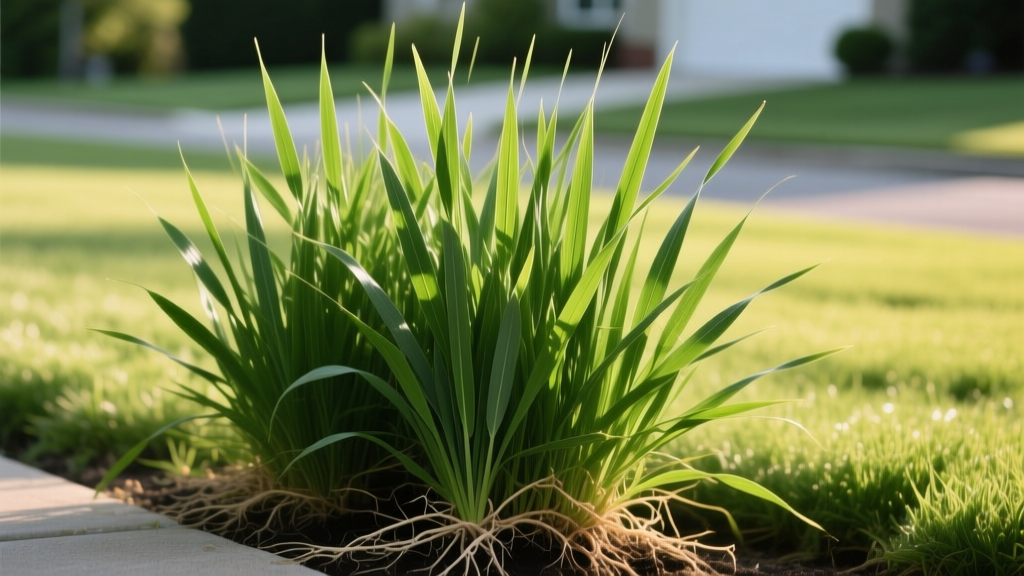
What Does Tall Fescue Look Like? A Visual Identification Guide
Identifying cool-season grasses can be frustrating for homeowners, especially when transitioning between seasons or dealing with patchy lawn thinning. If you are asking, 'what does tall fescue look like?', you are likely trying to distinguish it from Kentucky bluegrass, perennial ryegrass, or even invasive crabgrass. Tall fescue (Festuca arundinacea, also classified as Schedonorus arundinaceus) is a deep-rooted, drought-tolerant bunchgrass that dominates the transition zone of the United States. However, its visual characteristics vary wildly depending on whether you are looking at an older pasture variety or a modern turf-type cultivar.
This guide breaks down the exact botanical markers, blade structures, and growth habits you need to positively identify tall fescue in your lawn, utilizing data from the North Carolina State University TurfFiles and current National Turfgrass Evaluation Program (NTEP) standards.
The Blade: Texture, Width, and Color
The most immediate way to identify tall fescue is by examining the leaf blade. Unlike the fine, narrow blades of Kentucky bluegrass, tall fescue features a distinctly broad and coarse texture.
- Width: Mature blades typically measure between 1/4 and 3/8 of an inch wide. This is roughly two to three times wider than Kentucky bluegrass.
- Midrib: A prominent, distinct midrib runs down the center of the upper leaf surface. If you fold the blade in half lengthwise, it will naturally crease along this vein.
- Surface Texture: The upper surface is dull and heavily veined, while the underside is highly glossy and smooth.
- Edge Serration: The margins (edges) of the blade are finely serrated. If you pinch the blade and pull your fingers upward toward the tip, it will feel rough and catch slightly; pulling downward feels smooth.
- Color: Older varieties present a light, almost yellowish-green. Modern turf-type tall fescues (TTTF) exhibit a deep, rich dark green, often maintaining this hue well into early winter.
Quick Botanical ID Cheat Sheet
Vernation (Bud): Rolled (unlike Kentucky bluegrass, which is folded).
Ligule: Short, membranous, and slightly fringed (0.5mm to 1mm long).
Auricles: Short, blunt, and often barely visible or entirely absent. They do not clasp the stem tightly.
Collar: Broad, continuous, and distinctively angled.
Below the Surface: Root and Crown Structure
What does tall fescue look like beneath the soil? Understanding its subterranean structure explains its famous drought tolerance and its primary visual flaw: clumping.
Tall fescue is primarily a bunch-type grass. It does not spread laterally via aggressive rhizomes (underground stems) or stolons (above-ground runners) like Kentucky bluegrass or bermudagrass. Instead, it grows in distinct, dense clumps or 'bunches' from a central crown. While some newer TTTF cultivars (such as 'Titan Ultra' or 'Mustang IV') have been bred to produce very short, limited rhizomes to improve lateral spread, they still fundamentally rely on a bunching growth habit.
Because it lacks aggressive lateral spread, tall fescue cannot naturally 'fill in' bare spots. If a clump dies from disease or dog urine, it leaves a distinct, circular bare patch that will not heal on its own, requiring manual overseeding. However, its root system is its superpower. Tall fescue roots can penetrate 2 to 3 feet deep into heavy clay soils, allowing it to access moisture that shallow-rooted grasses cannot reach during peak summer heat.
Tall Fescue vs. Lookalikes: A Comparison Matrix
Homeowners frequently confuse tall fescue with other cool-season grasses or summer annual weeds. Use this matrix to cross-reference your lawn's physical traits against common lookalikes.
| Grass Species | Blade Width | Vernation | Auricles | Growth Habit |
|---|---|---|---|---|
| Tall Fescue | 1/4' - 3/8' (Broad) | Rolled | Blunt / Absent | Bunch |
| Kentucky Bluegrass | 1/8' - 1/5' (Narrow) | Folded | Short / Claw-like | Rhizomatous |
| Perennial Ryegrass | 1/8' - 1/4' (Medium) | Folded | Long / Clasping | Bunch |
| Crabgrass (Weed) | 1/4' - 2/5' (Broad) | Folded | Absent | Stoloniferous |
Note: According to the University of California IPM, tall fescue is sometimes misidentified as a weed in bluegrass lawns because its bunching habit and wider blades create a visually disruptive, clumpy texture compared to the uniform carpet of rhizomatous grasses.
Modern Turf-Type (TTTF) vs. Kentucky 31 (K-31)
When discussing what tall fescue looks like, you must distinguish between the two main categories available on the market. The visual difference between them is drastic.
Kentucky 31 (K-31) Pasture Fescue
Introduced in the 1930s, K-31 is an agricultural forage grass. It features very wide, coarse, light-green blades and an aggressive, upright growth habit. In a residential lawn, K-31 looks incredibly clumpy, resembles a weed, and requires frequent mowing to prevent it from developing thick, unsightly seed stalks. It is often sold in cheap, generic 'Sun & Shade' seed mixes. Avoid K-31 for aesthetic lawn applications.
Turf-Type Tall Fescue (TTTF)
Developed through intensive breeding programs, TTTF cultivars (such as 'Rebel', 'Mustang IV', and 'Titan Ultra') are engineered specifically for residential lawns. TTTF features blades that are 30% to 40% narrower than K-31, a much darker green genetic hue, and a denser, more prostrate growth habit that mimics the carpet-like look of Kentucky bluegrass while retaining the deep root system of traditional fescue. If you are purchasing seed in 2026, always verify the tag specifies 'Turf-Type' or lists specific NTEP-rated cultivars.
Seasonal Appearance and Stress Responses
Tall fescue's appearance changes distinctly based on environmental stressors. Recognizing these shifts prevents misdiagnosis of lawn diseases.
- Summer Heat Stress: During prolonged periods above 90°F, tall fescue will slow its vertical growth. The blades may roll inward slightly (a defense mechanism to reduce transpiration surface area) and take on a bluish-gray tint before browning if irrigation is withheld.
- Brown Patch Disease: Tall fescue is highly susceptible to Rhizoctonia solani (Brown Patch) in hot, humid weather. Visually, this presents as irregular, tan-colored lesions on the leaf blades with dark brown borders, often forming distinct circular patches 1 to 3 feet in diameter that feature a dark 'smoke ring' at the perimeter in the early morning.
- Winter Dormancy: Unlike warm-season grasses that turn completely straw-brown, tall fescue retains a degree of green in mild winters. In hard freeze zones, the tips will burn back and turn tan, but the crown and lower sheath will remain viable and green.
Expert Identification Field Test
If you are standing in your yard and need to confirm the grass type immediately, perform this 60-second physical field test:
- Extract a Single Shoot: Pull a single grass plant from the soil, ensuring you get the base and a bit of the root.
- Check the Base (Vernation): Look at the lowest, unopened leaf bud. If it is tightly rolled like a cigarette, it is likely tall fescue or perennial ryegrass. If it is folded flat like a book, it is bluegrass.
- Inspect the Sheath Color: Look at the stem sheath near the soil line. Tall fescue sheaths frequently exhibit a distinct reddish-purple pigmentation at the very base, a key indicator not found in ryegrass.
- Feel the Blade Edges: Run your thumb and forefinger up the blade toward the tip. The distinct 'grabbing' or rough sensation confirms the serrated margins of tall fescue.
- Look for Auricles: Peel back the leaf sheath to expose the collar. If you see long, finger-like auricles wrapping around the stem, you have perennial ryegrass. If they are blunt, tiny, or missing entirely, you have successfully identified tall fescue.

