
Grass Types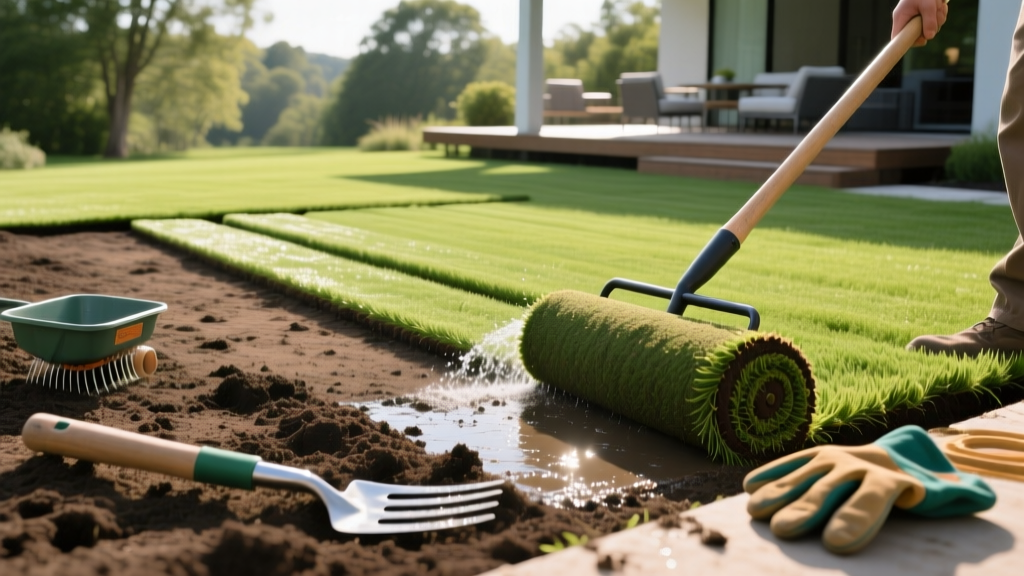
Installing Bahia Sod: Soil Prep and Establishment Guide
Bahia sod (Paspalum notatum) is the undisputed workhorse of the deep South and coastal plains. Prized for its exceptional drought tolerance, deep root system, and ability to thrive in nutrient-poor, sandy soils where other turfgrasses fail, Bahia is a practical choice for homeowners seeking a low-maintenance, rugged lawn. However, its establishment phase requires precise soil manipulation and strict watering protocols. Unlike St. Augustine or Zoysia, Bahia sod is highly sensitive to soil alkalinity and improper planting depth, making site preparation the single most critical factor in long-term turf survival.
This guide details the exact agronomic steps, cultivar selection metrics, and 30-day watering matrices required to successfully establish Bahia sod in challenging soil environments.
Choosing the Right Bahia Cultivar for Your Lawn
Not all Bahia is created equal. While often sold generically at local sod farms, Bahia has distinct varietals that dictate blade width, color density, and seedhead production. Selecting the wrong cultivar for a residential lawn often results in a sparse, pasture-like appearance.
| Cultivar / Variety | Blade Characteristics | Best Use Case | Seedhead Production |
|---|---|---|---|
| Argentine | Wide, dark green, dense canopy | Residential lawns, high-traffic areas | Moderate (requires frequent mowing) |
| Pensacola | Narrow, light green, sparse | Roadsides, pastures, erosion control | Heavy (produces tall Y-shaped stalks) |
| Tifton-9 | Improved Pensacola, finer texture | Large estates, low-input commercial sites | Low to Moderate |
Expert Selection Tip: Always specify Argentine Bahia when ordering from a sod farm for a residential property. Pensacola is cheaper and often substituted by unscrupulous suppliers, but its aggressive, tall seedheads and sparse growth habit make it unsuitable for a manicured home lawn.
Critical Soil Preparation: The pH and Phosphorus Mandate
Bahia sod has a unique agronomic quirk: it suffers severely from iron chlorosis in alkaline soils. If your soil pH exceeds 7.0, the grass will be unable to absorb iron and manganese, resulting in a sickly, pale-yellow lawn that no amount of nitrogen fertilizer can fix. According to turfgrass researchers at the University of Florida IFAS Extension, Bahia thrives optimally in a pH range of 5.5 to 6.5.
Step-by-Step Soil Amendment
- Conduct a Core Soil Test: Extract 4-inch core samples from 10 locations across the yard. Send them to a university extension lab for a comprehensive pH and phosphorus analysis.
- Acidify Alkaline Soil: If pH is above 7.0, apply elemental sulfur. A standard application rate is 1 pound of elemental sulfur per 100 square feet to drop the pH by approximately 0.5 points. Incorporate this into the top 4 inches of soil using a rototiller.
- Till to 6 Inches: Bahia develops a massive, deep rhizome system. Compacted subsoil will stunt root penetration. Rototill the site to a depth of 4 to 6 inches, breaking up hardpan layers.
- Apply Starter Fertilizer: New sod lacks the root mass to forage for nutrients. Apply a high-phosphorus starter fertilizer (such as a 10-20-10 NPK ratio) at a rate of 1 pound of nitrogen per 1,000 square feet immediately before laying the sod. Phosphorus is critical for rapid root cell division.
Laying the Sod: Techniques for Rapid Rooting
Once the soil is graded and lightly raked to remove debris, the physical installation begins. Bahia sod rolls are typically harvested at 16 inches wide by 4.5 feet long (covering roughly 6 square feet per roll). Current market pricing for Argentine Bahia sod averages between $0.45 and $0.75 per square foot, depending on regional freight and farm availability.
Warning: The Drying Window
Bahia sod is highly porous and loses moisture rapidly. You have a maximum 2-hour window from the time the sod is unloaded from the pallet to when it must be watered. If installing in summer temperatures above 85°F, lay and water in small 500-square-foot sections rather than laying the entire yard at once.
Bahia sod is highly porous and loses moisture rapidly. You have a maximum 2-hour window from the time the sod is unloaded from the pallet to when it must be watered. If installing in summer temperatures above 85°F, lay and water in small 500-square-foot sections rather than laying the entire yard at once.
Installation Mechanics:
- Stagger the seams in a brick-like pattern to prevent continuous water channels that can wash away topsoil.
- Push edges tightly together; do not overlap, but do not leave gaps wider than 1/8 inch.
- Use a lawn roller filled with water to press the sod firmly into the soil. This eliminates air pockets beneath the rhizomes that will otherwise desiccate and kill the root nodes.
The 30-Day Establishment Watering Matrix
Overwatering is the leading cause of Bahia sod failure. Unlike St. Augustine, which tolerates saturated soils, Bahia is susceptible to root rot (Pythium) if kept constantly soggy. The goal is to keep the top 1 inch of soil moist while encouraging roots to chase deeper moisture. The USDA NRCS Plant Database notes that mature Paspalum notatum roots can reach depths of over 6 feet, but this requires proper early training.
| Timeframe | Watering Frequency | Volume / Duration | Visual Indicators to Watch |
|---|---|---|---|
| Days 1-10 | 2 to 3 times daily | 1/4 inch per session (approx. 10 mins) | Sod should feel spongy; edges must not curl. |
| Days 11-20 | 1 time daily | 1/2 inch per session (approx. 20 mins) | Gently tug sod; resistance indicates root anchoring. |
| Days 21-30 | Every 2nd day | 3/4 inch per session | Reduce watering if soil remains muddy at 2-inch depth. |
| Day 31+ | 1 to 2 times weekly | 1 inch per session (deep soak) | Transition to deep, infrequent drought-training cycles. |
Troubleshooting Early Establishment Failures
1. Iron Chlorosis (Yellowing Turf)
If your newly laid Bahia sod turns pale yellow or white while the veins remain green, your soil pH is too high, locking out iron. The Fix: Apply a liquid chelated iron spray (Fe-EDDHA formulation) directly to the foliage for immediate greening, followed by a granular elemental sulfur application to the soil to permanently lower the pH. Do not apply high-nitrogen synthetic fertilizers to chlorotic Bahia; it will exacerbate the deficiency by forcing top growth without the necessary micronutrients.
2. Mole Cricket Damage
Mole crickets are the most destructive insect pest for Bahia grass in the Southeastern United States. They tunnel through the top 2 inches of soil, severing new rhizomes and lifting the sod away from the soil surface, causing rapid desiccation. The Fix: If you notice small, muddy mounds or spongy, detached turf, apply a curative insecticide containing Bifenthrin or Imidacloprid immediately. For long-term prevention, apply a preventative granular treatment in early spring of the second year.
3. Scalping and Mowing Shock
Bahia sod requires a higher mowing height than almost all other warm-season grasses. The growing point (crown) is elevated. Mowing below 3 inches will scalp the lawn, exposing the soil to weed invasion and severely stunting the root system. The Fix: Set your mower deck to exactly 3.5 to 4 inches. Never remove more than one-third of the blade height in a single pass. Because Bahia produces tough, fibrous leaves, ensure your mower blades are razor-sharp; dull blades will shred the tips, leaving the lawn vulnerable to fungal pathogens like gray leaf spot.

