
Grass Types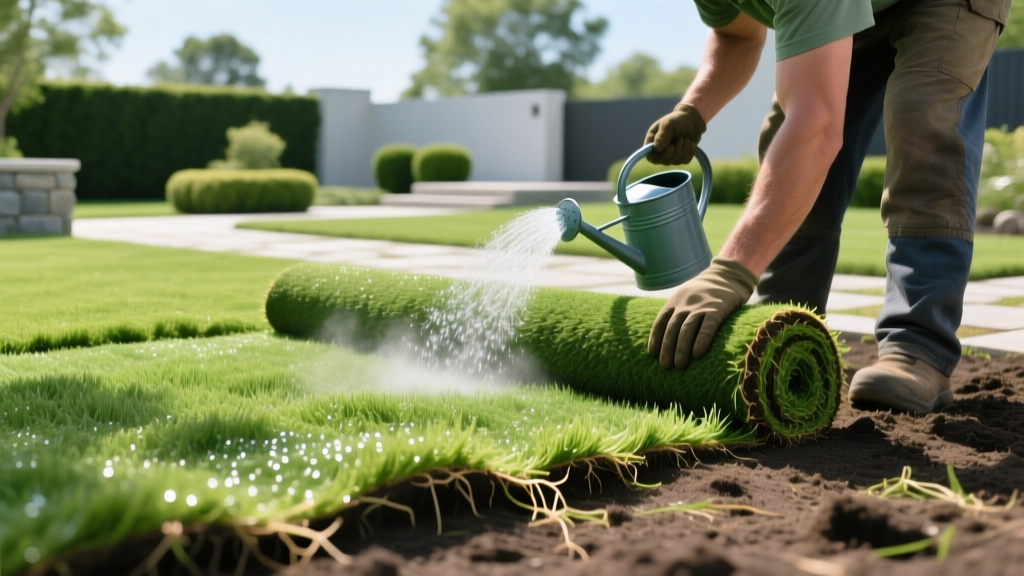
Installing Sod in Summer: Heat Stress Prevention and Watering Guide
The Summer Sod Paradox: Evaporation vs. Root Rot
Installing sod during peak summer months (June through August) presents a narrow margin for error. The primary challenge is balancing the high evaporation rates caused by ambient temperatures exceeding 90°F with the severe risk of fungal pathogens that thrive in warm, saturated soil. When soil temperatures surpass 85°F, turfgrass root growth naturally stalls, meaning the sod must rely entirely on its pre-harvest root mass and the moisture in the top 1.5 inches of soil to survive the first 14 days.
According to turfgrass research from Texas A&M Agrilife Extension, summer sod failure is rarely caused by the grass itself, but rather by hydrophobic native soil and improper irrigation cycling. Deep, infrequent watering—the standard advice for established lawns—will kill new summer sod within 48 hours by allowing the shallow root zone to desiccate between cycles.
Warning: Pythium Blight Risk
Overwatering combined with soil temperatures above 80°F creates the perfect environment for Pythium blight, a devastating water mold. If your newly laid sod develops greasy, dark, water-soaked lesions that quickly turn brown and mat to the soil, you are overwatering. Reduce irrigation frequency immediately and apply a preventative fungicide containing azoxystrobin or pyraclostrobin.
Overwatering combined with soil temperatures above 80°F creates the perfect environment for Pythium blight, a devastating water mold. If your newly laid sod develops greasy, dark, water-soaked lesions that quickly turn brown and mat to the soil, you are overwatering. Reduce irrigation frequency immediately and apply a preventative fungicide containing azoxystrobin or pyraclostrobin.
Pre-Installation Soil Architecture
Before the delivery truck arrives, the native soil must be engineered to hold moisture without drowning the stolons. Summer heat bakes clay soils into a hydrophobic crust, causing irrigation water to sheet off the surface rather than penetrate the sod-soil interface.
Amending and Pre-Wetting
- Tillage Depth: Rototill the top 4 to 6 inches of native soil. Shallow tilling (less than 3 inches) creates a hardpan that prevents deep root penetration once the summer heat breaks.
- Organic Matter: Incorporate 2 to 3 cubic yards of fully composted organic matter per 1,000 square feet. This increases the soil's water-holding capacity by up to 20%.
- Surfactant Application: 24 hours before installation, apply a yucca-based wetting agent (such as Aqua-Aid or a generic soil surfactant) to the bare soil and water it in. This breaks the surface tension of hydrophobic soil particles.
- Starter Fertilizer: Apply a high-phosphorus starter fertilizer (e.g., 10-18-10 NPK) at a rate of 1.0 lb of nitrogen per 1,000 square feet to stimulate rapid root initiation.
Heat-Tolerant Cultivar Selection & 2026 Pricing
Not all grasses handle the shock of summer harvest and installation equally. Selecting a cultivar bred for heat and drought tolerance is critical. Below are the top performers for warm-season and transitional zone summer installations, reflecting current 2026 wholesale-to-retail pricing.
| Cultivar | Grass Type | Heat/Drought Tolerance | Avg. Price (per 450 sq ft pallet) |
|---|---|---|---|
| TifTuf | Bermuda | Exceptional (Uses 38% less water) | $275 - $340 |
| Zeon | Zoysia | High (Excellent shade/heat balance) | $310 - $395 |
| RTF (Rhizomatous) | Tall Fescue | Moderate (Best cool-season option) | $220 - $280 |
| Palmetto | St. Augustine | High (Superior coastal heat tolerance) | $240 - $300 |
For homeowners in the transitional zone struggling with summer heat, RTF Tall Fescue offers a unique advantage: its rhizomatous root system allows it to recover from summer stress laterally, unlike traditional bunch-type fescues. However, if ambient temperatures consistently exceed 95°F, warm-season options like TifTuf Bermuda remain the safest establishment bet.
The 21-Day Summer Watering Matrix
The goal of the first three weeks is to keep the top 1.5 inches of soil consistently moist, not soggy. A standard impact sprinkler delivers roughly 1.5 inches of water per hour. Therefore, 0.1 inches of water requires approximately 4 minutes of run time. Use the following matrix, adjusting slightly based on your specific soil type (clay retains water longer; sand drains faster).
Pro Tip: The Tug Test
Starting on Day 10, gently pull upward on the corner of a sod piece. If you feel resistance, roots are penetrating the native soil. If it lifts easily, the soil interface is too dry or compacted.
Starting on Day 10, gently pull upward on the corner of a sod piece. If you feel resistance, roots are penetrating the native soil. If it lifts easily, the soil interface is too dry or compacted.
| Timeframe | Frequency | Duration per Zone | Target Moisture Depth |
|---|---|---|---|
| Days 1-7 | 3 to 4 times daily | 3-5 minutes | Top 1 inch (Keep interface wet) |
| Days 8-14 | 2 times daily | 6-8 minutes | Top 2 inches (Encourage downward roots) |
| Days 15-21 | 1 time daily | 10-12 minutes | Top 3 inches (Wean to standard schedule) |
Watering should occur in the early morning (between 4:00 AM and 8:00 AM) and early afternoon. Avoid watering after 6:00 PM in the summer, as prolonged leaf wetness overnight drastically increases the incidence of Brown Patch and Dollar Spot diseases.
Troubleshooting Establishment Failures
Seam Shrinkage and Gapping
If you notice gaps forming between the edges of the sod rolls within the first week, the turf is experiencing severe moisture stress and shrinking. This is highly common in summer installations. The Fix: Do not pull the sod to close the gaps, as this will tear the fragile new micro-roots. Instead, top-dress the gaps with a 50/50 mix of play sand and peat moss, and increase your mid-day watering cycle by 2 minutes to rehydrate the edges.
Spongy or Floating Turf
If the sod feels like a waterbed when you walk on it, you are drowning the roots. The native soil has reached field capacity and cannot absorb more water, leading to anaerobic conditions that rot the basal nodes. The Fix: Skip one full watering cycle to allow the soil profile to breathe. Core aerate the sod lightly using a manual aerator to introduce oxygen to the root zone, and apply a preventative fungicide if temperatures remain above 85°F.
Yellowing or Chlorosis
While some transplant shock is normal, widespread yellowing by Day 12 indicates a nitrogen deficiency or a pH lockout caused by excessive alkaline irrigation water. The Fix: Apply a liquid, fast-release nitrogen source (such as ammonium sulfate, 21-0-0) at a light rate of 0.25 lbs per 1,000 sq ft. Liquid applications bypass the soil and are absorbed directly through the leaf tissue, providing a rapid green-up within 48 hours without risking root burn.
For comprehensive regional data on evapotranspiration rates and localized turfgrass watering restrictions, consult the NC State Extension Carolina Lawns guide and your local water authority's summer conservation mandates before programming your irrigation controller.

