Grass Types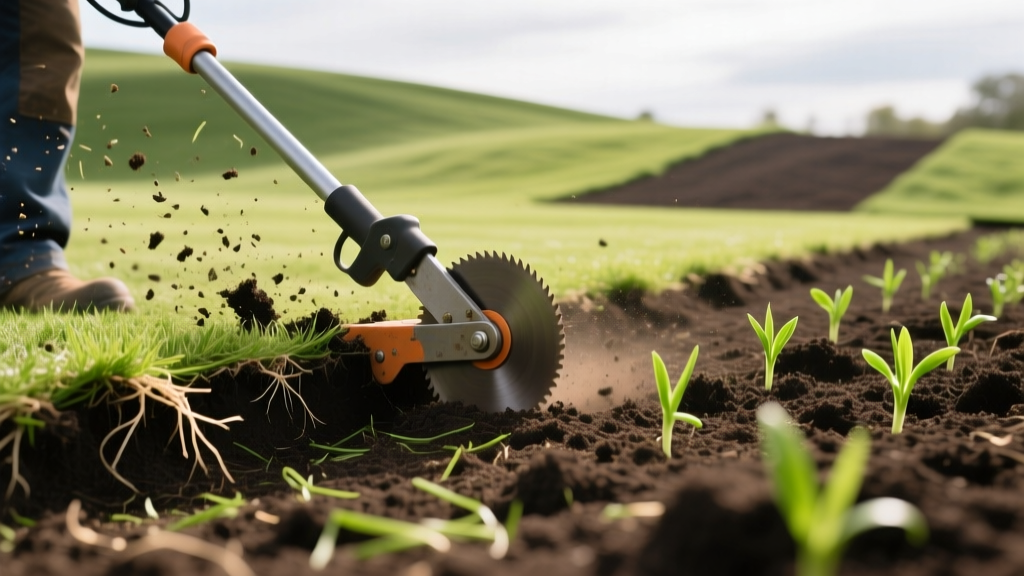
When to Use a Kick Sod Cutter for Grass Seed Bed Preparation
The Mechanics of a Manual Kick Sod Cutter
Establishing a new lawn from seed requires a clean, level, and uncompacted seedbed. While rototillers are the default choice for many homeowners, they destroy soil structure, create a hardpan layer just below the tilling depth, and bring dormant weed seeds to the surface. A manual kick sod cutter offers a precise, low-impact alternative for stripping old turf before grass seed establishment.
A standard kick sod cutter features a 9 to 12-inch hardened steel blade mounted on a long, angled handle with a foot stirrup. The user pushes the blade into the soil at a shallow 15-degree angle, aiming for a depth of 1 to 1.5 inches. By kicking the stirrup forward while pulling back on the handle, the blade severs the grass roots and rhizomes just below the thatch layer, allowing you to roll up the old turf like a carpet. This leaves the underlying soil structure entirely intact, which is critical for the deep root penetration of newly germinated grass seed.
Kick Sod Cutter vs. Rototiller: Seedbed Impact Analysis
Choosing the right turf removal method dictates the success of your grass seed establishment. Below is a structural and biological comparison of the two primary methods.
| Feature | Manual Kick Sod Cutter | Rototiller (Front/Rear Tine) |
|---|---|---|
| Soil Structure | Preserves natural soil horizons and prevents compaction layers. | Destroys soil aggregates; creates a hardpan layer 4-6 inches deep. |
| Weed Seed Exposure | Leaves dormant weed seeds buried deep in the soil profile. | Brings thousands of dormant weed seeds to the surface to germinate. |
| Surface Leveling | Leaves a flat, uniform grade ideal for seed-to-soil contact. | Creates deep ruts and uneven clods requiring extensive raking. |
| Labor Intensity | High physical exertion; best for areas under 2,000 sq ft. | Low physical exertion; machine does the heavy lifting. |
| Cost (Average) | $45 - $85 (Tool purchase, e.g., Ames 12-inch model). | $70 - $120 per day (Equipment rental). |
The Rhizome Trap: Critical Warning for Warm-Season Turf
Before deploying a kick sod cutter, you must identify the grass species you are removing. Kick sod cutters are highly effective for bunch-type cool-season grasses like Tall Fescue and Perennial Ryegrass. However, they present a massive biological risk when removing rhizomatous or stoloniferous grasses.
⚠️ WARNING: Do Not Blindly Cut Rhizomatous Grasses
If you are removing Bermuda, Zoysia, Quackgrass, or creeping Bentgrass, a kick sod cutter will only slice off the top 1 inch of the plant. The deep rhizomes (which can extend 3 to 6 inches below the surface) will remain in the soil. Once you begin watering your new grass seed, these severed rhizomes will aggressively regenerate and choke out your vulnerable seedlings. For these species, you must apply a non-selective herbicide 14 days prior to cutting, or rent a gas-powered walk-behind sod cutter that can dig 3 inches deep to extract the entire root mass.
For authoritative guidance on identifying turfgrass species and their growth habits before renovation, consult the University of Minnesota Extension turf renovation guidelines.
Step-by-Step Turf Removal for Grass Seed Sowing
If your soil test confirms you are dealing with a non-rhizomatous turf, follow this exact protocol to prepare your seedbed using a manual kick sod cutter.
- Mow and Hydrate: Mow the existing lawn down to 1.5 inches. Water the area deeply (applying roughly 0.5 inches of water) 48 hours before cutting. The soil must be at field capacity—moist enough to slice cleanly, but dry enough that it does not stick to the steel blade in heavy clumps.
- Set the Blade Depth: Adjust the blade to cut exactly 1 inch below the soil surface. Cutting too deep wastes energy and removes valuable topsoil; cutting too shallow leaves behind a mat of dead roots that will block water infiltration for your new seed.
- Cut in Parallel Strips: Push the blade into the turf and kick the stirrup in a rhythmic motion. Cut parallel strips roughly 10 to 12 inches apart.
- Cross-Cut and Roll: Make perpendicular cross-cuts every 24 to 36 inches. Use a flat spade to pop up the edge of the grid, then roll the sod strips tightly for removal or composting.
Post-Removal Seedbed Conditioning and Grading
Once the old turf is removed, you are left with bare, undisturbed soil. Do not till this soil. Instead, focus on surface conditioning to maximize seed-to-soil contact, which is the primary driver of germination rates.
Use a heavy-duty lawn leveling rake, such as the Rocklin Industry Levelawn Pro (30-inch model), to drag across the bare soil. This knocks down minor high spots and fills in low divots without inverting the soil profile. If your soil test indicates a pH imbalance, apply pelletized lime or elemental sulfur now, as it will take 3 to 4 weeks to react in the soil profile.
According to Penn State Extension, applying a high-phosphorus starter fertilizer at the time of seeding is critical for root development. Apply a starter fertilizer (e.g., Scotts Turf Builder Starter Food 24-25-4) at a rate of 3.2 lbs per 1,000 square feet immediately before broadcasting your grass seed. Follow up with a light top-dressing of compost or peat moss (no more than 1/4 inch deep) to retain moisture during the 14 to 21-day germination window.
Grass Seed Establishment FAQs
Can I use a kick sod cutter on slopes?
Manual kick sod cutters are safe and effective on gentle grades, but they become dangerous and inefficient on slopes exceeding a 15% grade. The forward-kicking motion compromises your balance on steep inclines, and the blade tends to glide over the surface rather than biting into the soil. For steep slopes, a string trimmer used to scalp the grass down to the dirt, followed by a slit-seeder, is a safer establishment method.
How do I maintain the blade of a kick sod cutter?
The cutting edge of a kick sod cutter dulls rapidly when encountering subsurface pebbles and clay. After every 500 square feet of cutting, inspect the bevel edge. Use a 10-inch flat mill bastard file to maintain the original 30-degree bevel angle. Do not use a bench grinder, as the high heat will draw the temper out of the hardened steel, causing the edge to roll over upon impact with rocks.
What is the best grass seed to plant immediately after sod removal?
Because the soil is undisturbed and weed competition is minimized, you have an ideal environment for slow-establishing, high-quality cultivars. For cool-season lawns, a blend of 3-way Kentucky Bluegrass and fine fescue will thrive. For warm-season lawns (provided rhizomes were properly managed), hulled Bermuda seed or centipedegrass seed will establish rapidly in the late spring when soil temperatures consistently exceed 65°F.