
Grass Types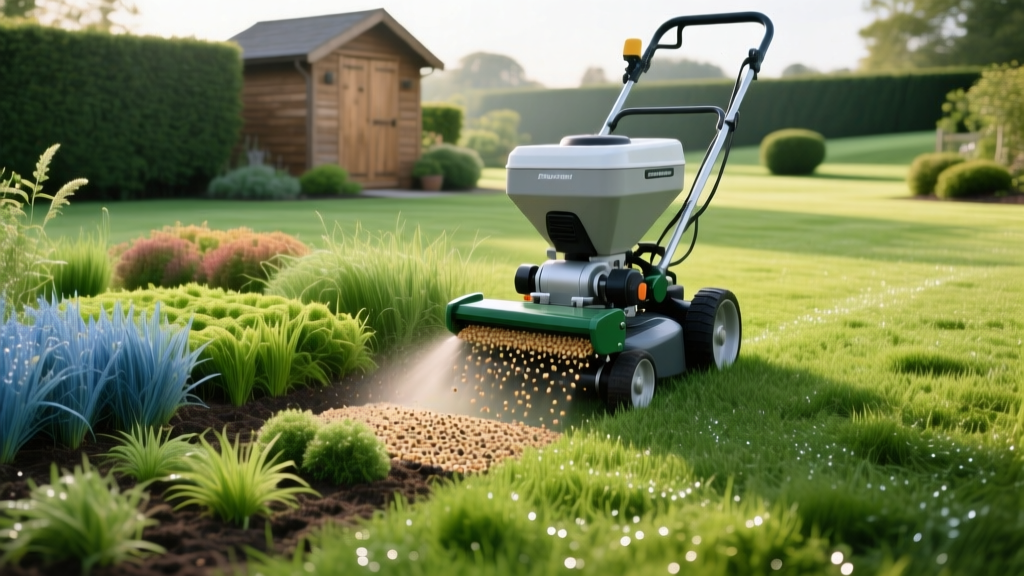
Mastering the Lawn Grass Seeder: Calibration, Selection, and Species-Specific Rates
The Mechanics of Seed Placement: Broadcast vs. Drop vs. Slit Seeders
Selecting the right lawn grass seeder depends entirely on your lot size, terrain, and whether you are establishing a new lawn or overseeding an existing one. Using the wrong equipment leads to uneven germination, seed waste, and vulnerability to weed invasion. In 2026, the market is dominated by three primary seeder architectures, each with distinct mechanical advantages and failure modes.
Broadcast (Rotary) Seeders
Broadcast seeders, such as the Lesco Professional or Scotts EdgeGuard Mini, utilize a spinning impeller to throw seed in a 6- to 12-foot swath. They are ideal for large, open areas and uneven terrain. However, their primary drawback is lateral distribution inconsistency; the heaviest seed concentration falls in the center of the swath, tapering off at the edges. To compensate, operators must employ a 50% overlap pattern on return passes. Current retail pricing for high-quality residential broadcast models ranges from $80 to $180, while commercial-grade stainless steel models exceed $350.
Drop Seeders
Drop seeders, like the Scotts Classic Drop, release seed directly below the hopper through a series of gated holes. They offer pinpoint accuracy, making them mandatory for small urban lots, tight property lines, and areas adjacent to garden beds where stray seed would cause nuisance germination. The trade-off is a narrow application width (typically 22 to 36 inches) and a high susceptibility to 'striping' if the operator fails to align the wheel tracks perfectly on subsequent passes. Expect to pay between $90 and $150 for a durable drop seeder.
Slit Seeders (Overseeders)
For renovation and overseeding, a slit seeder (e.g., Ryan Ren-O-Thin or Billy Goat Overseeder) is unmatched. These motorized machines use vertical steel blades to cut 1/4-inch grooves into the soil, dropping seed directly into the furrow before a trailing brush covers it. This guarantees the critical seed-to-soil contact required for high germination rates. Because they are heavy and motorized, homeowners typically rent them. As of 2026, daily rental rates average $85 to $125, plus a mandatory shear-pin replacement fee if you strike buried irrigation heads.
| Feature | Broadcast (Rotary) | Drop | Slit (Overseeder) |
|---|---|---|---|
| Best Use Case | New lawns, large open areas | Small lawns, precise borders | Overseeding, lawn renovation |
| Application Width | 6 to 12 feet | 2 to 3 feet | 1.5 to 2 feet (motorized) |
| Seed-to-Soil Contact | Poor (requires raking/rolling) | Poor (requires raking/rolling) | Excellent (mechanical injection) |
| Operator Skill Required | Moderate (overlap management) | High (precise wheel tracking) | Low (machine handles placement) |
| Average Cost (2026) | $80 - $350 (Purchase) | $90 - $150 (Purchase) | $85 - $125 (Daily Rental) |
Calibration Framework: Dialing in Your Lawn Grass Seeder
The most common establishment failure is trusting the manufacturer's suggested dial setting printed on the seed bag. These settings are notoriously inaccurate because seed morphology varies wildly between brands. For instance, a heavily polymer-coated seed like Jonathan Green Black Beauty is physically larger and denser than an uncoated Pennington seed, requiring a significantly wider gate opening to achieve the same volumetric flow rate.
According to the University of Minnesota Extension, proper calibration ensures you apply the exact agronomic rate required for your specific turfgrass species, preventing both under-seeding (which invites weeds) and over-seeding (which causes fatal seedling competition for moisture and nutrients).
The 1,000 Square Foot Tarp Method
Do not calibrate on soil, where you cannot recover the seed. Use this exact procedure on a driveway or large tarp:
- Measure the Test Area: Mark off a 10-foot by 100-foot area (exactly 1,000 square feet). If your driveway is shorter, measure a 50-foot run and multiply the final catch weight by 2.
- Prepare the Catchment: Duct-tape a lightweight plastic bag or cloth over the discharge ports of your drop seeder, or place a large tarp on the ground for a broadcast seeder.
- Weigh the Baseline: Weigh 5 pounds of your exact seed mix on a digital kitchen scale. Record the exact weight in ounces.
- Execute the Run: Walk at your normal, steady mowing pace (approx. 3 mph) across the measured distance. Engage the seeder for the exact length of the run.
- Calculate the Rate: Weigh the captured seed. If you started with 80 ounces and captured 6 ounces, you applied 6 ounces per 1,000 sq ft. Multiply by 16 to find the rate per acre, or simply adjust the dial and repeat until your catch weight matches the target rate on the seed tag (e.g., if the target is 4 lbs per 1,000 sq ft, you need to catch exactly 64 ounces).
Species-Specific Seeding Rates and Equipment Pairings
Different grass species have drastically different seed sizes and optimal planting depths. Applying Kentucky Bluegrass at the same rate as Tall Fescue will result in a suffocated, disease-prone stand. The NC State Turfgrass Program emphasizes that seeding depth is just as critical as seeding rate; planting too deep prevents the cotyledon from reaching sunlight, while planting too shallow exposes the radicle to desiccation.
| Turfgrass Species | Target Rate (lbs/1,000 sq ft) | Optimal Planting Depth | Recommended Seeder Type | Establishment Timeline |
|---|---|---|---|---|
| Tall Fescue | 6.0 - 8.0 | 1/4 to 1/2 inch | Slit or Broadcast | 7 - 14 days |
| Kentucky Bluegrass | 1.0 - 2.0 | 1/8 to 1/4 inch | Drop or Broadcast | 21 - 30 days |
| Perennial Ryegrass | 5.0 - 7.0 | 1/4 inch | Drop or Broadcast | 5 - 10 days |
| Bermudagrass (Hulled) | 1.0 - 2.0 | 1/8 inch | Slit or Broadcast | 10 - 21 days |
| Zoysiagrass | 2.0 - 3.0 | 1/4 inch | Slit | 14 - 28 days |
Troubleshooting Common Establishment Failures
Even with a perfectly calibrated lawn grass seeder, environmental and mechanical variables can derail establishment. Use this diagnostic framework to identify and correct issues in the field.
Warning: The 'Striping' Effect
Symptom: Alternating bands of thick and thin grass emergence.
Cause: Inconsistent overlap with a broadcast seeder, or misaligned wheel tracks with a drop seeder. Wind drift exceeding 8 mph can also cause asymmetric distribution on rotary models.
Fix: For broadcast seeders, align the right wheel of the seeder with the left wheel track of the previous pass. Never operate a broadcast seeder in winds over 5 mph. For drop seeders, use the 'cross-hatch' method: apply half the seed walking North-South, and the other half walking East-West.
Pro Tip: Preventing Seed Washouts
Symptom: Bare patches at the bottom of slopes or near downspouts after a rain event.
Cause: Surface water velocity exceeds the friction coefficient of the seed, carrying it away before the radicle can anchor into the soil.
Fix: Never rely on the seeder's mechanical action alone on slopes greater than 15%. After seeding, apply a layer of weed-free straw mulch at a rate of 100 lbs per 1,000 sq ft, or use a bonded fiber matrix (BFM) hydromulch. If using a slit seeder on a slope, always drive horizontally across the grade (on the contour), never vertically up and down.
Dealing with Soil Crusting
In heavy clay soils, intense sunlight and overhead irrigation can bake the top 1/8-inch of soil into a hard crust. This physical barrier prevents the delicate coleoptile of species like Kentucky Bluegrass from penetrating the surface. If you observe a hard crust forming 48 hours after seeding, do not increase watering volume, which will only cause rot. Instead, lightly drag a piece of chain-link fence or a specialized lawn roller with cleats over the area to fracture the crust without displacing the seed.
'The single greatest point of failure in DIY lawn establishment is the assumption that the seeder dial is accurate out of the box. Seed coatings, humidity, and gear wear all alter the volumetric flow. A 15-minute calibration on the driveway saves hundreds of dollars in wasted seed and months of patchy turf recovery.'
Mastering your lawn grass seeder requires treating it as a precision agricultural instrument rather than a simple garden tool. By matching the seeder architecture to your specific turfgrass species, rigorously calibrating the gate opening for your exact seed mix, and employing proper overlap techniques, you establish the foundation for a dense, drought-resilient lawn that will outperform neighboring properties for decades.

