
Grass Types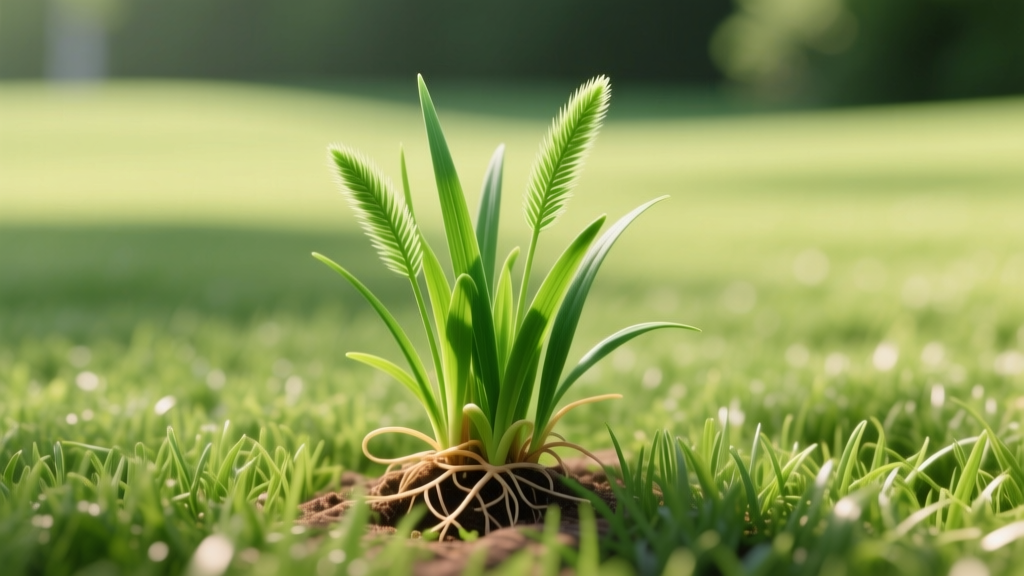
Identifying and Nurturing New Bermuda Grass Sprouts: A Care Guide
The Anatomy of Early Bermuda Grass Sprouts
When establishing Cynodon dactylon (Bermuda grass) from seed or stolons, recognizing the initial growth stages is critical for adjusting your irrigation and mowing practices. New bermuda grass sprouts do not immediately resemble the dense, dark-green turf of a mature lawn. Instead, the first emergence is a single, pale-green, needle-like shoot known as the coleoptile, which protects the emerging leaf. Within 48 to 72 hours of breaking the soil surface, the first true leaf unfurls. This leaf is notably thinner and lighter in color than mature Bermuda blades, often featuring a slight reddish tint at the base near the soil line.
Because these early sprouts lack a developed fibrous root system, they are entirely dependent on surface moisture. According to Clemson University Home & Garden Information Center, the transition from a vulnerable sprout to an anchored seedling requires precise environmental management, particularly regarding soil temperature and surface tension.
Seed Selection: Hulled vs. Unhulled Germination Rates
The speed at which your bermuda grass sprouts emerge depends heavily on the seed preparation you purchase. The physical anatomy of the seed dictates the germination timeline and the required seeding rate.
- Hulled Seed (e.g., Pennington Sahara II): The outer hull is mechanically removed. This allows moisture to penetrate the endosperm rapidly, resulting in sprouts emerging in 7 to 10 days under optimal conditions. Expect to pay between $45 and $60 per 5-pound bag in the current market. Seeding rate: 1 to 2 lbs per 1,000 sq ft.
- Unhulled Seed (e.g., Common Bermuda): Retains its protective outer casing, which must degrade before the sprout can emerge. Germination takes 14 to 21 days. It is more economical ($20 to $30 per 5 lbs) but requires a higher seeding rate of 2 to 3 lbs per 1,000 sq ft to account for lower Pure Live Seed (PLS) percentages.
Germination Timelines and Soil Temperature Matrix
Bermuda grass is a warm-season species that requires consistent heat to trigger enzymatic activity within the seed. Air temperature is a poor metric for germination; you must measure soil temperature at a 2-inch depth using a digital soil probe.
| Soil Temperature (at 2" depth) | Hulled Seed Sprout Time | Unhulled Seed Sprout Time | Germination Success Rate |
|---|---|---|---|
| Below 60°F (15°C) | No emergence | No emergence | 0% (Seed may rot) |
| 60°F - 65°F (15-18°C) | 14 - 21 days | 21 - 30 days | 40% - 55% |
| 65°F - 75°F (18-24°C) | 7 - 10 days | 14 - 21 days | 75% - 85% |
| 75°F - 85°F (24-29°C) | 5 - 7 days | 10 - 14 days | 85% - 95% (Optimal) |
| Above 90°F (32°C) | 5 - 7 days | 10 - 14 days | 60% (High desiccation risk) |
Pro Tip: If your soil is hovering around 62°F, delay planting. The prolonged moisture required to force sprouting at low temperatures invites Pythium blight and seed rot.
The 30-Day Sprout Establishment Protocol
Once the first bermuda grass sprouts break the surface, you enter a critical 30-day window. The goal is to transition the plant from surface-dependent moisture to deep-rooted drought tolerance without inducing shock.
Phase 1: Days 1–14 (Moisture Management)
Sprouts at this stage have roots less than half an inch deep. You must keep the top 1 inch of soil consistently moist, but never waterlogged. Run your irrigation system 3 to 4 times daily for 5 to 8 minutes per zone. If you observe standing water or a spongy soil surface, reduce the duration to prevent drowning the shallow root hairs.
Phase 2: Days 15–21 (Root Anchoring)
As the sprouts develop their second and third true leaves and reach a height of 1.5 inches, begin stretching out the watering intervals. Reduce frequency to once daily for 15 to 20 minutes. This mild surface drying encourages the stolons and rhizomes to push deeper into the soil profile in search of moisture.
Phase 3: Days 22–30 (First Mow and Feed)
When the majority of the sprouts reach 2.5 inches in height, it is time for the first mowing. Set your mower deck to 1.5 inches and ensure the blades are razor-sharp. Dull blades will tear the tender sprouts, pulling them out of the ground entirely due to their weak root anchorage. Immediately following the first mow, apply a high-phosphorus starter fertilizer.
Fertilizer Recommendation: Apply a product like Scotts Turf Builder Starter Food for New Grass (18-24-6 NPK) at a rate of 1 lb of Nitrogen per 1,000 sq ft. The high phosphorus content (the middle number) is non-negotiable for stimulating rapid rhizome development in young Bermuda sprouts.
Troubleshooting Sprout Failure Modes
Even with meticulous preparation, bermuda grass sprouts can fail. According to NC State University TurfFiles, diagnosing the exact failure mode requires observing the physical symptoms of the dying tissue.
- Damping Off (Pythium spp.): Sprouts emerge successfully but suddenly pinch off at the soil line and collapse. The base of the stem will appear water-soaked and brown. Fix: Improve drainage, reduce watering frequency, and apply a preventative fungicide containing Azoxystrobin (e.g., Scotts DiseaseEx) at the first sign of pinching.
- Desiccation (Wind Burn): Sprouts turn white or pale yellow at the tips and curl inward. This occurs when hot, dry winds evaporate surface moisture faster than the shallow roots can replace it. Fix: Increase mid-day irrigation cycles by 2 minutes and consider laying a light layer of compost or peat moss (no more than 1/8 inch) over the seedbed to retain surface humidity.
- Pre-Emergent Herbicide Carryover: Seeds fail to sprout entirely, or sprouts emerge stunted and immediately turn purple before dying. If you applied a pre-emergent like Prodiamine (Barricade) within the last 6 to 8 months, the chemical barrier is still active in the top inch of soil. Fix: There is no chemical reversal. You must heavily aerate the soil, apply activated charcoal, or wait until the pre-emergent naturally degrades before re-seeding.
Managing Volunteer Sprouts in Cool-Season Lawns
The term "bermuda grass sprouts" is also frequently used by homeowners dealing with invasive volunteer growth in Fescue or Kentucky Bluegrass lawns. Because Bermuda spreads aggressively via above-ground stolons and below-ground rhizomes, small sprouts often breach the canopy of cool-season turf during late spring.
If you are trying to eradicate these volunteer sprouts without killing your cool-season lawn, timing and active ingredients are paramount. Do not use Mesotrione (Tenacity), as it is highly phytotoxic to Bermuda grass and will cause severe bleaching, but it is also unsafe for certain cool-season grasses at high rates. Instead, utilize Fluazifop-butyl (found in Ortho Grass B Gon) or Quinclorac (Drive XLR8). Apply these post-emergent herbicides when the volunteer bermuda sprouts are actively growing but before daytime air temperatures exceed 85°F, which prevents thermal stress and chemical burn on your desirable Fescue or Bluegrass.
Summary Checklist for Success
- Verify soil temperature is consistently above 65°F at a 2-inch depth.
- Choose hulled seed for faster sprouting or unhulled for budget-friendly bulk coverage.
- Maintain surface moisture with short, frequent irrigation cycles for the first 14 days.
- Execute the first mow at exactly 1.5 inches using a sharpened blade.
- Apply a high-phosphorus starter fertilizer immediately after the first mow to force rhizome expansion.

