
Grass Types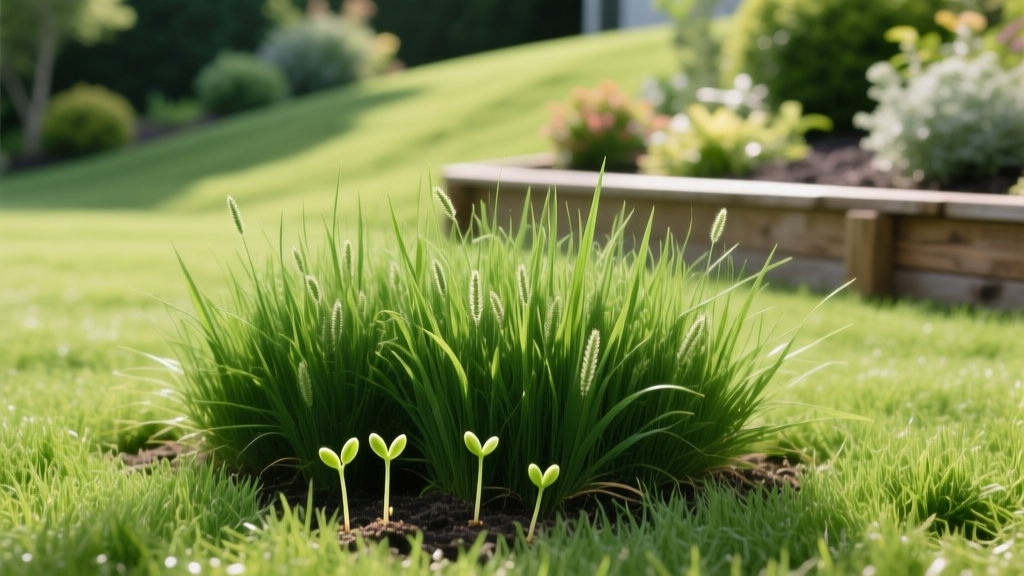
How to Overseed and Thicken a Clumping Fescue Lawn
The Bunchgrass Dilemma: Why Clumping Fescue Thins Out
Unlike Kentucky bluegrass or Bermudagrass, which spread laterally via rhizomes and stolons to naturally repair damaged areas, clumping fescue—encompassing turf-type tall fescue (TTTF) and fine fescue varieties—exhibits a bunch-type growth habit. It expands vertically through tillering rather than horizontally. When a mature tiller dies from drought stress, disease, or heavy foot traffic, it leaves a permanent void in the turf canopy. According to North Carolina State Extension, this biological limitation makes routine overseeding not just a cosmetic enhancement, but a mandatory structural maintenance practice for fescue lawns.
To maintain a dense, weed-resistant turf, you must artificially reintroduce seed into the soil profile annually. This guide details the precise agronomic steps, seeding rates, and environmental thresholds required to successfully thicken a clumping fescue lawn and eliminate bare patches.
Optimal Timing and Soil Temperature Thresholds
Clumping fescue is a cool-season grass. Seeding during the heat of summer invites Pythium blight and rapid desiccation, while late spring seeding results in shallow root systems that cannot survive July temperatures. The ideal window for overseeding is late summer to early fall, specifically when soil temperatures at a 2-inch depth consistently drop to between 50°F and 65°F. This typically aligns with daytime air temperatures of 60°F to 75°F and nighttime temperatures around 50°F.
Pro Tip: Do not rely on air temperature alone. Use a digital soil thermometer inserted 2 inches into the ground. Fescue seed germinates optimally when the soil is cooling down, allowing the seedling to establish a deep taproot before winter dormancy.
Step-by-Step Overseeding Protocol
Phase 1: Canopy Reduction and Soil Fracturing
Seed-to-soil contact is the single most critical variable in fescue germination. Seed suspended in the thatch layer or resting on top of matted grass blades will desiccate and die within hours of sprouting.
- Scalp the Existing Turf: Mow the existing clumping fescue down to 1.5 inches. Bag and remove all clippings to expose the soil surface and allow sunlight to reach the new seedlings.
- Core Aeration: Run a mechanical core aerator over the lawn in two perpendicular directions. The goal is to pull 3-inch deep soil cores, spaced no more than 2 to 3 inches apart. This fractures compacted soil and creates micro-depressions for seed and water to pool.
- Leave the Plugs: Do not rake up the aeration cores. Allow them to break down naturally over the next two weeks; they contain beneficial soil microbes that will inoculate the new seedbed.
Phase 2: Seed Selection and Application Rates
Selecting the correct cultivar prevents future thinning. Avoid older "K-31" Kentucky 31 tall fescue, which produces wide, coarse blades and an open, clumpy canopy. Instead, source modern Turf-Type Tall Fescue (TTTF) blends, which feature darker color, finer blades, and improved brown patch resistance. For heavily shaded areas, integrate fine fescues (Chewings, Hard, or Sheep fescue).
| Fescue Variety | Overseeding Rate (lbs / 1,000 sq ft) | Germination Window | Ideal Use Case |
|---|---|---|---|
| Turf-Type Tall Fescue (TTTF) | 5.0 - 8.0 lbs | 7 - 14 days | Full sun to partial shade; high traffic |
| Fine Fescue Blend | 4.0 - 6.0 lbs | 10 - 21 days | Deep shade; low traffic areas |
| RTF (Rhizomatous Tall Fescue) | 5.0 - 7.0 lbs | 10 - 14 days | Lawns requiring minor lateral spread |
Apply the seed using a broadcast spreader, splitting the total application rate in half and walking in perpendicular patterns to ensure uniform distribution. Immediately follow with a starter fertilizer high in phosphorus (e.g., a 10-18-10 NPK ratio) to stimulate rapid root development. Penn State Extension recommends a soil test prior to application to verify baseline phosphorus levels, as excessive phosphorus can contribute to local watershed runoff.
Phase 3: The 21-Day Germination Watering Matrix
Clumping fescue seed lacks the energy reserves to survive drying out during the initial radicle (root) emergence. You must maintain continuous moisture in the top 1/2 inch of soil without creating anaerobic, waterlogged conditions.
- Days 1–10 (Pre-Germination): Water 3 times daily for 5 to 7 minutes per zone. The goal is to keep the seedbed damp, not saturated. Water in the morning, early afternoon, and late afternoon. Avoid watering after 4:00 PM to prevent prolonged overnight leaf wetness, which triggers damping-off disease.
- Days 11–21 (Seedling Establishment): As seedlings reach 1 inch, reduce frequency to once daily for 15 minutes. This encourages the young roots to stretch deeper into the aeration holes to seek moisture.
- Days 22+ (Deep Root Training): Transition to infrequent, deep watering. Apply 1/2 inch of water every third day. Fescue roots can penetrate up to 3 feet deep in well-aerated soil, but only if the surface is allowed to dry slightly between waterings, forcing the roots downward.
CRITICAL WARNING: Pre-Emergent Herbicide Conflict
Standard pre-emergent herbicides like Prodiamine (Barricade) and Dithiopyr (Dimension) will inhibit the root development of newly germinated fescue seed, resulting in total seedling death. If you must control winter annual weeds or late-season crabgrass during your fall seeding window, use a pre-emergent containing Mesotrione (e.g., Tenacity). Mesotrione is the only active ingredient proven safe for use at the time of cool-season grass seeding.
Standard pre-emergent herbicides like Prodiamine (Barricade) and Dithiopyr (Dimension) will inhibit the root development of newly germinated fescue seed, resulting in total seedling death. If you must control winter annual weeds or late-season crabgrass during your fall seeding window, use a pre-emergent containing Mesotrione (e.g., Tenacity). Mesotrione is the only active ingredient proven safe for use at the time of cool-season grass seeding.
First Mow and Long-Term Density Management
Wait to mow the new seedlings until they reach approximately 4 inches in height. Set your mower deck to 3.0 or 3.5 inches. Never remove more than the top 1/3 of the grass blade in a single mowing. Scalping a clumping fescue lawn below 2.5 inches destroys the plant's photosynthetic capacity and invites Poa annua (annual bluegrass) invasion.
To prevent the lawn from reverting to a thin, clumpy state the following summer, implement a heavy fall nitrogen program. Apply 0.8 to 1.0 lbs of nitrogen per 1,000 square feet in early September, and repeat in late October. This fuels the tillering process, ensuring each individual fescue plant produces multiple lateral shoots, thereby thickening the clump from the inside out and creating a uniform, carpet-like appearance despite the grass's bunch-type genetics.

