Grass Types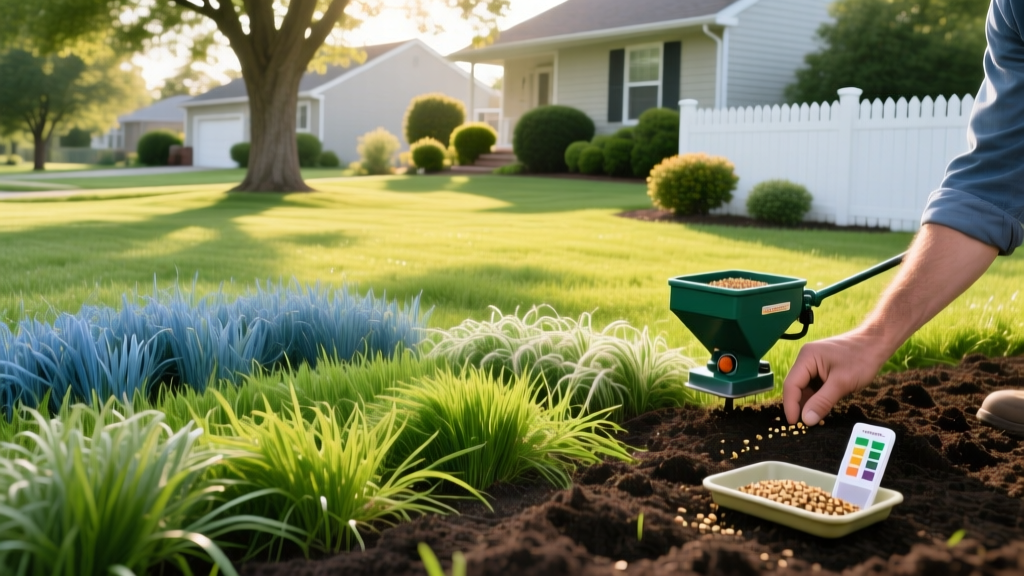
Overseeding Forsyth, IL Lawns: Timing, Seed, and Soil Prep
The Macon County Clay Challenge: Why Forsyth Lawns Thin Out
Forsyth, Illinois, sits squarely in the transition zone, but its local soil profile dictates a very specific approach to turf management. Most residential lots in Forsyth and the greater Macon County area are built on Drummer or Flanagan silty clay loam. While these soils are highly fertile for row crops, they are notorious for severe compaction in residential settings. Heavy foot traffic, combined with the natural shrinking and swelling of central Illinois clay, chokes turfgrass roots by late summer.
If your lawn is primarily composed of older Kentucky Bluegrass (KBG) or generic Tall Fescue planted during initial home construction, you are likely seeing thinning, bare patches, and increased susceptibility to brown patch fungus. Overseeding is not just a cosmetic fix here; it is a biological necessity to introduce modern, deep-rooting, drought-tolerant cultivars that can penetrate Macon County clay. According to the University of Illinois Extension, introducing Turf-Type Tall Fescue (TTTF) into existing lawns is the most effective strategy for long-term survival in this specific microclimate.
The Exact Overseeding Window for Central Illinois
Timing is the single highest point of failure for DIY overseeding in Forsyth. Many homeowners wait until October when the air feels crisp, but this is too late for optimal root establishment before the first hard freeze (typically late October or early November in Zone 6a).
Critical Soil Temperature Thresholds:
- Ideal Germination Range: Soil temperatures between 50°F and 65°F.
- Ideal Air Temperature Range: Daytime highs of 70°F to 80°F; nighttime lows above 50°F.
- Forsyth Target Window: August 25th through September 15th. This allows 45 to 60 days of active growth before winter dormancy.
Do not rely on the calendar alone. Use a soil thermometer pushed 2 inches into the ground. If the soil is still reading above 70°F in late August, delay seeding by a week to avoid damping-off disease, a fungal pathogen that thrives in hot, humid soil and will rot young seedlings overnight.
Selecting the Right Seed: NTEP-Rated Blends for Forsyth
Never buy generic "contractor mix" seed from a big box store for a Forsyth lawn. These blends often contain annual ryegrass or forage grasses that will die off by the next summer. You need seed evaluated by the National Turfgrass Evaluation Program (NTEP) for the Midwest transition zone.
| Grass Species | Clay Soil Adaptability | Drought Tolerance | Recommended Forsyth Cultivars |
|---|---|---|---|
| Turf-Type Tall Fescue (TTTF) | Excellent (Deep roots penetrate clay) | High | Titan Ultra, Falcon IV, Bullseye, Mustang IV |
| Kentucky Bluegrass (KBG) | Poor (Shallow roots, compacts easily) | Low to Moderate | Midnight, Blue Note, Everest (Use only for shade mixes) |
| Perennial Ryegrass (PRG) | Moderate | Low | Not recommended for permanent Forsyth lawns |
For a standard Forsyth lawn receiving 6+ hours of direct sunlight, a 100% TTTF blend is optimal. TTTF requires a seeding rate of 5 to 8 pounds per 1,000 square feet when overseeding. Expect to pay between $80 and $120 for a high-quality, weed-free 50-pound bag of premium TTTF seed in 2026.
The 5-Step Forsyth Overseeding Protocol
Step 1: Scalp and Dethatch
Mow your existing lawn down to 1.5 inches. This is lower than the standard summer mowing height of 3 inches, but it is necessary to allow sunlight to reach the soil surface. If your thatch layer exceeds 0.5 inches, run a power dethatcher over the lawn and rake up the debris. Seed that lands on thatch will germinate but die when its roots fail to reach the soil.
Step 2: Deep Core Aeration
Because of the Drummer silty clay loam, aeration is non-negotiable. Rent a walk-behind core aerator (such as a Billy Goat or Ryan Ren-O-Thin). The Rule of Thumb: Make two passes over the lawn in perpendicular directions. You want to pull 3-inch deep plugs, leaving them on the lawn to break down naturally. Aim for 20 to 30 holes per square foot. This physically fractures the clay pan, allowing water, oxygen, and seed to make direct soil contact.
Step 3: Apply Starter Fertilizer
Illinois law restricts phosphorus application unless you are establishing a new lawn or a soil test proves a deficiency. Overseeding qualifies as establishment. Apply a starter fertilizer with a ratio similar to 10-18-10 or 12-24-12. The high phosphorus content is critical for rapid root development in cool autumn soils. Apply at a rate of 1 pound of actual nitrogen per 1,000 square feet.
Warning: Herbicide Conflicts
If you applied a pre-emergent herbicide like Prodiamine (Barricade) or Dithiopyr (Dimension) in the spring for crabgrass control, it will prevent your grass seed from germinating. You must wait at least 12 to 16 weeks after application before overseeding. If you need to control weeds during the fall seeding window, use a product containing Mesotrione (Tenacity), which is safe to apply at the exact time of seeding and will actually bleach out competing weeds without harming new fescue seedlings.
If you applied a pre-emergent herbicide like Prodiamine (Barricade) or Dithiopyr (Dimension) in the spring for crabgrass control, it will prevent your grass seed from germinating. You must wait at least 12 to 16 weeks after application before overseeding. If you need to control weeds during the fall seeding window, use a product containing Mesotrione (Tenacity), which is safe to apply at the exact time of seeding and will actually bleach out competing weeds without harming new fescue seedlings.
Step 4: Seed Distribution
Use a broadcast spreader, splitting your seed volume in half. Apply the first half walking in a North-South pattern, and the second half in an East-West pattern. This cross-hatching prevents streaking and ensures uniform coverage. Pay special attention to the edges and bare spots, hand-casting seed into the aeration holes.
Step 5: The 14-Day Watering Matrix
Forsyth's autumn winds can dry out the top quarter-inch of soil in hours. Your watering schedule must be precise:
- Days 1-10: Water 3 times a day (morning, noon, late afternoon) for 10-15 minutes per zone. The goal is to keep the top 1 inch of soil constantly moist, not muddy.
- Days 11-21: Reduce to once a day for 20-30 minutes as roots begin to anchor into the clay.
- Day 22+: Transition to deep, infrequent watering (1 inch per week) to force roots deeper into the soil profile.
Common Overseeding Failures in Macon County
- Seed Washout on Slopes: Clay soils have poor initial infiltration rates. If your Forsyth lawn has a slope toward Lake Decatur or a drainage swale, heavy autumn rain will wash seed away before it germinates. Apply a hydromulch or a light layer of peat moss (1/8 inch thick) over seeded slopes to hold the seed in place.
- Bird Predation: European Starlings and grackles will strip bare areas of seed. If birds are a persistent issue, use seed coated with a bird-repellent polymer, or cover high-value bare patches with erosion control blankets.
- Premature Mowing: Do not mow the new seedlings until they reach 3.5 inches in height. When you do mow, ensure your mower blade is razor-sharp; a dull blade will rip the shallow-rooted seedlings entirely out of the soft autumn soil.
Frequently Asked Questions
Can I overseed my Forsyth lawn in the spring?
While technically possible, spring overseeding in central Illinois is highly discouraged. The young grass will not have time to develop a deep root system before the brutal July heat and drought hit. Furthermore, you cannot apply standard pre-emergent crabgrass preventers without killing your new seed, guaranteeing a massive crabgrass invasion by August.
How much does professional overseeding cost in Forsyth?
For a standard 5,000 square foot lawn in Forsyth, professional aeration and overseeding services typically charge between $350 and $550 in 2026. This includes commercial-grade aeration, premium TTTF seed, and starter fertilizer. DIY costs will run approximately $180 to $250 when factoring in equipment rental, seed, and fertilizer.
Should I add topsoil over my seed?
Do not bury your seed under thick topsoil. Grass seed requires light to germinate optimally. If you must level low spots, use a 50/50 mix of compost and sand, applying no more than 1/4 inch over the seed. The seed should still be partially visible through the topdressing.