Grass Types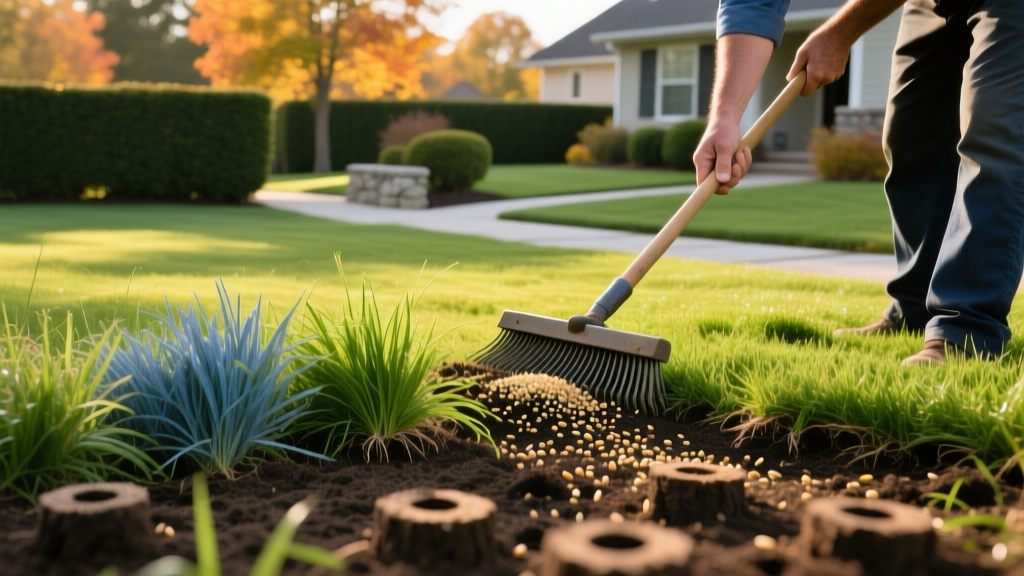
Mastering Overseeding in Autumn: Timing, Seed Rates, and Soil Prep
The Biological Window: Why Soil Temperature Dictates Success
Overseeding in autumn is not about the calendar date; it is entirely dictated by soil thermodynamics. Cool-season grasses like Tall Fescue, Kentucky Bluegrass (KBG), and Perennial Ryegrass require a specific thermal window to trigger enzymatic germination and establish deep radicles before winter dormancy. While air temperatures in early September might still hover in the 80s, the critical metric is the soil temperature at a 2-inch depth.
Target Soil Temperature Matrix:
- Optimal Germination Zone: 50°F to 65°F (10°C to 18°C) at a 2-inch depth.
- Danger Zone (Too Warm): Above 70°F. Seeds will germinate too rapidly, resulting in shallow root systems highly susceptible to autumn drought stress and Pythium blight.
- Danger Zone (Too Cold): Below 45°F. Germination stalls, and seedlings will not develop sufficient crown tissue to survive winter freeze-thaw cycles.
To accurately track this, invest in a basic soil probe thermometer rather than relying on local weather apps. According to NC State TurfFiles, seeding when soil temperatures are steadily dropping through the 60°F mark ensures that the energy of the plant is directed toward root development rather than excessive top-growth, which is the exact physiological advantage of autumn over spring seeding.
Cool-Season Seed Selection and Application Rates
Choosing the right cultivar and applying it at the correct density prevents resource competition and thin turf. Overseeding requires different rates than establishing a lawn from bare dirt because you are working around existing root systems.
| Grass Species | Overseeding Rate (lbs/1,000 sq ft) | Germination Days | Top 2026 Cultivar Recommendations |
|---|---|---|---|
| Tall Fescue | 6.0 - 8.0 | 7 - 14 | Titan Ultra, G-Titan |
| Kentucky Bluegrass | 1.0 - 2.0 | 14 - 28 | Midnight, NuGlide |
| Perennial Ryegrass | 4.0 - 5.0 | 5 - 10 | Palmer IV, Apple GL |
Expert Note: Never purchase cheap, unbranded seed mixes from big-box stores that contain 'Annual Ryegrass' or 'Creeping Red Fescue' as filler. These species will outcompete your desired turf in the short term but will die off during summer heat, leaving you with bare patches. Always check the seed tag for a weed seed percentage of less than 0.1%.
Site Preparation and the Herbicide Conflict
Seed-to-soil contact is the single most critical physical requirement for germination. Seed resting on top of thatch or existing grass blades will desiccate and die within 48 hours.
Core Aeration vs. Power Raking
For lawns with more than 0.5 inches of thatch or compacted clay soils, core aeration is mandatory. Set your aerator to pull 3-inch plugs, aiming for a minimum of 20 to 30 holes per square foot. Make two passes in perpendicular directions. Leave the plugs on the lawn; they will break down and introduce beneficial soil microbes to the surface.
If your soil is loose but thatch is the primary issue, use a power rake (dethatcher) with blades set to just nick the soil surface (1/8 inch deep). Setting the blades too deep will rip out the existing, healthy turfgrass crown.
CRITICAL WARNING: Pre-Emergent Herbicide Conflicts
If you applied a standard pre-emergent like Prodiamine (Barricade) or Dithiopyr (Dimension) in the spring, you cannot overseed in the autumn. These chemicals create a non-selective barrier that prevents all seeds, including turfgrass, from developing roots. The residual effect lasts 3 to 4 months. If you must seed, you are restricted to using Mesotrione (Tenacity) at seeding, which selectively targets weeds while allowing cool-season grasses to germinate safely.
The 28-Day Autumn Watering Protocol
Watering new seed requires a phased approach to transition the plant from surface moisture dependency to deep root foraging. According to UMass Amherst Turf Extension, overwatering in autumn is just as lethal as underwatering, as cold, soggy soils invite Microdochium patch (Pink Snow Mold).
| Phase | Timeframe | Frequency & Duration | Objective |
|---|---|---|---|
| Phase 1 | Days 1 - 10 | 2 to 3x daily for 5-8 mins | Keep top 1/2 inch perpetually moist to prevent seed desiccation. |
| Phase 2 | Days 11 - 21 | 1x daily for 15-20 mins | Encourage radicles to stretch downward for moisture. |
| Phase 3 | Days 22+ | 2x per week, 30+ mins | Transition to deep, infrequent watering (1 inch total per week). |
Starter Fertilizer and First Mow
Apply a high-phosphorus starter fertilizer at the exact time of seeding. Phosphorus (the middle number on the N-P-K ratio) is immobile in soil and is strictly required for early root ATP synthesis. Look for a formulation like 18-24-12 or 24-25-4. A 50lb bag of Scotts Turf Builder Starter Food for New Grass (24-25-4) costs approximately $45 and covers 5,000 square feet, providing the exact nutrient load required for autumn establishment.
When to Make the First Cut
Do not mow the lawn until the new seedlings reach a height of 3.5 inches. When you do mow, ensure your mower blade is freshly sharpened. A dull blade will not cut the tender, un-lignified tissue of a new seedling; instead, it will rip the entire plant out of the soil by the root. Set your mower deck to 3 inches and never remove more than 1/3 of the leaf blade in a single pass. Bag the clippings for this first mow to prevent them from smothering the remaining young seedlings.
Autumn Overseeding Cost Breakdown (per 5,000 sq ft)
Budgeting accurately prevents mid-project shortcuts. Here is the realistic material cost for a professional-grade DIY autumn overseeding in 2026:
- Core Aeration Rental: $75 - $110 (4-hour minimum from local equipment yards)
- Premium Tall Fescue Seed (50 lbs): $140 - $180 (e.g., Jonathan Green Black Beauty Ultra)
- Starter Fertilizer (50 lbs): $45 - $55
- Mesotrione (Tenacity) Generic: $35 (Optional, but highly recommended for weed competition)
- Total Estimated Material Cost: $295 - $380
By strictly adhering to soil temperature triggers, utilizing precise seeding rates, and managing the herbicide and watering variables, your autumn overseeding will yield a dense, disease-resistant turf canopy ready to break dormancy aggressively the following spring. For further regional cultivar data, consult the University of Minnesota Turf Science autumn care bulletins.