
Grass Types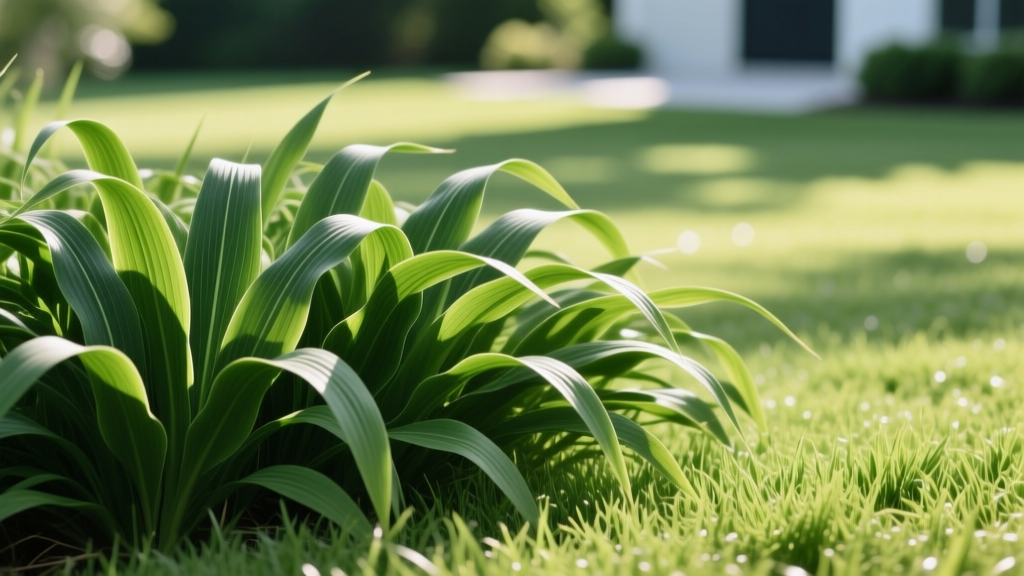
Pictures of St Augustine Grass: Visual Identification & Care Guide
The Visual Hallmarks of St. Augustine Grass
When homeowners search for pictures of St Augustine grass (Stenotaphrum secundatum), they are typically trying to confirm their lawn's identity or diagnose a visual anomaly. St. Augustine is the most widely planted warm-season turf in the coastal southern United States, prized for its aggressive spreading habit and salt tolerance. However, proper care begins with accurate visual identification, as mistaking it for Centipede or Zoysia grass leads to disastrous mowing and fertilization errors.
Visually, St. Augustine is characterized by its thick, spongy mat and prominent above-ground runners, known as stolons. Unlike Bermuda grass, which spreads via both above-ground stolons and below-ground rhizomes, St. Augustine relies entirely on stolons. The leaf blades are broad (typically 8mm to 10mm wide), flat, and feature a distinct V-shaped taper at the tip. The color ranges from medium green to a deep, blue-green hue depending on the specific cultivar and soil nitrogen levels. According to the Texas A&M AgriLife Extension, the ligule (the membrane where the leaf meets the stem) is a dense fringe of short hairs, a key macroscopic identifier when comparing it to similar coarse-bladed grasses.
Cultivar Visual Comparison: Floratam, Palmetto, Raleigh, and CitraBlue
Not all St. Augustine looks identical. Plant breeders have developed specific cultivars to address the species' traditional weaknesses, such as shade intolerance and chinch bug susceptibility. If you are matching pictures of St Augustine grass to your own yard, note the subtle differences in blade width and color density among the top four varieties.
| Cultivar | Visual Traits & Blade Width | Shade Tolerance | Best Use Case |
|---|---|---|---|
| Floratam | Coarse, wide blades (10mm+); lighter medium-green color. | Poor (Needs 6+ hrs sun) | Open, full-sun coastal lawns. |
| Palmetto | Finer, narrower blades (8mm); deep emerald green. | Moderate to Good | Yards with partial tree canopy. |
| Raleigh | Medium width; lighter green; denser mat formation. | Moderate | Transition zones with colder winters. |
| CitraBlue | Distinctive blue-green hue; slightly folded leaf blades. | Excellent | Heavily shaded lots; high-disease areas. |
CitraBlue, developed by the University of Florida and released to the commercial market in recent years, has become a dominant force by 2026 due to its striking blue-green visual profile and superior resistance to gray leaf spot and root rot. If your grass has a distinct bluish tint under direct sunlight and thrives under oak canopies, you are likely looking at CitraBlue or a similar shade-tolerant proprietary blend.
Diagnosing Common Issues: What Unhealthy St. Augustine Looks Like
Visual diagnosis is critical because St. Augustine is highly susceptible to specific fungal pathogens and insects. Misidentifying the cause of browning often leads to the wrong chemical application, exacerbating the damage.
Visual Troubleshooting: Brown Patch vs. Chinch Bugs
Brown Patch (Rhizoctonia solani): Appears as irregular, circular patches of brown, blighted grass ranging from 1 to 5 feet in diameter. In early morning dew, you may see a dark 'smoke ring' at the outer edge of the lesion. The roots remain healthy and anchored.
Southern Chinch Bug (Blissus insularis): Manifests as yellowing, stunted patches, usually in the hottest, driest areas of the lawn (near sidewalks or driveways). The grass pulls up easily because the bugs sever the stems and inject a toxic saliva. Part the thatch at the border of the dying grass to spot tiny, black-and-white insects scurrying near the soil line.
Another severe visual threat is Take-All Root Rot (TARR). Unlike the localized patches of Brown Patch, TARR causes widespread, diffuse yellowing (chlorosis) that progresses to severe thinning. If you pull a stolon and the roots are black, short, and rotted rather than white and fibrous, TARR is the culprit. The Clemson University Home & Garden Information Center emphasizes that TARR is often triggered by alkaline soil (pH above 7.0) and excessive thatch buildup, requiring immediate acidification and fungicidal intervention.
Precision Warm-Season Care Protocols
Once you have used pictures of St Augustine grass to confirm your turf type and diagnose its current state, you must implement a rigorous, data-driven care schedule. St. Augustine requires specific thresholds for mowing, nutrition, and hydration to maintain its aggressive stolon growth without suffocating under its own thatch.
Mowing and Thatch Management
St. Augustine must be mowed higher than almost any other warm-season grass. Setting a mower to 2.0 inches will scalp the turf, exposing the soil to weed invasion and sun-scalding the stolons.
- Optimal Height: Maintain between 3.0 and 4.0 inches. Floratam requires the higher end (3.5 to 4.0 inches), while Raleigh and Palmetto can tolerate 2.5 to 3.0 inches.
- Mower Type: Use a rotary mower. Reel mowers struggle with the thick, fibrous stolons and broad blades of St. Augustine, often tearing the tissue rather than cutting it cleanly.
- Thatch Threshold: St. Augustine produces heavy thatch. Measure the spongy layer between the soil and the green blades. If it exceeds 0.5 inches, you must dethatch. Use a vertical mower (verticutter) or a heavy-duty power rake set to penetrate the thatch layer without severely tearing the primary root crown.
Fertilization and Soil Chemistry
St. Augustine is a heavy feeder, requiring 3.0 to 4.0 pounds of actual nitrogen per 1,000 square feet annually during the active growing season (May through September). However, visual chlorosis (yellowing between the veins of the leaf) is a massive issue in coastal areas with high-pH, calcareous soils.
Pro-Tip: Iron and Micronutrient Delivery
If your soil pH is above 7.2, granular iron will lock up in the soil and become unavailable to the roots, leaving your grass pale yellow. To achieve that deep, dark green visual profile, apply a chelated iron product (specifically Fe-EDDHA, which remains stable in high-pH soils) or use a foliar liquid spray containing 15% to 20% chelated iron. Expect to pay between $45 and $65 for a professional-grade 50lb bag of 15-0-15 with 2% chelated iron in 2026.
For weed control, avoid herbicides containing 2,4-D during the heat of summer, as St. Augustine is highly sensitive to it and will exhibit severe visual leaf-curling and necrosis. Use atrazine-based pre-and-post-emergent products specifically labeled for St. Augustine, applying them in early spring when soil temperatures reach 55°F.
Hyration and Catch-Can Testing
St. Augustine requires 1.0 to 1.5 inches of water per week, but visual wilting (footprinting, where grass blades fold in half lengthwise and fail to bounce back) is your primary indicator for irrigation. Apply 0.5 to 0.75 inches of water per session to encourage deep root growth. Place three straight-sided tuna cans in different irrigation zones to measure exact output, adjusting your sprinkler run-times based on the physical water depth collected rather than relying on smart-controller estimates.
Frequently Asked Visual Identification Questions
Why does my St. Augustine look like it has purple tips?
Purple or reddish-brown leaf tips are a classic visual indicator of phosphorus deficiency or environmental stress (such as a sudden cold snap in late fall). Conduct a soil test; if phosphorus is low, apply a starter fertilizer with a higher middle number (e.g., 10-20-10) to correct the imbalance.
How can I visually tell St. Augustine apart from Crabgrass?
Crabgrass grows in low, sprawling clumps with seed heads that look like a turkey foot. St. Augustine stolons are much thicker, spongy, and root at the nodes to form a continuous, dense carpet. Crabgrass blades are lighter green and feature a prominent, membranous ligule, whereas St. Augustine has a hairy fringe.
For comprehensive regional data on turfgrass pathology and visual diagnostics, consult the NC State University TurfFiles database, which provides high-resolution diagnostic imagery and localized chemical control recommendations.

