Grass Types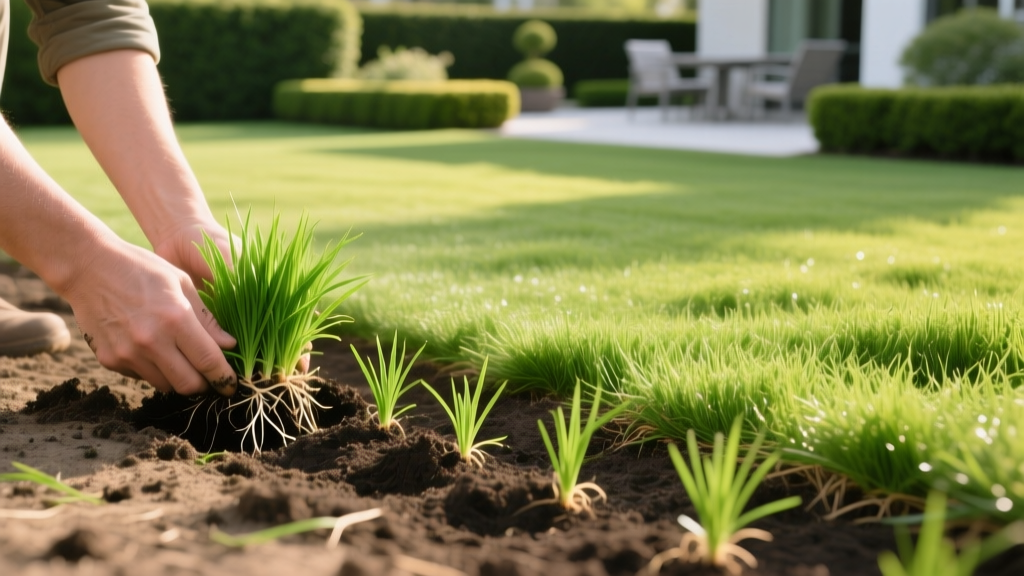
Step-by-Step Guide to Planting Zoysia Grass Plugs for Fast Coverage
The Economics and Strategy of Zoysia Plug Establishment
Establishing a warm-season lawn with vegetative propagules requires a strategic balance between upfront material costs and the time required for full canopy closure. While Zoysia grass (Zoysia japonica and Zoysia matrella hybrids) can technically be grown from seed, germination rates for premium cultivars like Zeon and Geo are notoriously unreliable. Sod provides instant coverage but commands a premium price. For homeowners managing medium-to-large yards, planting zoysia grass plugs offers the highest return on investment, provided you execute the spacing and soil preparation with mathematical precision.
Data Highlight: The Cost-to-Coverage Ratio
Based on 2026 regional turf supplier averages, establishing a 5,000 sq. ft. Zoysia lawn breaks down as follows:
• Solid Sod: $2,000 - $4,000 (Instant coverage, high labor/transport cost)
• Plugs (12-inch spacing): $350 - $500 (Requires ~500 plugs, 12-18 months to fill)
• Plugs (6-inch spacing): $1,200 - $1,600 (Requires ~2,000 plugs, 6-8 months to fill)
• Seed: $150 - $250 (High failure rate for hybrid cultivars, severe weed competition)
Based on 2026 regional turf supplier averages, establishing a 5,000 sq. ft. Zoysia lawn breaks down as follows:
• Solid Sod: $2,000 - $4,000 (Instant coverage, high labor/transport cost)
• Plugs (12-inch spacing): $350 - $500 (Requires ~500 plugs, 12-18 months to fill)
• Plugs (6-inch spacing): $1,200 - $1,600 (Requires ~2,000 plugs, 6-8 months to fill)
• Seed: $150 - $250 (High failure rate for hybrid cultivars, severe weed competition)
Soil Preparation and the Pre-Emergent Trap
The most common point of failure when planting zoysia grass plugs occurs before the first hole is even dug. Zoysia thrives in a soil pH between 6.0 and 6.5. Conduct a baseline soil test and amend with elemental sulfur to lower pH or agricultural lime to raise it at least four weeks prior to planting. Till the top 4 inches of soil to break up compaction, which is critical because Zoysia stolons (above-ground runners) need loose soil to root into the spaces between plugs.
CRITICAL WARNING: The Pre-Emergent Herbicide Conflict
Do not apply pre-emergent herbicides like prodiamine (Barricade) or dithiopyr (Dimension) within three months before or two months after planting plugs. These chemicals inhibit cell division in growing root tips. While they stop weed seeds, they will simultaneously prevent your Zoysia stolons from rooting into the bare soil between the plugs, effectively stunting lateral spread and killing the plug network.
Do not apply pre-emergent herbicides like prodiamine (Barricade) or dithiopyr (Dimension) within three months before or two months after planting plugs. These chemicals inhibit cell division in growing root tips. While they stop weed seeds, they will simultaneously prevent your Zoysia stolons from rooting into the bare soil between the plugs, effectively stunting lateral spread and killing the plug network.
According to NC State University TurfFiles, incorporating a starter fertilizer high in phosphorus (such as a 10-18-10 NPK ratio) at the time of planting accelerates root development. Apply at a rate of 1 lb of nitrogen per 1,000 sq. ft., raking it lightly into the top inch of the tilled soil.
Optimal Spacing Frameworks by Cultivar
Not all Zoysia grass spreads at the same rate. Fine-bladed Zoysia matrella varieties tend to spread slightly slower than aggressive Zoysia japonica types. Use the matrix below to determine your plug volume and expected timeline for full coverage.
| Cultivar | Blade Type | Recommended Spacing | Time to Full Coverage |
|---|---|---|---|
| Zeon | Fine / Shade Tolerant | 9 to 12 inches | 14 - 18 months |
| Empire | Broad / High Traffic | 12 to 15 inches | 12 - 15 months |
| Geo | Fine / Dense Canopy | 9 to 12 inches | 14 - 18 months |
| Meyer (Z-52) | Medium / Cold Hardy | 12 inches | 12 - 14 months |
The Planting Execution: Tooling and Depth
Forget the manual bulb planters or narrow step-pluggers; they create too much physical fatigue and often result in inconsistent hole depths. For any yard larger than 1,000 square feet, the professional standard is using a 2-inch or 2.5-inch diameter auger bit attached to an 18V cordless drill. This excavates a perfectly cylindrical hole in seconds, preserving the soil structure and your lower back.
Follow this strict execution protocol for every plug:
- Extract the Core: Drill or dig to a depth of exactly 3 inches. Zoysia plugs are typically sold in 2.5-inch to 3-inch deep trays.
- Check the Crown: The most critical anatomical feature is the root crown (the transition point between roots and green shoots). The crown must sit exactly flush with the surrounding soil grade. If you bury the crown under an inch of dirt, it will rot. If it sits above grade, the roots will desiccate.
- Backfill and Tamp: Push the loose soil back into the crevices around the plug. Step firmly on the plug with your heel to eliminate air pockets and ensure direct root-to-soil contact.
The 60-Day Watering and Rooting Protocol
According to Texas A&M AgriLife Extension, Zoysia requires careful moisture management during establishment to prevent both desiccation and fungal pathogens like Large Patch (Rhizoctonia solani). Do not treat newly planted plugs like established sod.
- Days 1 to 10 (The Anchor Phase): Water lightly 2 to 3 times daily for 5 to 10 minutes per zone. The goal is to keep the top 2 inches of soil consistently moist, not saturated. The plugs have zero lateral root mass and will dry out in hours under direct sun.
- Days 11 to 30 (The Stolon Phase): Reduce frequency to once daily, but increase duration to 15 minutes. This encourages the stolons to reach downward and outward for moisture.
- Days 31 to 60 (The Deep Root Phase): Transition to deep, infrequent watering. Apply 0.5 to 1 inch of water twice a week. This forces the taproots to penetrate deeper into the soil profile, building drought resilience.
Pro Tip: The Tug Test
Around day 21, gently tug upward on a few test plugs. If you feel distinct resistance, the initial roots have anchored into the native soil. If they lift out effortlessly, increase your watering frequency and check for soil compaction at the base of the hole.
Around day 21, gently tug upward on a few test plugs. If you feel distinct resistance, the initial roots have anchored into the native soil. If they lift out effortlessly, increase your watering frequency and check for soil compaction at the base of the hole.
Troubleshooting Early Plug Failures
Even with meticulous preparation, environmental variables can disrupt establishment. Use this diagnostic framework to correct issues before they compromise the entire grid.
Symptom: Plugs Turning Yellow or Brown at the Base
Cause: Crown rot from overwatering or burying the crown too deep. In warm, humid climates, excessive moisture invites Pythium root rot.
Fix: Pull back any soil mounded over the crown. Reduce watering frequency immediately. If the rot is widespread, apply a preventative fungicide containing Azoxystrobin or Propiconazole, following label rates for active disease control.
Symptom: Plugs Lifting Out of the Ground Overnight
Cause: Frost heave (if planted too late in the fall) or animal digging (skunks and raccoons digging for grubs beneath the fresh soil).
Fix: Re-seat the plugs immediately and tamp down. If animals are the culprit, apply a castor oil-based animal repellent to the perimeter of the yard, or lay biodegradable jute netting over the plug grid and pin it down with landscape staples until the grass anchors.
Symptom: Weeds Overtaking the Bare Spaces
Cause: Because pre-emergents are banned during plug establishment, bare soil is highly vulnerable to crabgrass and spurge.
Fix: You must manually hand-pull weeds or use a targeted post-emergent herbicide containing Quinclorac or 2,4-D (ensure the specific product is labeled safe for young Zoysia). Never use non-selective herbicides like Glyphosate near the plugs, as drift will kill the Zoysia stolons instantly.