
Grass Types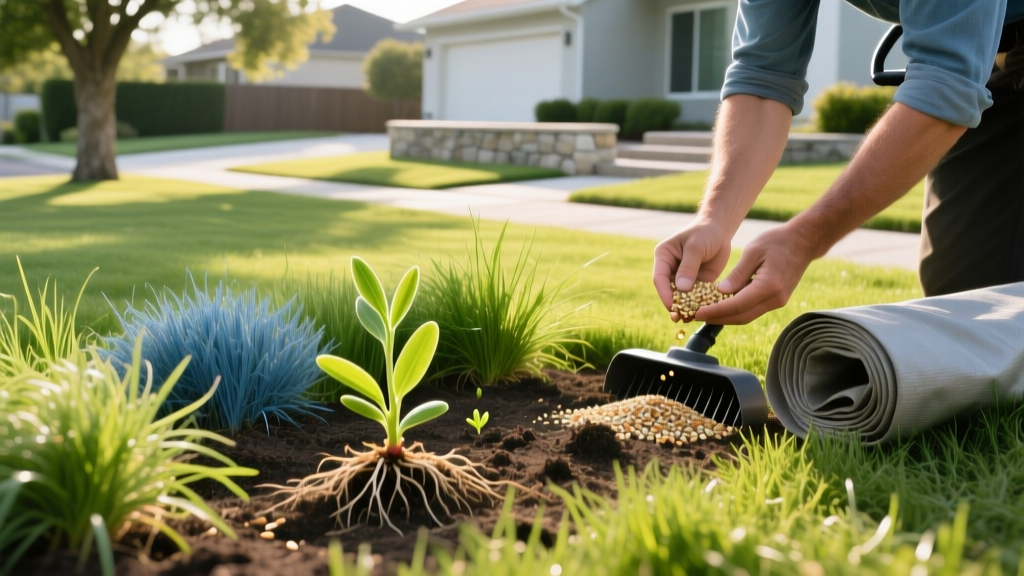
Reseeding a Patchy Lawn: Step-by-Step Seed Establishment Guide
Diagnosing Bare Spots: Why Your Grass Failed
Before dropping seed, you must identify why the existing turf died. Reseeding over unresolved soil or environmental issues guarantees a second failure. The three most common culprits for localized bare patches are soil compaction from heavy foot traffic, localized grub damage severing the root zone, and dog urine nitrogen burns. If the bare spot is caused by severe shade (less than 4 hours of direct sunlight), standard sun-loving cultivars will fail again. In heavily shaded zones, you must switch to fine fescues or prune the tree canopy to allow dappled light to reach the soil surface.
Decision Framework: Reseeding vs. Overseeding
Reseeding targets completely bare or dead patches (less than 50% turf cover) requiring full soil-to-seed contact, aggressive scarification, and higher localized seed rates. Overseeding is the practice of broadcasting seed over an existing, living lawn to improve overall density. This guide focuses strictly on the intensive soil preparation required for reseeding bare spots.
Reseeding targets completely bare or dead patches (less than 50% turf cover) requiring full soil-to-seed contact, aggressive scarification, and higher localized seed rates. Overseeding is the practice of broadcasting seed over an existing, living lawn to improve overall density. This guide focuses strictly on the intensive soil preparation required for reseeding bare spots.
Selecting the Right Seed for Patch Repair
Never use cheap, unbranded seed mixes for spot repairs. They often contain annual ryegrass or weed seeds that will disrupt your established lawn's uniformity. Look for National Turfgrass Evaluation Program (NTEP) rated cultivars. As of 2026, premium NTEP-rated tall fescue blends cost between $7.00 and $9.00 per pound, meaning a 10-pound bag for spot repairs will run $70 to $90. This investment pays off in disease resistance and drought tolerance.
| Grass Type | Recommended Cultivar | Spot Repair Seed Rate (per 1,000 sq ft) | Germination Days |
|---|---|---|---|
| Tall Fescue | 'Titan Ultra' or 'Rhizomatous' (RTF) | 5.0 - 6.0 lbs | 7 - 12 |
| Kentucky Bluegrass | 'Midnight' or 'Award' NTEP rated | 2.0 - 3.0 lbs | 14 - 28 |
| Perennial Ryegrass | 'Palmer IV' or 'Caddysack' | 4.0 - 5.0 lbs | 5 - 7 |
| Bermudagrass | 'Yukon' or 'Savannah' (Hulled) | 1.0 - 2.0 lbs | 10 - 20 |
According to Penn State Extension, matching your reseeding cultivar to your existing lawn's species is critical for maintaining a uniform color and texture profile throughout the growing season.
The 5-Step Soil Preparation Protocol
Seed-to-soil contact is the single most important variable in grass establishment. Seed resting on top of hard-packed dirt or thick thatch will dry out and die within 24 hours.
- Clear Debris: Remove dead thatch, rocks, and weeds down to bare soil. Use a flat spade to slice out any remaining dead roots.
- Scarify the Soil: Use a steel bow rake or a motorized dethatcher to create 1/4-inch deep grooves in the topsoil. This creates micro-trenches that protect the seed from wind and water runoff.
- Amend the Base: If the soil is heavily compacted clay, incorporate a 1/2-inch layer of compost or topsoil into the scarified grooves to improve moisture retention.
- Level the Grade: Ensure the patch is slightly mounded (about 1/4 inch higher than the surrounding lawn). Soil will settle after watering, and a slight mound prevents water from pooling and drowning the new seed.
- Apply Starter Fertilizer: Broadcast your fertilizer immediately before seeding to ensure nutrients are in the root zone.
Seeding Rates, Depth, and Starter Fertilizer Math
For localized reseeding, you must apply seed at a slightly heavier rate than standard broadcast overseeding to account for losses to birds and washout. Calculate the square footage of your bare patches (Length x Width) and multiply by the species-specific rate listed in the table above.
Expert Agronomy Note: Do not bury grass seed. Kentucky Bluegrass and fine fescues require light to trigger germination. Rake the seed lightly so that 80% is covered by a dusting of soil and 20% remains visible on the surface. Burying seed deeper than 1/4 inch will cause it to rot before reaching the surface.
Starter fertilizer is non-negotiable for reseeding. Phosphorus (the middle number in the N-P-K ratio) drives early root development. Apply a starter fertilizer with an N-P-K ratio near 10-18-10 or 18-24-12 (such as Lesco Professional Starter) at a rate of 1 lb of nitrogen per 1,000 square feet. The University of Minnesota Extension emphasizes that phosphorus is tightly bound in soil and does not move easily, making it vital to incorporate it into the top inch of soil during the raking phase.
Post-Reseeding Watering & Establishment Timeline
Improper watering is the leading cause of reseeding failure. New seed lacks a root system and will die if the top 1/2 inch of soil dries out, even for a few hours on a windy day.
- Days 1 to 14 (Germination Phase): Water the reseeded patches for 10 to 15 minutes, 2 to 3 times per day. The goal is to keep the seedbed consistently moist but not saturated. Avoid heavy streams that wash the seed away; use a fine mist or oscillating sprinkler.
- Days 15 to 28 (Rooting Phase): Once seedlings reach 1 inch tall, reduce watering frequency to once per day for 20 minutes. This forces the developing roots to stretch deeper into the soil profile to find moisture.
- Days 29+ (Establishment Phase): Transition to deep, infrequent watering. Apply 1 inch of water per week, split into two sessions, to encourage deep drought-resistant roots.
First Mowing Rules
Do not mow the reseeded area until the new grass reaches 3.5 to 4 inches in height. When you do mow, ensure your mower blade is freshly sharpened. A dull blade will tear the tender new seedlings out of the ground by the roots. Set your deck to 3 inches and never remove more than 1/3 of the blade in a single pass.
Troubleshooting Common Reseeding Failures
Warning: Damping-Off Disease
If you notice new seedlings collapsing with water-soaked, mushy lesions at the soil line, they are suffering from Pythium damping-off disease. This fungus thrives in overly wet, poorly drained seedbeds during warm weather. Halt watering immediately, allow the soil surface to dry, and apply a preventative fungicide containing azoxystrobin (e.g., Scotts DiseaseEx) to save the remaining crop.
If you notice new seedlings collapsing with water-soaked, mushy lesions at the soil line, they are suffering from Pythium damping-off disease. This fungus thrives in overly wet, poorly drained seedbeds during warm weather. Halt watering immediately, allow the soil surface to dry, and apply a preventative fungicide containing azoxystrobin (e.g., Scotts DiseaseEx) to save the remaining crop.
FAQ: Reseeding Edge Cases
Can I reseed over existing weeds?
No. Weeds will outcompete tender grass seedlings for water and nutrients. You must kill existing weeds using a non-selective herbicide like glyphosate, wait 7 to 10 days for the weeds to die, and then rake them out before reseeding.
Should I use straw to cover the reseeded patches?
Avoid traditional agricultural straw, which is notorious for introducing thousands of weed seeds into your pristine soil bed. If you need erosion control on a slope, use weed-free wheat straw or a specialized hydromulch product like Penn Mulch, which breaks down into organic matter as the grass establishes.
When is the best time of year for reseeding?
For cool-season grasses (Fescue, Bluegrass, Ryegrass), early fall (late August to mid-September) is optimal. Soil temperatures are warm enough for fast germination, but air temperatures are cooling, which reduces heat stress and weed competition. For warm-season grasses (Bermuda, Zoysia, Centipede), reseed in late spring to early summer when soil temperatures consistently exceed 65°F.

