Grass Types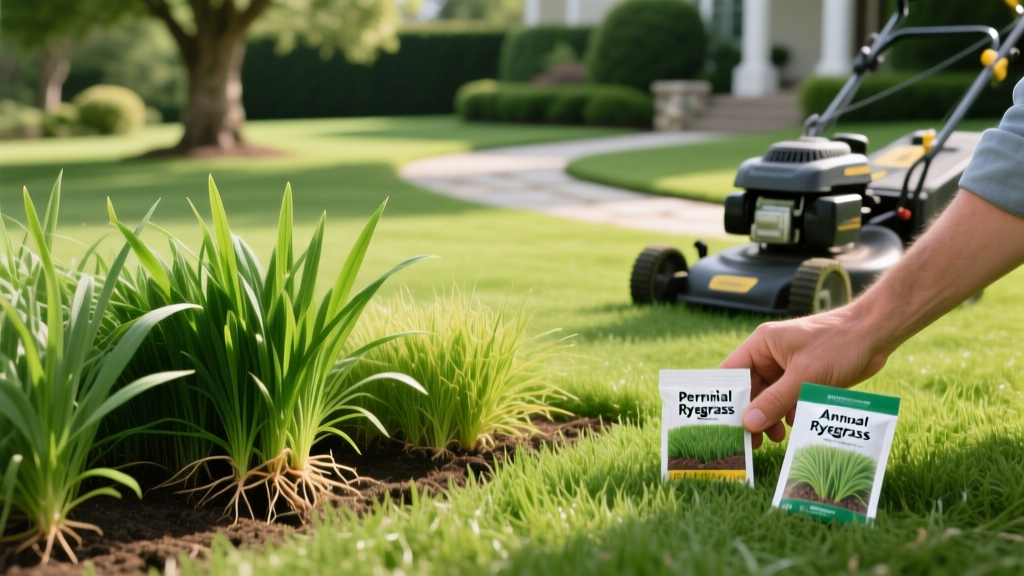
Ryegrass Perennial or Annual: How to Choose and Seed Your Lawn
The Core Dilemma: Annual vs. Perennial Ryegrass
Homeowners evaluating winter lawn color or quick-establishing cool-season turf inevitably face a critical botanical fork in the road: is ryegrass perennial or annual? The answer dictates your entire maintenance calendar, seed budget, and spring transition strategy. While both belong to the Lolium genus and share rapid 5-to-10-day germination windows, their life cycles and physiological behaviors demand entirely different management protocols.
Annual ryegrass (Lolium multiflorum) is a true winter annual. It germinates in fall, provides vibrant green cover through winter, and naturally dies off when late-spring soil temperatures consistently exceed 65°F. Perennial ryegrass (Lolium perenne) is a long-lived cool-season grass that survives for multiple years, requiring active summer management or chemical suppression if planted over warm-season turf.
Decision Matrix: Which Species Fits Your Scenario?
| Feature | Annual Ryegrass | Perennial Ryegrass |
|---|---|---|
| Primary Use Case | Winter overseeding in the Deep South (Zones 8-10) | Permanent lawns in the North, or transition zone overseeding |
| Lifespan | 6 to 8 months (dies in late spring) | Multiple years (requires summer survival management) |
| Seed Cost (Avg) | $2.00 - $3.50 per pound | $4.50 - $7.00 per pound |
| Spring Transition | Effortless (natural die-off) | Difficult (competes with Bermudagrass/Zoysia) |
| Mowing Height | 1.5 to 2.0 inches | 1.5 to 2.5 inches |
Scenario A: Winter Overseeding Warm-Season Lawns (Annual Focus)
If you live in the Deep South and want a green lawn over dormant Bermudagrass or Zoysia from November through April, annual ryegrass is the superior choice. According to Texas A&M AgriLife Extension, annual ryegrass avoids the fierce spring competition that perennial varieties inflict on emerging warm-season turf.
Step-by-Step Overseeding Protocol
- Timing the Seed Drop: Wait until daytime air temperatures consistently drop below 75°F and soil temperatures at a 2-inch depth fall below 70°F. In Zone 8, this is typically mid-October; in Zone 9, early November.
- Scalping and Dethatching: Lower your mower blade to 1 inch and bag the clippings. Remove the thatch layer to ensure the ryegrass seed makes direct contact with the soil, not the dead Bermudagrass canopy.
- Core Aeration: Run a core aerator over the lawn in two perpendicular passes. This relieves soil compaction and creates micro-pockets for seed retention.
- Broadcasting: Apply annual ryegrass seed at a rate of 15 to 20 pounds per 1,000 square feet. Use a rotary spreader, splitting the application into two perpendicular passes for even distribution.
- Germination Watering: Water lightly 3 to 4 times daily for 5-minute intervals. The goal is to keep the top 1/4 inch of soil constantly moist without creating runoff. Germination occurs in 5 to 7 days.
⚠️ Spring Transition Warning: Do not apply high-nitrogen fertilizers to annual ryegrass after March 1. Late-season nitrogen forces aggressive top growth just as your underlying Bermudagrass is trying to break dormancy, starving the warm-season grass of vital sunlight.
Scenario B: Establishing a Permanent Cool-Season Lawn (Perennial Focus)
For homeowners in the Northern U.S. (Zones 3-6) or the Transition Zone (Zones 6-7) seeking a durable, high-traffic lawn, perennial ryegrass is the standard. Penn State Extension notes that perennial ryegrass boasts exceptional wear tolerance, making it ideal for lawns with active children or pets. However, it lacks the deep root system of tall fescue and requires precise summer irrigation to survive heat stress.
Top-Performing Cultivars for 2026
Avoid generic "contractor grade" seed blends. For disease resistance (specifically against brown patch and gray leaf spot) and dark genetic color, source these specific NTEP (National Turfgrass Evaluation Program) rated cultivars:
- 'Palmer IV': Exceptional wear tolerance and deep root structure; ideal for high-traffic family lawns.
- 'Dark Horse': Features a naturally dark green genetic color, reducing the need for heavy nitrogen applications to maintain visual appeal.
- 'Pinnacle': Bred for improved heat tolerance, making it a safer bet for the warmer edges of the Transition Zone.
Seeding and Soil Contact
When establishing a new perennial ryegrass lawn from bare dirt, the seeding rate drops significantly compared to overseeding. Apply 8 to 10 pounds of seed per 1,000 square feet. After broadcasting, use a lawn roller filled with water to press the seed firmly into the soil bed. Perennial ryegrass seed must not be buried deeper than 1/8 inch; if buried too deep, the coleoptile will exhaust its energy reserves before reaching the surface, resulting in total germination failure.
Precise Seeding Rates & Cost Breakdown
Miscalculating seed volume is the most common cause of patchy establishment. Use this matrix to calculate your exact material requirements based on your specific project scope.
| Project Type | Species | Rate (lbs / 1,000 sq ft) | Cost per 1,000 sq ft (Est.) |
|---|---|---|---|
| Winter Overseeding (Dense Cover) | Annual | 15 - 20 lbs | $30 - $70 |
| Winter Overseeding (Thin Cover) | Annual | 10 - 12 lbs | $20 - $42 |
| New Lawn Establishment | Perennial | 8 - 10 lbs | $36 - $70 |
| Bare Spot Repair / Overseeding | Perennial | 5 - 7 lbs | $22 - $49 |
Managing the Spring Die-Off and Transition
The most complex phase of ryegrass management occurs in April and May. If you utilized perennial ryegrass to overseed a Bermudagrass lawn in the Transition Zone, the perennial grass will not die off naturally. It will actively compete with the waking Bermudagrass for water, nutrients, and light.
To force the transition, you must employ a multi-pronged approach:
- Vertical Mowing: Lower the mowing height of the perennial ryegrass to 0.75 inches. This scalps the cool-season grass, opening the canopy to allow sunlight to reach the Bermudagrass stolons below.
- Chemical Suppression: In severe competition scenarios, turf managers apply low-rate applications of sulfonylurea herbicides (such as Revolver or Tranxit) to chemically stunt the perennial ryegrass without killing it outright, giving the Bermudagrass a 3-week window to establish dominance.
- Fertilizer Shift: Stop feeding the ryegrass. Apply a quick-release nitrogen source (like ammonium sulfate at 0.5 lbs N/1000 sq ft) specifically timed to coincide with soil temperatures hitting 65°F, which triggers Bermudagrass green-up.
Quick-Reference FAQ
Can I mix annual and perennial ryegrass seed together?
No. Mixing the two creates a chaotic spring transition. The annual will die off, leaving irregular, patchy voids in the lawn where the perennial failed to establish uniformly due to competition during the winter months. Always select one species based on your primary objective.
Why is my perennial ryegrass turning brown in July?
Perennial ryegrass is highly susceptible to summer heat stress and fungal pathogens like Pythium blight when nighttime temperatures remain above 70°F. If your lawn is browning in mid-summer, you are likely dealing with a fungal outbreak exacerbated by shallow, frequent watering. Switch to deep, infrequent watering (1 inch per week applied in a single session) and apply a preventative fungicide containing azoxystrobin in early June.
Does ryegrass produce thatch?
Annual ryegrass produces negligible thatch because it dies and decomposes completely each spring. Perennial ryegrass, however, produces a moderate thatch layer due to its tough, lignin-rich stolons. If your perennial ryegrass lawn is older than three years, plan to core aerate annually in the early fall to manage thatch accumulation.
"The decision between annual and perennial ryegrass isn't about which grass is 'better'—it's about aligning the plant's biological lifecycle with your local climate and spring transition capabilities. Forcing perennial ryegrass in the Deep South guarantees a turf war you will lose." — Turfgrass Management Best Practices, University Extension Guidelines