Grass Types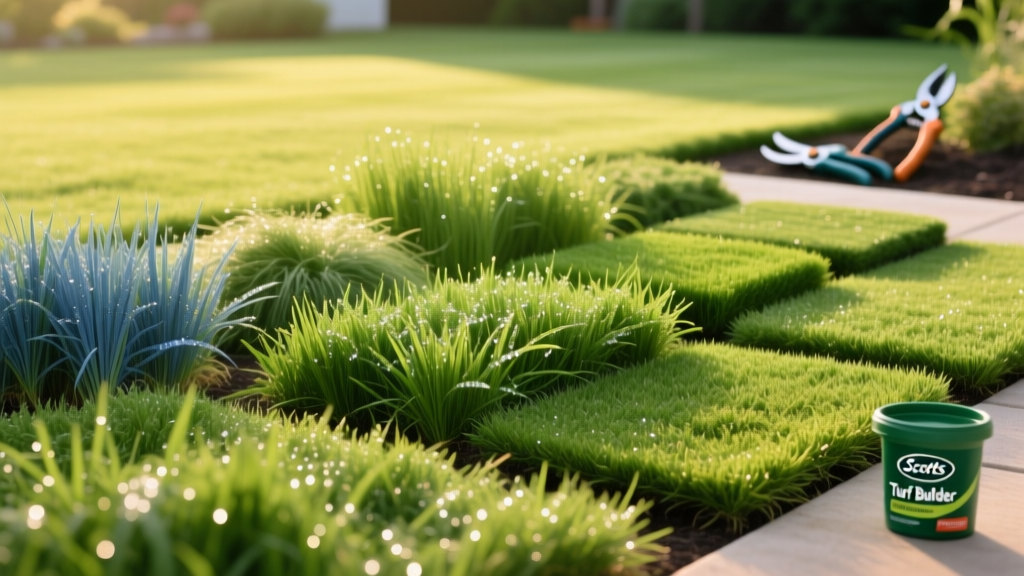
Scotts Turf Builder Triple Action Built For Seeding: Grass Type Guide
Establishing a new lawn from seed while simultaneously fighting off crabgrass and broadleaf weeds is one of the most difficult challenges in turf management. Standard pre-emergent herbicides like dithiopyr or prodiamine create a chemical barrier that stops all seed germination—including your expensive turfgrass seed. However, Scotts Turf Builder Triple Action Built for Seeding bypasses this limitation by utilizing a specialized active ingredient that selectively targets weeds while allowing specific turfgrass species to germinate safely.
This guide breaks down the exact grass type compatibility, soil nutrition mechanics, and application economics of this product to ensure your 2026 seeding project succeeds without chemical burn or germination failure.
The Chemistry: Why "Built for Seeding" is Different
The primary reason standard "Triple Action" products cannot be used during seeding is their reliance on HPPD-inhibitor alternatives or root-inhibitors that halt cell division in all germinating seeds. Scotts Turf Builder Triple Action Built for Seeding replaces these with Mesotrione (the active ingredient in commercial Tenacity).
Mesotrione inhibits the enzyme 4-hydroxyphenylpyruvate dioxygenase (HPPD) in susceptible weeds. This disruption prevents carotenoid production, leading to the rapid bleaching and death of emerging crabgrass, dandelions, and clover. Crucially, cool-season turfgrasses and specific warm-season species possess a natural metabolic pathway to detoxify Mesotrione, allowing them to germinate and establish roots unharmed. According to turfgrass research from NC State University's TurfFiles, Mesotrione is one of the only pre-emergent herbicides safe for use at the time of seeding for select grass species.
⚠️ Critical Regulatory Edge Case: Because this product contains a high-phosphorus starter fertilizer (NPK 16-22-8), it is restricted in states with strict phosphorus runoff laws (e.g., New York, New Jersey, Minnesota, Washington) unless you have a certified soil test proving a phosphorus deficiency or are actively establishing new grass. Always verify local municipal codes before purchasing.
Grass Type Compatibility Matrix
Not all grass species can metabolize Mesotrione. Applying this product to incompatible grass types will result in severe chlorosis (whitening) and potential seedling death. Below is the definitive compatibility framework based on the manufacturer label and Syngenta's agronomic data on Mesotrione tolerance.
| Grass Species | Safe to Seed? | Application Timing | Known Edge Cases & Notes |
|---|---|---|---|
| Kentucky Bluegrass | Yes | Pre-plant or at seeding | Highly tolerant. Excellent for fall overseeding. |
| Tall Fescue | Yes | Pre-plant or at seeding | Safe. Ensure seed-to-soil contact is not blocked by thick granule layers. |
| Fine Fescue | Caution | At seeding only | May experience temporary tip-whitening (bleaching) under high heat stress. |
| Perennial Ryegrass | Yes | Pre-plant or at seeding | Germinates rapidly; Mesotrione does not stunt initial root flush. |
| Bermudagrass | Yes | At seeding only | Do not use on sprigs or newly laid sod until fully rooted. |
| Centipede / Bahia / Zoysia | Yes | At seeding only | Safe for seeded varieties only. Avoid on vegetative plantings. |
| Dichondra / Bentgrass | NO | N/A | Highly susceptible to Mesotrione. Will result in total seedling kill. |
Soil Nutrition Breakdown & Root Development
While the herbicide component gets the most attention, the nutritional profile of Scotts Turf Builder Triple Action Built for Seeding (NPK 16-22-8) is specifically engineered for the physiological demands of germinating seeds.
Nitrogen (16%): The Establishment Engine
The 16% nitrogen content utilizes a mix of fast-release urea and slow-release methylene urea. Fast-release nitrogen provides the immediate energy required for the cotyledon to break the soil surface, while the slow-release fraction sustains the seedling through its critical first 30 days of vegetative growth without causing the excessive top-growth that leads to weak, spindly grass.
Phosphorus (22%): ATP and Root Proliferation
Standard mature lawn fertilizers contain little to no phosphorus. However, a 22% phosphate (P2O5) concentration is vital for seedling establishment. Phosphorus is a core component of ATP (adenosine triphosphate), the energy currency plants use to drive root cell division. Without this high-phosphorus spike, new grass will struggle to anchor into the soil profile before summer drought or winter freeze sets in.
Potassium (8%): Osmotic Regulation
The 8% potash (K2O) aids in stomatal regulation and osmotic pressure, helping delicate new seedlings retain water and resist the environmental stress of high surface temperatures during late summer or early fall seeding windows.
Spreader Calibration & Application Rates
Uneven application of Mesotrione can lead to localized phytotoxicity (chemical burn) or gaps in the pre-emergent barrier where crabgrass will penetrate. The product is calibrated to be applied at a rate of 3.6 lbs per 1,000 square feet.
- Scotts Classic Drop Spreader: Setting 6.5
- Scotts Rotary Spreader (EdgeGuard): Setting 4.5
- Earthway Rotary Spreader: Setting 13
"The most common failure mode with Mesotrione-based pre-emergents is inadequate water activation. You must apply 0.5 inches of irrigation within 3 days of application to move the chemical off the granule and into the top inch of the soil profile. If it sits on the surface in UV sunlight, the active ingredient degrades and crabgrass will germinate right through it."
— Dr. James R. Hill, Turfgrass Pathologist
2026 Cost Economics & Coverage
When budgeting your lawn establishment, it is important to weigh the convenience of an all-in-one product against purchasing components separately. As of early 2026, a 14 lb bag of Scotts Turf Builder Triple Action Built for Seeding (covering 4,000 sq. ft.) retails for approximately $42.00 to $48.00, equating to roughly $11.25 per 1,000 sq. ft.
By comparison, buying a standalone starter fertilizer (approx. $2.00/1,000 sq. ft.) and a bottle of commercial liquid Mesotrione (approx. $0.75/1,000 sq. ft. when diluted correctly) costs around $2.75 per 1,000 sq. ft. While the DIY liquid route is 75% cheaper, it requires precise liquid calibration, a pump sprayer, and surfactant. For homeowners seeding under 10,000 square feet, the granular convenience and time savings of the Scotts product justify the premium.
Troubleshooting Edge Cases
My Fine Fescue Seedlings Turned White
Do not panic. Fine fescues (creeping red, chewings, hard fescue) occasionally exhibit a temporary bleaching effect when exposed to Mesotrione, especially if daytime temperatures exceed 80°F during the germination window. This is a known physiological response, not a lethal dose. As long as the crown of the seedling remains firm and white (not mushy and brown), the grass will metabolize the herbicide and produce green chlorophyll within 7 to 10 days.
Can I Use This on Sod or Sprigs?
No. The product label explicitly restricts use to seeded lawns. Applying Mesotrione to newly laid sod or vegetative sprigs (like Bermudagrass or Zoysia plugs) can severely stunt stolon and rhizome development, delaying the knit-to-soil phase by several weeks and increasing the risk of the sod drying out and dying before it roots.