
Grass Types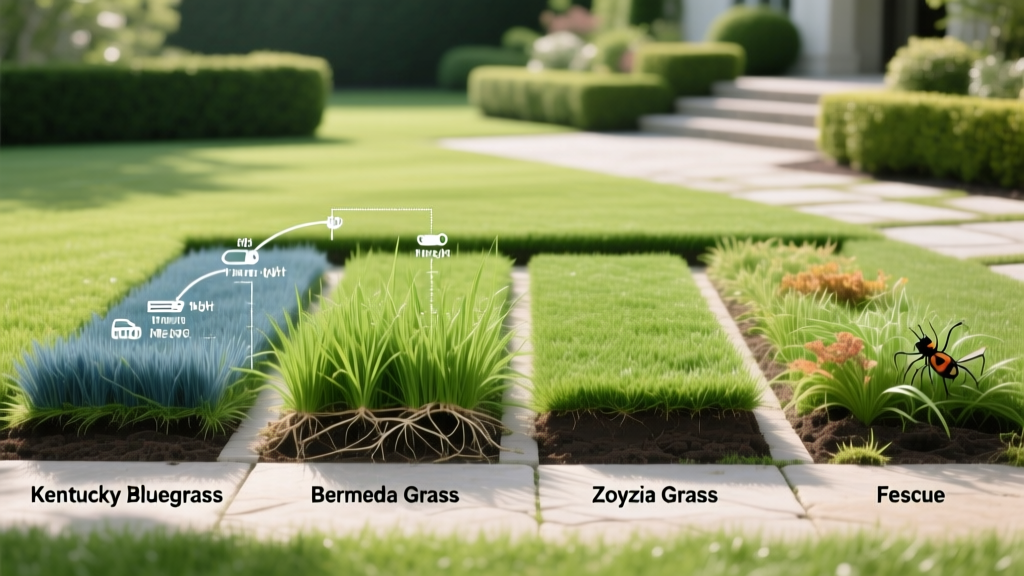
Step-by-Step Maintenance Procedures for Major Turf Grass Types
The Photosynthetic Divide: Why One Calendar Fails
Turfgrass maintenance is strictly dictated by photosynthetic pathways. Cool-season (C3) turf grass types like Tall Fescue and Kentucky Bluegrass thrive in 60°F–75°F air temperatures and suffer heat stress when soil temperatures exceed 85°F. Conversely, warm-season (C4) grasses like Bermudagrass and Zoysia peak at 80°F–95°F and enter dormancy when soil temperatures drop below 55°F. Applying a generic, calendar-based maintenance schedule to both categories guarantees physiological stress, disease susceptibility, and eventual turf loss. The following protocols provide exact, science-backed procedures tailored to the biological needs of specific turf grass types.
Turf Grass Types: Biological Requirements Matrix
Before executing seasonal procedures, reference this matrix to align your inputs with your specific grass species. Data sourced from University of California Agriculture and Natural Resources and Texas A&M Aggie Turf.
| Turf Grass Type | Classification | Optimal Mowing Height | Annual Nitrogen (lbs/1k sq ft) | Peak Growth Window |
|---|---|---|---|---|
| Tall Fescue | Cool-Season (C3) | 2.5" – 3.5" | 2.0 – 4.0 | Spring & Fall |
| Kentucky Bluegrass | Cool-Season (C3) | 1.5" – 2.5" | 3.0 – 5.0 | Spring & Fall |
| Bermudagrass | Warm-Season (C4) | 0.5" – 2.0" | 3.0 – 6.0 | Mid-Summer |
| Zoysiagrass | Warm-Season (C4) | 0.5" – 2.0" | 2.0 – 4.0 | Mid-Summer |
| St. Augustinegrass | Warm-Season (C4) | 2.5" – 4.0" | 2.0 – 4.0 | Summer & Early Fall |
Step-by-Step Protocol: Cool-Season Turf Grass Types
Cool-season grasses require a heavy emphasis on fall establishment and summer survival management. The following steps outline the critical interventions for Tall Fescue and Kentucky Bluegrass (KBG).
Step 1: Spring Pre-Emergent and Soil Temperature Tracking
Do not apply pre-emergent herbicides based on the calendar or blooming forsythia bushes. Apply Prodiamine 65 WDG at a rate of 1.15 lbs per acre (approx. 0.42 oz per 1,000 sq ft) only when 24-hour average soil temperatures at a 2-inch depth reach 50°F–55°F for three consecutive days. This targets crabgrass germination precisely. If you plan to overseed bare spots in the spring, skip the Prodiamine and use a post-emergent like Quinclorac later, as pre-emergents will inhibit cool-season seed germination for up to 16 weeks.
Step 2: Summer Irrigation and Disease Prevention
When air temperatures consistently exceed 85°F, cool-season grasses enter a semi-dormant state to protect their crowns. Reduce nitrogen inputs to zero; applying nitrogen in July forces lush, weak growth that is highly susceptible to fungal pathogens.
Disease Alert: Brown Patch (Rhizoctonia solani)
Tall Fescue is highly vulnerable to Brown Patch when nighttime temperatures remain above 68°F combined with high humidity. Apply a preventative fungicide containing Azoxystrobin or Propiconazole in early June before symptoms appear. Once the leaf tissue blights and turns brown, fungicides will not reverse the damage; they only protect new growth.
Tall Fescue is highly vulnerable to Brown Patch when nighttime temperatures remain above 68°F combined with high humidity. Apply a preventative fungicide containing Azoxystrobin or Propiconazole in early June before symptoms appear. Once the leaf tissue blights and turns brown, fungicides will not reverse the damage; they only protect new growth.
Irrigate deeply but infrequently. Apply 1 to 1.5 inches of water per week, split into two early-morning sessions (between 4:00 AM and 6:00 AM) to minimize leaf wetness duration and reduce fungal pressure.
Step 3: Fall Renovation and Overseeding
Early fall (late August to mid-September) is the most critical window for cool-season turf. Soil temperatures are still warm enough for rapid seed germination, but air temperatures are cooling, reducing weed competition.
- Core Aerate: Extract 2-to-3-inch soil plugs on 2-inch centers to alleviate summer compaction and expose the soil profile.
- Overseed: Apply a turf-type Tall Fescue blend at a heavy rate of 6 to 8 lbs per 1,000 sq ft. For KBG, use 2 to 3 lbs per 1,000 sq ft due to its rhizomatous spreading nature.
- Starter Fertilizer: Apply a high-phosphorus starter fertilizer (e.g., 18-24-12) at the label rate to fuel rapid root development in the new seedlings.
- Topdress: Drag a leveling mat or push broom over the lawn to work the seed and fertilizer into the aeration holes, ensuring seed-to-soil contact.
Step-by-Step Protocol: Warm-Season Turf Grass Types
Warm-season grasses demand aggressive summer management and careful transition-zone preparation. Bermudagrass and Zoysia require distinct approaches to mowing and thatch control.
Step 1: Spring Scalping and Green-Up
As warm-season grasses exit winter dormancy, they often suffer from "spring dead spot" or slow green-up due to thick layers of dead, dormant tissue blocking sunlight from reaching the crown. Once the turf shows 30% to 50% green-up, lower your mower deck to its minimum setting (approx. 0.5 inches) and scalp the lawn. Bag and remove all the brown clippings. This allows solar radiation to penetrate the soil, warming the root zone and stimulating uniform stolon and rhizome growth. Follow this with a liquid application of chelated iron and a light nitrogen dose (0.5 lbs N/1,000 sq ft) to accelerate chlorophyll production.
Step 2: Summer Spoon-Feeding and Precision Mowing
During peak summer growth, avoid applying massive doses of granular nitrogen, which causes excessive vertical leaf growth and rapid thatch accumulation. Instead, "spoon-feed" Bermudagrass with 0.25 to 0.5 lbs of nitrogen per 1,000 sq ft every 14 to 21 days using a fast-release source like ammonium sulfate (21-0-0).
Mower Selection for Zoysia and Bermuda
While rotary mowers are sufficient for St. Augustine and Tall Fescue, cutting Zoysia or hybrid Bermudagrass below 1.5 inches with a rotary blade results in severe scalping and a ragged cut that invites disease. For heights between 0.5" and 1.25", invest in a greens-grade reel mower. The scissor-action cut of a reel mower promotes rapid healing and a denser, carpet-like turf canopy.
While rotary mowers are sufficient for St. Augustine and Tall Fescue, cutting Zoysia or hybrid Bermudagrass below 1.5 inches with a rotary blade results in severe scalping and a ragged cut that invites disease. For heights between 0.5" and 1.25", invest in a greens-grade reel mower. The scissor-action cut of a reel mower promotes rapid healing and a denser, carpet-like turf canopy.
Step 3: Fall Dormancy Prep and Winter Weed Control
As daylight hours shorten and soil temperatures drop below 70°F, cease all nitrogen applications to warm-season grasses. Applying nitrogen in early fall delays dormancy and severely depletes the plant's carbohydrate reserves, increasing the risk of winter kill. Switch to a high-potassium fertilizer (such as 0-0-25 or 5-10-30) in late September. Potassium acts as an antifreeze within the plant cells, lowering the freezing point of the cellular fluid and enhancing winter hardiness. Simultaneously, apply a pre-emergent like Dithiopyr to prevent winter annual weeds such as Poa annua (annual bluegrass) and henbit from establishing during the turf's dormant phase.
Advanced Troubleshooting: Thatch and Soil pH Edge Cases
Maintenance procedures often fail when underlying soil chemistry or physical barriers are ignored. Address these common edge cases specific to certain turf grass types:
- Zoysia Thatch Buildup: Zoysia produces heavy lignin-rich thatch. If the thatch layer exceeds 0.5 inches, water and nutrients will not penetrate to the root zone. Rent a vertical mower (verticutter) in early summer and set the blades to slice 0.25 inches into the soil surface. Rake out the debris and topdress with 0.25 inches of coarse river sand to dilute remaining organic matter.
- Kentucky Bluegrass Summer Patch: KBG is highly susceptible to Summer Patch (Magnaporthe poae) in compacted, high-pH soils. If you observe circular, frog-eye patches of dead grass in mid-summer, test your soil pH. If the pH is above 6.5, switch your nitrogen source exclusively to ammonium sulfate. As soil microbes process ammonium sulfate, they release hydrogen ions, naturally lowering the soil pH over time and suppressing the pathogen.

