Grass Types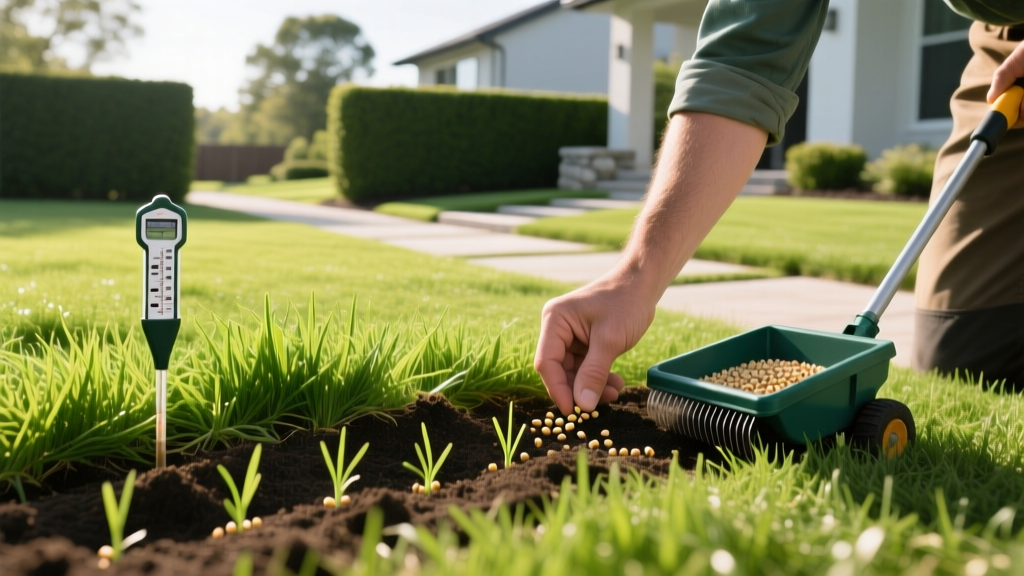
Seeding a New Lawn: The Complete Step-by-Step Establishment Guide
The Economics and Agronomy of Seeding a New Lawn
Establishing turf from seed costs between $0.20 and $0.40 per square foot, a fraction of the $1.50 to $2.50 per square foot required for professional sod installation. However, seeding a new lawn trades upfront capital for intensive labor and precise environmental management during the critical 30-day establishment window. Success relies on achieving optimal seed-to-soil contact, maintaining precise moisture levels in the top half-inch of the soil profile, and selecting cultivars adapted to your specific USDA hardiness zone and microclimate shade patterns.
This guide details the exact agronomic protocols for site preparation, seed rate calculations, and germination management to ensure a dense, weed-resistant root system.
Phase 1: Subgrade Preparation and Soil Chemistry
Turfgrass roots require a minimum of 4 to 6 inches of loose, well-draining topsoil to establish a drought-tolerant foundation. Compacted subgrades lead to shallow rooting and immediate summer dormancy.
Soil Testing and Amendment
Before tilling, extract 5 to 7 core samples at a depth of 3 inches and send them to a university extension laboratory. Turfgrass thrives in a pH range of 6.0 to 6.8. If your soil tests below 6.0, apply pelletized calcitic lime at a rate of 50 lbs per 1,000 square feet to raise the pH by approximately 0.5 points. According to Penn State Extension, incorporating lime into the top 4 inches of soil during tilling accelerates the chemical reaction, whereas surface application can take up to two years to fully alter the root-zone pH.
Tilling and Site Grading
Use a rear-tine rototiller to break up the soil to a depth of 6 inches. Remove all rocks larger than 1 inch and existing weed rhizomes. Proper grading is critical to prevent water pooling, which causes seed rot and fungal diseases like Pythium blight.
The 2% Slope Rule: Grade your soil to drop exactly 1/4 inch per linear foot (a 2% slope) away from your home's foundation. Use a 4-foot carpenter's level and a wooden stake grid to verify the gradient before the final raking pass.
Phase 2: Seed Selection and Rate Matrix
Selecting the right seed mixture dictates the long-term resilience of your lawn. Avoid cheap 'contractor grade' mixes that contain annual ryegrass as a filler. Instead, look for certified seed blends with a germination rate of 85% or higher and less than 0.5% weed seed content on the tag. The University of Massachusetts Amherst Turf Program recommends blending at least three different cultivars of the same species to maximize genetic resistance to localized pathogens.
| Grass Species | Climate Zone | Seeding Rate (lbs / 1,000 sq ft) | Top Cultivar Examples |
|---|---|---|---|
| Kentucky Bluegrass | Cool-Season (Northern) | 2.0 - 3.0 | Midnight, Award, NuGlide |
| Turf-Type Tall Fescue | Cool-Season (Transition) | 6.0 - 8.0 | Titan Ultra, Falcon IV, Mustang |
| Perennial Ryegrass | Cool-Season (Northern) | 4.0 - 5.0 | Palmer V, Pinnacle, Fiesta IV |
| Bermudagrass | Warm-Season (Southern) | 1.0 - 2.0 (Hulled) | Yukon, Riviera, Princess 77 |
| Zoysiagrass | Warm-Season (Southern) | 1.0 - 2.0 | Zenith, Compadre |
Phase 3: Sowing and Starter Fertilizer Application
For uniform coverage, divide your total seed volume in half. Calibrate a rotary broadcast spreader to the manufacturer's recommended setting for your specific seed size. Apply the first half walking horizontally across the yard, and the second half walking vertically. This cross-hatching technique eliminates striping and bare spots.
The Phosphorus Requirement
New seedlings require high levels of phosphorus to drive rapid root development. Apply a starter fertilizer with an N-P-K ratio similar to 18-24-6 or 10-18-10 immediately after sowing. Apply at a rate that delivers exactly 1.0 lb of nitrogen and 1.5 lbs of phosphorus (P2O5) per 1,000 square feet. Note: Many municipalities enforce strict phosphorus bans on established lawns to protect watersheds. However, Michigan State University Extension notes that most state laws include a specific exemption allowing phosphorus application when seeding a new lawn or repairing bare spots, provided a soil test verifies the need.
Seed-to-Soil Contact and Mulching
Grass seed must be in direct contact with soil particles to absorb the moisture required for germination. After spreading, use a lawn roller filled halfway with water to press the seed into the soil bed. Do not bury the seed deeper than 1/4 inch. Finally, apply a thin layer of certified weed-free straw or a hydro-mulch blanket. Avoid hay, which introduces thousands of agricultural weed seeds into your new turf. Apply straw at a rate of one bale per 1,000 square feet—enough to shade the soil but thin enough that you can still see the soil beneath it.
Phase 4: Germination Timelines and Irrigation Protocols
Water is the trigger for germination. The top 1/2 inch of soil must remain constantly moist, but never saturated, until the seedlings reach 1 inch in height. Set your irrigation controller to run 3 to 4 times daily for 5 to 10 minutes per zone. Adjust duration based on evaporation rates; if the soil surface dries out and turns light brown between cycles, the seedlings will die within hours.
Germination Tracker:
- Perennial Ryegrass: 5 - 10 days (Fastest establishment)
- Tall Fescue: 7 - 12 days
- Bermudagrass: 10 - 21 days (Requires soil temps above 65°F)
- Kentucky Bluegrass: 14 - 30 days (Slowest; keep moist for a full month)
- Zoysiagrass: 14 - 28 days
Once the grass reaches 1 inch, reduce watering frequency to once daily, but increase the duration to 20 minutes to encourage roots to chase the moisture deeper into the soil profile. By week four, transition to the standard establishment schedule of 1 inch of water per week, applied in two deep soakings.
Phase 5: First Mowing and Weed Management
Do not mow the lawn until the majority of the turf reaches 3.5 inches in height. For the first cut, remove no more than 1/3 of the blade, setting your mower deck to 2.5 inches. Ensure your mower blade is newly sharpened; a dull blade will tear the tender, unanchored seedlings and rip them entirely out of the soil.
Warning: Pre-Emergent Herbicide Conflict
Do not apply standard pre-emergent crabgrass preventers (like Prodiamine or Dithiopyr) when seeding a new lawn. These chemicals create a barrier that stops all seeds from germinating, including your expensive turfgrass. If crabgrass is a severe threat, use a product containing Siduron (Tupersan), which is the only pre-emergent specifically labeled as safe for use during cool-season grass seeding.
Post-Emergent Weed Control Timeline
Weeds will inevitably germinate alongside your grass. Resist the urge to pull them by hand, as this will disturb the fragile turf roots. Wait until you have mowed the new lawn at least three times before applying a selective, post-emergent broadleaf herbicide containing 2,4-D or Quinclorac. This typically occurs 6 to 8 weeks after the initial seeding date.