
Grass Types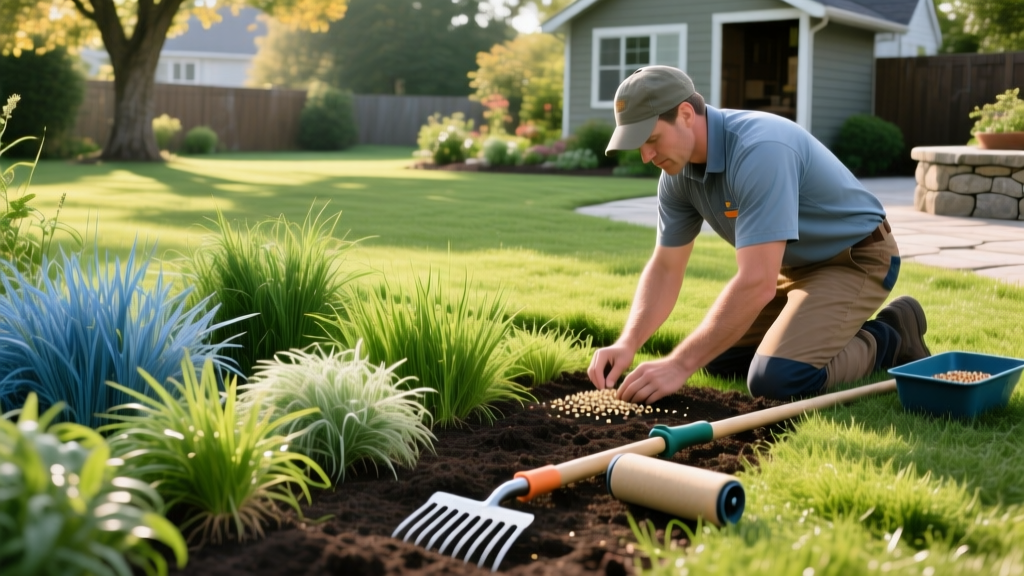
Seeding Grass for Thick Lawns: Soil Prep, Timing, and Pro Tips
The Hidden Bottleneck: Soil-to-Seed Contact
Most DIY lawn establishment projects fail not because of inferior seed, but due to poor soil-to-seed contact and erratic watering schedules. Successfully seeding grass requires treating your lawn like a precision agricultural crop. Seed left resting on top of dry thatch or compacted clay will desiccate within hours of germination. The primary objective during site preparation is creating a friable, 1/4-inch layer of loose soil where the seed can anchor its radicle (first root).
For existing lawns requiring overseeding, rent a core aerator to pull 3-inch plugs at a density of 20-30 holes per square foot. For bare-ground establishment, use a heavy-duty landscape rake to grade the soil, removing rocks larger than a golf ball. Apply a 1/4-inch layer of screened compost (such as Leafgro or local municipal compost) and till it into the top 2 inches of native soil. This increases water retention and provides a hospitable microbial environment for young roots.
Pro Tip: The Straw Blanket Alternative
Instead of loose straw, which often blows away and introduces weed seeds, use a biodegradable rolled erosion control blanket (like Curlex or straw/coconut fiber mats) on slopes greater than a 15% grade. This maintains soil moisture and prevents seed washout during heavy rain events.
Instead of loose straw, which often blows away and introduces weed seeds, use a biodegradable rolled erosion control blanket (like Curlex or straw/coconut fiber mats) on slopes greater than a 15% grade. This maintains soil moisture and prevents seed washout during heavy rain events.
Decoding the Seed Tag: Pure Live Seed (PLS)
When purchasing seed for your lawn, the upfront price per pound is a misleading metric. You must calculate the Pure Live Seed (PLS) percentage to determine true value. The PLS is calculated by multiplying the Purity percentage by the Germination percentage.
For example, a $60 bag of Tall Fescue might list 98% purity and 90% germination, yielding an 88.2% PLS. A cheaper $40 bag might contain only 85% purity (with 15% inert matter or weed seeds) and 75% germination, yielding a 63.7% PLS. The cheaper bag requires you to apply 30% more product by weight to achieve the same number of viable seeds, negating the initial savings while introducing weed contaminants. Always look for the National Turfgrass Evaluation Program (NTEP) cultivar names on the tag, such as 'GTO' or 'Firewall' for fescues, rather than generic 'Contractor Grade' blends.
Seeding Rates and Cultivar Selection Matrix
Applying too much seed is a common mistake that leads to intense competition for nutrients, resulting in spindly, weak seedlings prone to fungal diseases like damping-off. Apply seed at the exact rates specified below using a calibrated rotary or drop spreader.
| Grass Species | Seeding Rate (lbs / 1,000 sq ft) | Germination Window | Top Cultivar Picks (2026) |
|---|---|---|---|
| Tall Fescue (Cool-Season) | 6.0 - 8.0 | 7 - 12 Days | Jonathan Green Black Beauty, Pennington Smart Seed |
| Kentucky Bluegrass (Cool-Season) | 1.5 - 2.5 | 14 - 28 Days | Midnight, Blue Note, NuGlobe |
| Perennial Ryegrass (Cool-Season) | 5.0 - 7.0 | 5 - 10 Days | Caddieshack, Brightstar SLT |
| Bermudagrass (Warm-Season) | 1.0 - 2.0 (Hulled) | 10 - 14 Days | LaPaloma, Sahara II |
For authoritative data on regional cultivar performance and disease resistance, consult the Rutgers Turfgrass research databases or your local university extension office. According to Cornell University Turfgrass experts, blending three or more cultivars of the same species (e.g., mixing three different Tall Fescues) dramatically increases genetic diversity, protecting the lawn from total loss if a specific rust or blight pathogen attacks.
Starter Fertilizer and the Phosphorus Caveat
Newly germinated grass requires immediate access to Phosphorus (P) to drive rapid root development. A standard maintenance fertilizer (like a 32-0-4) is useless for seeding grass because it lacks the necessary P. You must use a dedicated starter fertilizer, typically featuring an N-P-K ratio around 24-25-4 or 18-24-6.
- Product Recommendation: Scotts Turf Builder Starter Food for New Grass (24-25-4). Covers 5,000 sq ft for approximately $28.
- Organic Alternative: Milorganite (5-4-0) mixed with bone meal to boost phosphorus, though nutrient release is slower and temperature-dependent.
Warning: Phosphorus Fertilizer Bans
Many states and municipalities (including parts of New York, Minnesota, and Washington) strictly prohibit the application of phosphorus fertilizers unless a certified soil test from a lab (costing $20-$35) explicitly indicates a deficiency. Always check local environmental regulations before applying starter fertilizer to prevent runoff into local watersheds.
Many states and municipalities (including parts of New York, Minnesota, and Washington) strictly prohibit the application of phosphorus fertilizers unless a certified soil test from a lab (costing $20-$35) explicitly indicates a deficiency. Always check local environmental regulations before applying starter fertilizer to prevent runoff into local watersheds.
The 21-Day Germination Watering Matrix
Watering is where 80% of seeding grass projects fail. The goal is to keep the top 1 inch of soil consistently moist but never waterlogged. Overwatering displaces oxygen in the soil pores, suffocating the delicate new roots and inviting Pythium blight.
- Days 1 to 10 (Pre-Germination & Sprouting): Water 3 to 4 times daily for 5 to 8 minutes per zone. The soil surface should never be allowed to dry out and form a crust. If a crust forms, the tender coleoptile (shoot) cannot pierce it, and the seed will die underground.
- Days 11 to 15 (Root Establishment): Reduce frequency to 2 times daily, but increase duration to 10 to 12 minutes. This encourages the nascent roots to chase the moisture slightly deeper into the soil profile.
- Days 16 to 21 (Tiller Development): Water once daily for 15 to 20 minutes. The grass should now be anchored and capable of drawing from deeper soil reserves.
- Day 22 and Beyond: Transition to standard deep-and-infrequent watering (approximately 1 inch of water per week, applied in 1 or 2 sessions) to promote drought tolerance.
Troubleshooting Common Establishment Failures
Even with perfect preparation, environmental variables can disrupt establishment. Use this diagnostic matrix to correct issues on the fly.
| Symptom | Probable Cause | Corrective Action |
|---|---|---|
| Seed washes into low spots | Heavy rain on sloped or un-tacked seedbed. | Apply a tackifier or roll a biodegradable erosion blanket over the slope immediately. |
| White, cottony fuzz on seedlings | Pythium blight (fungus) due to overwatering and high humidity. | Reduce watering frequency immediately. Apply a systemic fungicide containing propiconazole or azoxystrobin. |
| Seeds sprout but turn yellow/die | 'Damping-off' disease or lack of starter nutrients. | Ensure soil temps are above 50°F. Apply a light dose of starter fertilizer if not done at seeding. |
| Patchy, uneven germination | Spreader overlap errors or localized soil compaction. | Overseed bare patches using a hand-held spreader. Core aerate compacted zones before re-seeding. |
Finally, resist the urge to mow too early. Wait until the new grass reaches at least 3.5 inches in height, and ensure your mower blades are razor-sharp. Dull blades will tear the young grass from the soil rather than cutting it, undoing weeks of careful establishment. For ongoing maintenance protocols, refer to the seasonal care guides published by the NC State TurfFiles program to ensure your newly seeded lawn matures into a dense, resilient turf.

