
Grass Types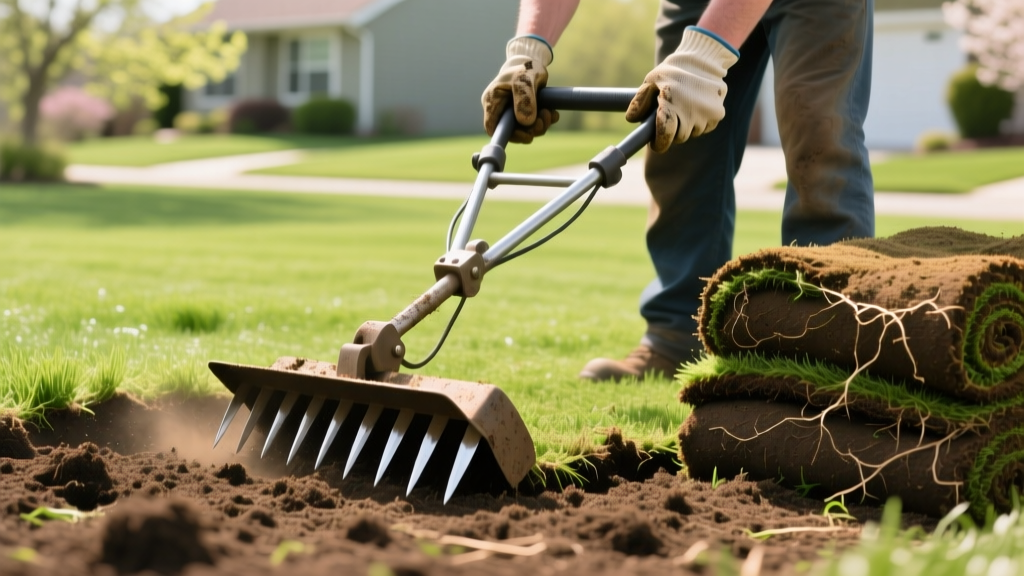
Using a Sod Lifter to Prep Soil for New Grass Seed
Removing established, failing turf is the most critical step in total lawn renovation. While many homeowners default to rototillers to clear a site for grass seed, this approach often leads to severe weed infestations and uneven seedbeds. A sod lifter (commonly referred to as a sod cutter or kick plow) provides a vastly superior, scientifically sound seedbed for grass seed establishment by preserving the underlying soil structure and burying dormant weed seeds.
The Science of the Weed Seed Bank: Why Lifting Beats Tilling
Every mature lawn harbors a 'weed seed bank' in the top 2 to 4 inches of soil. Seeds from annual weeds like crabgrass (Digitaria) and Poa annua can remain dormant in the dark for years. When you use a rototiller, you invert the soil profile, bringing thousands of buried weed seeds to the photoblastic zone (the top 0.5 inches of soil). Exposure to sunlight triggers rapid germination, meaning your newly seeded lawn will immediately compete with aggressive weeds.
According to University of Minnesota Extension, minimizing soil disturbance is key to reducing weed pressure during renovation. A sod lifter slices horizontally through the root zone and thatch layer at a precise depth, removing the old grass while leaving the underlying weed seed bank buried and undisturbed. This gives your new grass seed a massive competitive advantage.
Choosing the Right Sod Lifter Equipment
Selecting the correct tool depends entirely on your square footage and physical capability. The market is divided into manual and motorized options.
Manual Sod Kickers (Kick Plows)
- Best For: Areas under 500 square feet, tight corners, and edging.
- Specs: Typically feature a 30-inch ash handle and a 10 to 12-inch carbon steel blade. The Truper 30-inch sod cutter is a standard benchmark, retailing between $45 and $65.
- Technique: Requires kicking the back crossbar with your foot while pushing forward. Highly labor-intensive; expect to burn 400+ calories per hour.
Walk-Behind Motorized Sod Cutters
- Best For: Full lawn renovations (1,000 to 10,000+ square feet).
- Specs: Self-propelled machines with 3 to 4 HP engines (often Honda GX series) and 12 to 18-inch cutting widths. The Billy Goat SC1800 is an industry standard.
- Cost: Purchasing costs $3,500+, but renting from Sunbelt Rentals or Home Depot typically costs $150 to $190 for a 4-hour block in 2026.
- Blade Maintenance: Standard steel blades require sharpening or replacement every 2,000 square feet. Upgrading to a carbide-tipped blade extends life to 10,000+ square feet.
⚠️ CRITICAL WARNING: Call 811 Before You Dig
A sod lifter blade cuts up to 3 inches deep. This is deep enough to sever shallow irrigation lines, fiber optic cables, and low-voltage landscape lighting. Federal and state laws require you to contact the 811 National Call Before You Dig hotline at least 48 to 72 hours before operating any mechanized soil-cutting equipment. Utility locators will mark public lines for free, but you must privately hire a locator for underground dog fences or private sprinkler systems.
Sod Lifter vs. Rototiller: Soil Prep Comparison Matrix
| Feature | Sod Lifter (Cutter) | Rototiller |
|---|---|---|
| Weed Seed Germination | Low (Seeds remain buried) | Very High (Seeds brought to surface) |
| Soil Structure Impact | Preserves subsoil layers | Destroys structure, causes compaction |
| Thatch Removal | 100% removed with the sod roll | Mixed into soil, tying up nitrogen |
| Surface Leveling | Creates a perfectly flat seedbed | Leaves deep ruts and uneven mounds |
| Debris Disposal | Sod can be sold, reused, or composted | Roots must be manually raked out |
The 5-Step Sod Lifting and Seeding Protocol
To achieve maximum seed-to-soil contact and optimal germination rates, follow this exact operational sequence.
Step 1: Scalp and Hydrate
Two days before lifting, mow the existing lawn as short as your mower allows (usually 1 to 1.5 inches) and bag the clippings. Apply 0.5 inches of water. This softens the top 2 inches of soil, allowing the sod lifter blade to glide through the root zone without tearing or stalling the engine.
Step 2: Calibrate the Blade Depth
Set the sod lifter blade to a depth of exactly 1.5 inches. Setting it too shallow (under 1 inch) will leave behind rhizomes and stolons from aggressive grasses like Bermudagrass or Quackgrass, which will regrow and choke your new seed. Setting it too deep (over 2.5 inches) will lift heavy, nutrient-poor subsoil and severely strain the machine's drive belt.
Step 3: Slice and Roll
Run the sod lifter in long, continuous passes. Overlap each pass by 2 inches to ensure no strips of old grass are left behind. As the machine cuts, the turf will form a continuous ribbon. Have a partner follow behind with a shovel to cut the ribbon every 4 to 5 feet and roll it up for removal.
Step 4: Cultivate the Bare Seedbed
Once the sod is removed, you will be left with a flat, bare soil surface. Do not till this surface. Instead, use a core aerator to pull 2-to-3-inch plugs across the entire area. This relieves the compaction caused by the sod lifter's wheels and creates micro-pockets for seed and water retention.
Step 5: Amend, Seed, and Protect
Apply a high-phosphorus starter fertilizer to promote rapid root development. A formulation like Scotts Turf Builder Starter Food (24-25-4) is ideal. Crucially, look for a starter fertilizer that includes mesotrione (often branded as Tenacity). According to Purdue University Turf Science, mesotrione provides pre-emergent weed control that is safe for newly germinating grass seed, acting as an insurance policy against any weed seeds that were accidentally exposed during the lifting process.
Drop your grass seed at the manufacturer's recommended rate (e.g., 8 to 10 lbs per 1,000 sq ft for turf-type tall fescue). Finish by dragging a weighted chain-link fence or a specialized seed drag mat over the area to press the seed into the aeration holes, ensuring the vital seed-to-soil contact required for germination.
Post-Establishment Maintenance
After seeding, the bare soil will dry out rapidly. You must irrigate the seedbed with 0.1 to 0.2 inches of water 3 to 4 times daily for the first 14 days to keep the top inch of soil perpetually moist. Once the new grass reaches 3 inches in height, transition to deep, infrequent watering (0.5 inches twice a week) to force the roots deep into the undisturbed soil profile preserved by your sod lifter.

