
Grass Types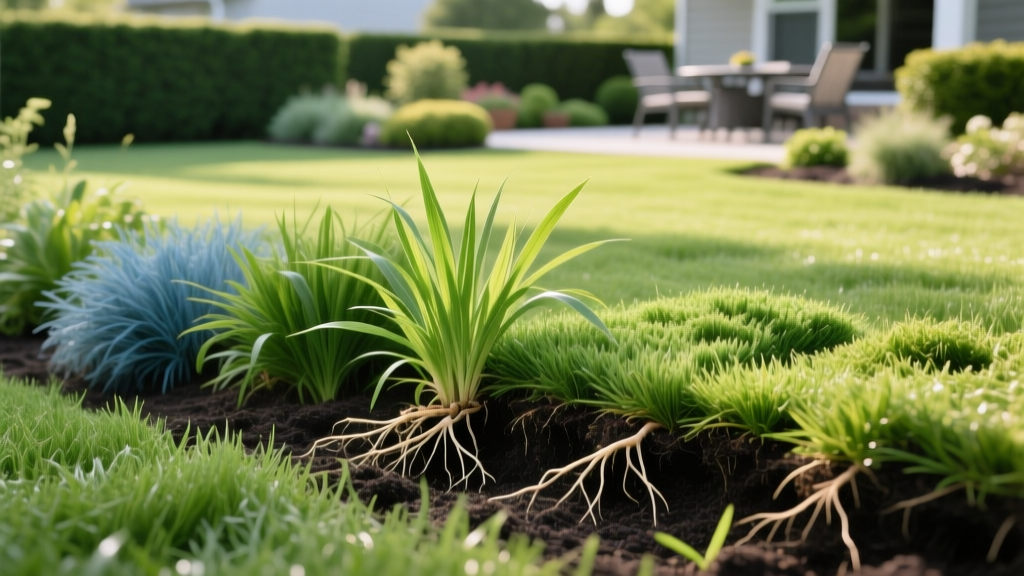
How Long Does Sod Take to Root? Watering Dosage & Cost Guide
The Rooting Timeline: How Long Does Sod Take to Root?
When installing a new lawn, the most critical question is how long does sod take to root. The answer depends on the grass species, soil temperature, and your watering dosage. Generally, sod develops shallow 'knitting' roots in 10 to 14 days, but deep structural root establishment takes 4 to 6 weeks. During this window, the sod is highly vulnerable to desiccation, shrinkage, and fungal pathogens.
According to the Clemson University Cooperative Extension, the transition from shallow anchoring to deep root penetration requires a precise tapering of irrigation. Overwatering during the deep-rooting phase suffocates the stolon and rhizome networks, while underwatering causes the sod seams to separate.
Quick Rooting Benchmarks:
- Days 1–3: Sod is entirely dependent on surface moisture; no soil integration.
- Days 10–14: Shallow roots (1-2 inches) knit into the topsoil. Sod resists light pulling.
- Days 28–42: Deep roots (4-6 inches) establish. Irrigation transitions to deep, infrequent cycles.
Rooting Speed by Grass Type
Warm-season grasses root significantly faster when soil temperatures exceed 70°F, while cool-season grasses prefer soil temperatures between 50°F and 65°F. Below is the expected rooting timeline for the most common residential turfgrasses.
| Grass Species | Shallow Rooting (Days) | Deep Rooting (Weeks) | Optimal Soil Temp |
|---|---|---|---|
| Bermudagrass (Warm) | 7 – 10 | 3 – 4 | 75°F – 85°F |
| Zoysia (Warm) | 14 – 21 | 5 – 7 | 70°F – 80°F |
| Kentucky Bluegrass (Cool) | 12 – 14 | 4 – 5 | 55°F – 65°F |
| Tall Fescue (Cool) | 10 – 14 | 4 – 6 | 50°F – 65°F |
| St. Augustine (Warm) | 10 – 14 | 4 – 5 | 70°F – 85°F |
Watering Dosage & Schedule for Root Establishment
Watering new sod is not about a fixed number of minutes; it is about delivering a specific volume of water to maintain moisture in the top 2 inches of soil. The UMass Amherst Extension emphasizes that the soil beneath the sod must remain consistently moist but never waterlogged during the first two weeks.
Calculating Your Precipitation Rate
Before setting your irrigation timer, you must know your sprinkler head output. Place three straight-sided tuna cans in a zone and run the system for 15 minutes. Measure the water depth:
- Standard Spray Heads: Typically deliver 1.5 to 1.6 inches per hour.
- Gear-Drive Rotor Heads: Typically deliver 0.4 to 0.6 inches per hour.
The 30-Day Tapering Dosage Schedule
For a standard lawn requiring 0.5 inches of water daily to keep the root zone moist during initial establishment:
- Days 1–10 (Shallow Rooting): Water 2 to 3 times daily for 10 minutes (spray heads) or 25 minutes (rotors). Total dosage: ~0.5 inches daily. Goal: Prevent the sod seams from drying out.
- Days 11–20 (Knitting Phase): Reduce to once daily for 15 minutes (spray) or 40 minutes (rotors). Total dosage: ~0.6 inches daily. Goal: Encourage roots to stretch downward to find moisture.
- Days 21–30 (Deep Establishment): Water every other day, applying 0.75 inches per session. Goal: Train roots to grow deep and build drought tolerance.
Fertilizer Coverage & Soil Prep Costs
Root development relies heavily on phosphorus (P), the middle number in the N-P-K fertilizer ratio. While mature lawns thrive on high-nitrogen blends, new sod requires a starter fertilizer to stimulate rapid root growth. A standard starter fertilizer profile is 18-24-12 or 24-25-4.
Warning on Phosphorus Bans: Check your local municipal regulations before purchasing starter fertilizer. Several states and counties restrict phosphorus applications unless a soil test explicitly proves a deficiency, even for new sod establishment. If restricted, use a high-potassium (K) root-builder alternative.
Coverage Math: A standard 15 lb bag of Scotts Turf Builder Starter Food (24-25-4) covers 5,000 square feet. The application rate is 3.0 lbs per 1,000 sq ft. Apply this immediately after laying the sod and water it in within 30 minutes to prevent leaf burn and push nutrients into the soil profile.
The True Cost of Sod Establishment (2026 Breakdown)
Budgeting for sod goes beyond the price of the grass itself. The rooting phase incurs specific material and utility costs. Below is a realistic cost matrix for establishing 1,000 square feet of sod in 2026.
| Material / Service | Unit / Coverage | Est. Cost (per 1,000 sq ft) |
|---|---|---|
| Premium Sod (e.g., Bluegrass/Bermuda) | Pallet (450 sq ft) | $450 – $650 |
| Topsoil Amendment (Compost/Sand mix) | 1 cubic yard (covers ~300 sq ft at 1" depth) | $120 – $180 |
| Starter Fertilizer (18-24-12) | 15 lb bag (covers 5,000 sq ft) | $8 – $12 |
| Liquid Soil Surfactant (Wetting Agent) | 32 oz bottle (covers 5,000 sq ft) | $6 – $9 |
| Water Surcharge (First 30 Days) | ~12,000 gallons total | $45 – $75 |
| Total Estimated Material Cost | 1,000 sq ft | $629 – $926 |
Troubleshooting Root Failure: Edge Cases & Fixes
Even with perfect timing, environmental factors can stall the rooting process. Here is how to diagnose and fix the most common establishment failures.
1. Hydrophobic Soil and Sod Shrinkage
If the soil beneath your sod was bone dry before installation, it can become hydrophobic, repelling water and causing the sod edges to shrink and separate. The Fix: Apply a liquid soil surfactant (like Simple Lawn Solutions Soil Softener) at a rate of 3 oz per 1,000 sq ft. This breaks the water's surface tension, allowing moisture to penetrate the soil-sod interface. Do not fill shrinkage gaps with sand during the first 30 days; wait until roots knit, then topdress with a 50/50 sand-compost mix.
2. Pythium Blight from Overwatering
Warm-season grasses watered heavily in high humidity (above 85°F) are prone to Pythium blight, a water mold that rots roots before they can establish. Symptoms include greasy, dark, matted patches that smell like rotting vegetation. The Fix: Immediately reduce watering frequency and apply a systemic fungicide containing azoxystrobin or metalaxyl at the preventative label rate (typically 0.2 to 0.4 oz per 1,000 sq ft).
3. The 'Tug Test' Failure at Day 14
At day 14, grasp a handful of grass and pull gently upward. If the sod lifts easily with no resistance, the roots have failed to knit. This is usually caused by poor soil-to-sod contact (air pockets beneath the roll). The Fix: Use a heavy lawn roller (filled halfway with water, weighing approx. 150 lbs) to press the sod firmly into the topsoil, then resume the Days 1-10 heavy watering schedule for another 5 days.
Frequently Asked Questions
When can I mow new sod?
You can mow new sod once it passes the tug test, typically around day 14. Never remove more than 1/3 of the blade height. Set your mower deck to 2.5 or 3 inches and ensure the blades are freshly sharpened to prevent tearing the shallow root network out of the soil.
Does rolling sod help it root faster?
Yes. Rolling sod immediately after installation with a lightweight, water-filled roller eliminates air pockets between the sod roots and the topsoil. This physical contact is mandatory for the root hairs to penetrate the soil matrix and begin drawing moisture.

