
Grass Types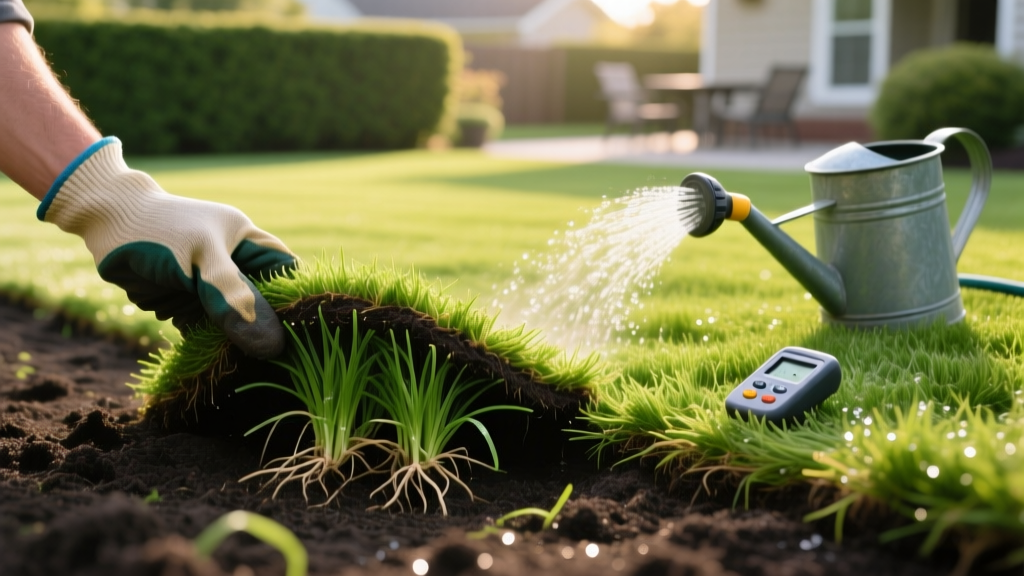
How Long Does It Take Sod to Root? Watering Dosage & Cost Guide
The Real Timeline: How Long Does It Take Sod to Root?
When investing in a new lawn, the most critical question homeowners ask is: how long does it take sod to root? The short answer is that shallow roots establish in 10 to 14 days, while deep, permanent root systems take 3 to 6 weeks to fully anchor into the native soil.
However, this timeline is not universal. It fluctuates heavily based on grass species, soil temperature, and your irrigation dosage. From a financial perspective, the rooting phase is the highest-risk period for your investment. With premium sod costing between $0.45 and $1.20 per square foot in 2026, a failure to establish roots means paying double for replacement materials and labor. Below, we break down the exact timelines, watering dosages, and coverage costs required to guarantee your sod takes root without draining your wallet.
Rooting Timelines by Grass Type
Warm-season grasses root faster in high heat but go dormant in cool weather, while cool-season grasses require consistent, moderate temperatures to push roots through the thatch layer. According to Texas A&M AgriLife Extension, soil-to-sod contact is the primary variable determining these speeds.
| Grass Species | Season Type | Shallow Roots (Anchor) | Deep Roots (Established) | Optimal Soil Temp |
|---|---|---|---|---|
| Bermudagrass | Warm | 7 - 10 Days | 3 - 4 Weeks | 75°F - 90°F |
| Zoysia | Warm | 10 - 14 Days | 4 - 6 Weeks | 70°F - 85°F |
| Kentucky Bluegrass | Cool | 12 - 15 Days | 4 - 5 Weeks | 60°F - 75°F |
| Tall Fescue | Cool | 10 - 14 Days | 3 - 4 Weeks | 60°F - 75°F |
Watering Dosage: The 3-Phase Rooting Schedule
The most common cause of sod failure is improper watering dosage—either drowning the shallow roots (causing fungal rot) or letting the edges dry out (causing shrinkage gaps). To calculate your exact dosage, remember this baseline metric: 1 inch of water equals 0.623 gallons per square foot.
Phase 1: Days 1 to 10 (The Moisture Tent)
Your goal is to keep the top 2 inches of soil constantly moist, not saturated.
- Dosage: Apply 0.25 inches of water (approx. 0.15 gallons/sq ft) 2 to 3 times daily.
- Timing: Early morning, midday, and late afternoon. Avoid watering after 6:00 PM to prevent brown patch fungus.
Phase 2: Days 11 to 21 (The Weaning Process)
Once the sod resists a gentle upward pull (the 'Tug Test'), shallow roots have anchored. You must now force roots to grow deeper to seek moisture.
- Dosage: Apply 0.5 inches of water (approx. 0.31 gallons/sq ft) once daily.
- Timing: Early morning only (between 5:00 AM and 8:00 AM).
Phase 3: Days 22 to 45 (Deep Establishment)
Transitioning to a standard lawn watering schedule.
- Dosage: Apply 1 to 1.5 inches of water per week, split across 2 or 3 deep watering sessions.
- Verification: Push a 6-inch screwdriver into the soil. If it slides in easily, your deep root moisture dosage is adequate.
Pro Tip: The Tug Test
Around day 12, grasp a handful of grass near the edge of a sod piece and pull gently upward. If the sod lifts easily, roots have not yet penetrated the soil interface. If you feel resistance and the soil tears slightly, shallow rooting is complete, and you can safely move to Phase 2 watering.
Around day 12, grasp a handful of grass near the edge of a sod piece and pull gently upward. If the sod lifts easily, roots have not yet penetrated the soil interface. If you feel resistance and the soil tears slightly, shallow rooting is complete, and you can safely move to Phase 2 watering.
Coverage Calculations & The True Cost of Rooting
Budgeting for sod requires more than just multiplying your lawn's square footage by the price per pallet. You must account for coverage waste, soil preparation, and the hidden utility costs of the 4-week rooting phase.
Calculating Coverage and Overage
Standard sod pallets cover between 400 and 500 square feet. However, cutting around landscaping beds, trees, and curved borders generates waste. The Dosage Rule: Always calculate your total square footage and add a 7% to 10% overage factor for cuts and damaged pieces. For a 2,000 sq ft lawn, order 2,200 sq ft (roughly 5 standard pallets).
Cost Breakdown: 1,000 Sq Ft Lawn Establishment
Below is a realistic cost matrix for establishing a 1,000 square foot lawn, factoring in 2026 average material and utility rates.
| Expense Category | Specification / Dosage | Estimated Cost |
|---|---|---|
| Sod Material (Mid-Grade) | 1,050 sq ft (includes 5% waste) | $525.00 ($0.50/sq ft) |
| Soil Amendment | 2 cubic yards compost (tilled 2" deep) | $90.00 ($45/yd) |
| Starter Fertilizer | High-Phosphorus (10-18-10) - 4 lbs/1,000 sq ft | $25.00 |
| Watering (Phase 1 & 2) | Approx. 9,500 gallons over 21 days | $42.75 (at $4.50/1k gal) |
| Watering (Phase 3) | Approx. 4,000 gallons over 24 days | $18.00 |
| Total Estimated Cost | Materials + Establishment Utilities | $700.75 |
Hidden Costs of Rooting Failure (And How to Avoid Them)
According to Penn State Extension, improper soil preparation and erratic watering are the leading causes of sod mortality. When sod fails to root, you do not just lose the cost of the grass; you pay for removal, re-grading, and replacement. Watch out for these specific edge cases:
- Hydrophobic Soil Repellency: If your native soil is heavy clay and completely dried out, it can become hydrophobic. Water will pool on the sod surface or run off into the street rather than penetrating the soil interface. Fix: Apply a liquid soil surfactant (like Yucca extract) during your first watering to break surface tension.
- Sod Shrinkage Gaps: If you fail to use a heavy lawn roller after installation, or if you under-water the edges, the sod pieces will shrink away from each other, leaving brown seams. Weeds will immediately colonize these gaps. Fix: Always butt the edges tightly together and roll the lawn with a water-filled roller (approx. 150 lbs) to eliminate air pockets.
- The 'Sponge' Effect (Overwatering): If you step on the sod and water squelches out from underneath, you are drowning the roots. Saturated soil lacks oxygen, causing the roots to rot before they can anchor. Fix: Reduce frequency, not duration, and ensure the native soil has adequate drainage.
"The interface between the sod and the soil is the most vulnerable micro-environment in turfgrass management. If that 1-inch zone dries out even once during the first 14 days, the capillary action breaks, and the roots will die back, delaying establishment by weeks."
Frequently Asked Questions
Can I mow the sod while it is rooting?
Do not mow until the sod has passed the Tug Test (usually around day 14). When you do mow for the first time, set your deck to the highest possible setting (3.5 to 4 inches) and ensure the blades are razor-sharp. Dull blades will tear the shallow-rooted grass out of the ground entirely.
Should I apply fertilizer before or after laying sod?
Apply a starter fertilizer high in phosphorus (the middle number in the N-P-K ratio, such as 10-18-10) directly to the bare soil before laying the sod. Phosphorus is immobile in soil and is critical for stimulating rapid root growth. Avoid high-nitrogen fertilizers until the deep roots are established at week 6, as excess nitrogen pushes top-growth at the expense of root development.
How long does it take sod to root in the shade?
Sod laid in heavy shade (less than 4 hours of direct sunlight) will take 30% to 50% longer to root due to lower soil temperatures and reduced photosynthetic energy. In shaded areas, reduce your watering dosage by 20% to prevent fungal diseases like Pythium blight, which thrive in cool, damp, shaded environments.

